Key Points
- Greenwich Council to consider cycle lane and carriageway proposals at Planning Board meeting on 18 November.
- Lewisham and Greenwich NHS Trust owns the 1km road stretch between Queen Elizabeth Hospital and Woolwich Common.
- Proposal involves widening road east side by up to 2.5m to create continuous footpath and cycleway.
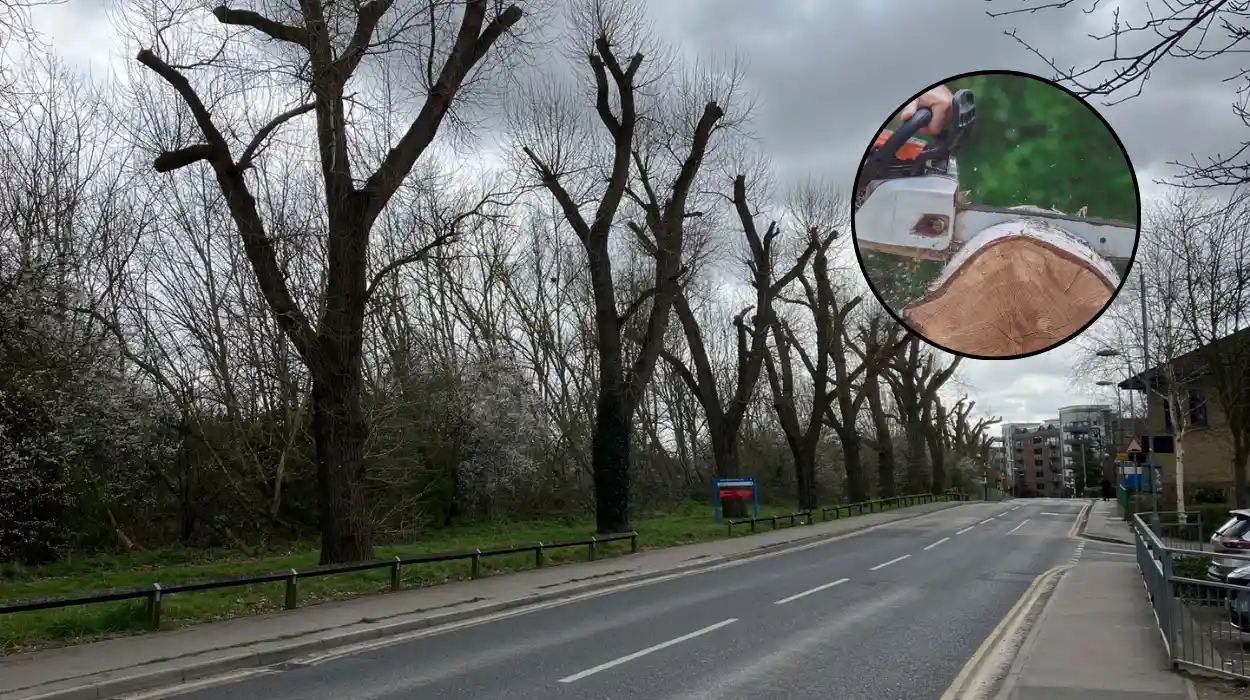
- Plan would require cutting down up to 46 mature trees plus 7 additional trees in poor condition.
- NHS Trust proposes planting 76 replacement saplings “as close to the sites of loss as possible.”
- Over 500 objections from local residents, plus opposition from Greenwich Cyclists, Friends of Woolwich Common, and The Charlton Society.
- Greenwich Cyclists support highway refurbishment but oppose extensive removal of mature trees.
- Friends of Woolwich Common seek further meetings with NHS Trust and Council; no agreement reached.
- Planning Board will also review proposal to add 75 homes to Woolwich town centre regeneration, involving demolition of The Bull Tavern.
What are the details of the proposed cycle path and carriageway improvements?
As reported by Cameron Blackshaw, Local Democracy Reporter for MyLondon, the Lewisham and Greenwich NHS Trust has applied to Greenwich Council to reconstruct and upgrade a 1km stretch of road between Queen Elizabeth Hospital and Woolwich Common to an adoptable highway standard. The current road runs with Woolwich Common on the east and the hospital on the west.
- Key Points
- What are the details of the proposed cycle path and carriageway improvements?
- Why is there opposition to chopping down trees for this project?
- How is the NHS Trust proposing to mitigate tree loss?
- What is the council’s role and timeline for decision making?
- What else should the public know about the Woolwich regeneration plans?
The trust proposes to widen this road’s eastern side by up to 2.5 metres, replacing the existing footpath and grass verge with a continuous, separated footpath and cycleway. This project aims to improve pedestrian and cyclist safety with better crossing facilities and enhanced carriageway quality.
However, this widening would necessitate the removal of up to 46 mature trees along the common, along with seven others that are described as being in “extremely poor condition” and already marked for removal.
Why is there opposition to chopping down trees for this project?
The removal of healthy, mature trees has raised significant opposition in the community. Over 500 residents lodged formal objections to the NHS trust’s plans. In addition, well-known local groups have voiced concerns.
Greenwich Cyclists acknowledged the benefits of refurbishing the highway but told MyLondon reporters they believed the “loss of over 50 mature, healthy trees significantly outweighs the benefit” of the new cycle paths. They pointed out that mature trees store carbon dioxide accumulated over decades, which would be released if cut down, whereas newly-planted trees take years to achieve the same carbon reduction.
Friends of Woolwich Common also objected to the plans, calling for a meeting with Greenwich Cyclists, the NHS trust, and council officers. Although such a meeting reportedly took place last month, no agreement was reached on alternatives to preserve the trees.
The Charlton Society and numerous residents similarly criticised the tree felling proposals as environmentally damaging.
How is the NHS Trust proposing to mitigate tree loss?
The NHS trust has committed to planting 76 replacement saplings “as close to the sites of loss wherever possible.” These replantings are intended to compensate for the mature trees being felled, though local campaigners remain sceptical about the ecological equivalence of young trees versus established ones.
What is the council’s role and timeline for decision making?
Greenwich Council’s Planning Board is scheduled to review the Stadium Road and Baker Road carriageway proposals on 18 November 2025. The board’s decision will determine whether the cycle path and road widening can move forward.
Besides approving the highway project, the council will also consider an application from Hill Residential Limited to add 75 new homes to the Woolwich town centre regeneration scheme. This addition would demolish The Bull Tavern and adjoining buildings on Vincent Road, a pub currently closed since 2024.
What else should the public know about the Woolwich regeneration plans?
The Woolwich regeneration includes the development of new residential units, aiming to increase housing stock and affordability. Hill Residential’s plan would bring the total units from 482 to 557, with 38 percent designated as affordable housing. The new flats will be situated in five high-rise blocks behind the soon-to-open Woolwich leisure centre on General Gordon Square.
This broader regeneration project was also covered by Cameron Blackshaw for MyLondon, highlighting the need for comprehensive community consultation given the mixed reactions to the proposals.