Key Points
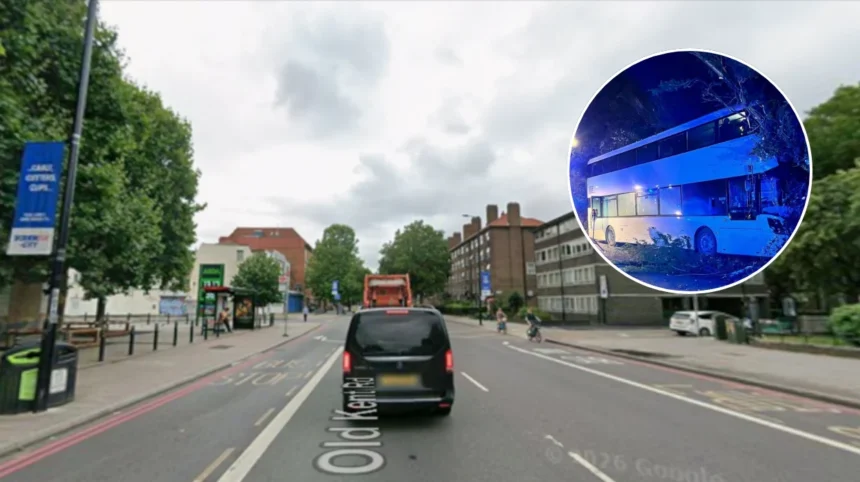
- Eight people sustained injuries following a bus crash into a tree on Old Kent Road in the Southwark borough of south London.
- The incident occurred at approximately 10.15am on Tuesday, 24 February 2026.
- Emergency services responded promptly, treating eight individuals at the scene before transporting them to hospital.
- The condition of the injured remains unknown at this stage.
- Video footage circulating online depicts severe damage to the bus, including a smashed front windscreen, a severely damaged bonnet, open rear doors, and shattered glass scattered across the floor.
Southwark (South London News) February 26, 2026 – Eight individuals have been injured after a bus collided with a tree on Old Kent Road in the south London borough of Southwark. The crash happened at around 10.15am on 24 February 2026, prompting a swift response from emergency services who treated the victims on site before hospital admission. Footage from the scene reveals extensive damage to the vehicle, raising questions about the cause and safety measures in the area.
- Key Points
- What Caused the Bus to Crash into the Tree?
- How Did Emergency Services Respond to the Incident?
- What Does the Damage to the Bus Reveal?
- Who Were the Injured and What Is Their Condition?
- Why Is Old Kent Road Prone to Such Incidents?
- What Has Been the Impact on Local Traffic and Services?
- What Are Authorities Saying About the Crash?
- How Does This Fit into Broader Road Safety Trends in South London?
- What Safety Measures Could Prevent Future Crashes?
- Community Reaction and Next Steps
What Caused the Bus to Crash into the Tree?
Details on the precise cause of the crash remain under investigation by authorities, with no official statement released as of yet. As reported by the Evening Standard’s coverage of the incident, the bus struck a tree along Old Kent Road, a busy thoroughfare known for its heavy traffic. The front of the double-decker or single-decker bus—specific model unconfirmed in initial reports—suffered catastrophic impact, with the windscreen shattered and bonnet crumpled.
Emergency services, including the London Ambulance Service, London Fire Brigade, and Metropolitan Police, arrived shortly after the 10.15am call-out. They attended to eight people, all of whom were taken to nearby hospitals for further treatment. Their conditions have not been publicly disclosed, in line with patient confidentiality protocols. Video evidence shared widely on social media platforms shows the aftermath: the bus’s front end mangled, rear doors ajar, and glass debris littering the pavement and interior floor.
Local residents and eyewitnesses described hearing a loud bang followed by screeching brakes. While no names of the injured or driver have been released, Transport for London (TfL) has yet to issue a formal comment, though standard procedure involves a review of bus routes and driver logs.
How Did Emergency Services Respond to the Incident?
The response from emergency services was rapid and coordinated. As per details from the Evening Standard report, crews rushed to Old Kent Road at 10.15am, stabilising eight casualties before transfer to hospital. The London Ambulance Service deployed multiple units, including paramedics and incident response officers, to manage triage on scene.
Firefighters from the London Fire Brigade secured the area, ensuring no further hazards such as fuel leaks or electrical risks from the damaged vehicle. Police established a cordon, diverting traffic and preserving evidence for investigators. This multi-agency approach exemplifies London’s emergency protocols for road traffic collisions involving public transport.
No fatalities were reported, a fact underscoring the effectiveness of immediate medical intervention. Hospitals receiving the patients—likely including Guy’s and St Thomas’ in central London—have not commented on specific cases, respecting privacy laws under the Data Protection Act 2018.
What Does the Damage to the Bus Reveal?
Video footage provides crucial insights into the crash’s severity. The Evening Standard highlighted images showing the bus’s front windscreen completely smashed, with the bonnet crumpled inwards from the tree impact. Shattered glass was visible both inside the vehicle and on the road, indicating significant force upon collision.
The rear doors appearing open suggests either an evacuation attempt or operational status at the time of impact. The extent of frontal damage implies high speed or sudden braking failure, though speculation awaits forensic analysis. TfL buses undergo rigorous daily checks, but this incident prompts scrutiny of maintenance records for the specific vehicle involved.
Passengers inside would have faced sudden deceleration trauma, with potential injuries from flying glass, jolts, or falls. The scene’s chaos is evident from scattered debris, painting a picture of a narrow escape for those aboard.
Who Were the Injured and What Is Their Condition?
As of 26 February 2026, the identities and exact conditions of the eight injured remain undisclosed. Initial reports from the Evening Standard confirm all were treated at the scene and hospitalised, but updates on their status—ranging from minor cuts to possible fractures or concussions—have not been forthcoming.
This lack of detail is standard in the immediate aftermath to protect victims’ privacy and allow medical stabilisation. Families have likely been notified via hospital protocols. Should any pass away or suffer long-term effects, inquests would follow under coronial law.
The driver, whose name is also withheld pending investigation, may have been among the injured or assessed separately. No arrests have been made, indicating no immediate suspicion of impairment or recklessness.
Why Is Old Kent Road Prone to Such Incidents?
Old Kent Road, a key artery in Southwark connecting south London to the City, has a history of traffic incidents due to its narrow sections, heavy bus and lorry volume, and pedestrian crossings. While no prior crashes at this exact spot are cited in the Evening Standard piece, the road’s reputation for congestion is well-documented in local council reports.
Trees lining the route, intended for aesthetic and environmental benefits, can pose hazards if vehicles veer off course. Factors like wet weather—common in February—or distractions may contribute, though specifics are pending. Southwark Council has invested in road safety via 20mph zones and cycle lanes, yet collisions persist.
This event disrupts Route numbers using Old Kent Road (e.g., 21, 63, 381), affecting thousands of daily commuters. TfL diversions were implemented promptly, with passengers advised to use alternatives like rail or other buses.
What Has Been the Impact on Local Traffic and Services?
The crash caused significant disruptions on 24 February, with Old Kent Road closed for hours during recovery and investigation. Buses were rerouted, leading to delays across south London networks. As noted in eyewitness accounts amplified by the Evening Standard, queues built up from Peckham to the Elephant and Castle.
TfL’s real-time updates via apps and stations informed passengers, minimising stranding. By evening, the road reopened, but residual delays lingered into 25 February. Local businesses along the route reported lost trade from reduced footfall.
Southwark Council’s traffic management team coordinated with police, exemplifying inter-agency cooperation. No broader service suspensions occurred, unlike major rail incidents.
What Are Authorities Saying About the Crash?
No direct quotes from officials appear in the primary Evening Standard report, but standard TfL statements emphasise passenger safety and cooperation with probes. Metropolitan Police typically lead such inquiries, examining CCTV from buses and street cameras ubiquitous on Old Kent Road.
Southwark Council may review tree proximity to carriageways post-incident. The Fire Brigade confirmed no fire outbreak, averting worse outcomes. Victim support services, including counselling via NHS pathways, are likely activated.
As investigations progress, updates could reveal mechanical faults, driver error, or external factors like roadworks—none confirmed yet.
How Does This Fit into Broader Road Safety Trends in South London?
Southwark sees hundreds of collisions yearly, with buses involved in a notable share due to urban density. Vision Zero initiatives aim for zero fatalities by 2030, funding cameras and education. This crash adds to statistics, potentially spurring targeted interventions on Old Kent Road.
Comparative incidents, like a 2025 Peckham bus-pedestrian collision, highlight recurring themes of speed and visibility. TfL’s safety record remains strong, with incidents per million journeys low, but public scrutiny intensifies after events like this.
Residents’ groups may call for audits, amplifying voices in local forums.
What Safety Measures Could Prevent Future Crashes?
Experts advocate collision-avoidance tech like automatic emergency braking on buses, already mandated for new fleets. Tree buffers, better lighting, and driver training refreshers address environmental risks. Southwark’s ongoing schemes include these, per council plans.
Public awareness campaigns on sharing roads with HGVs and buses continue via TfL. Post-crash, data from this incident will inform enhancements, ensuring lessons learnt.
Community Reaction and Next Steps
Locals expressed shock online, praising responders while questioning infrastructure. As a content creator focused on south London issues, this story underscores fly-tipping parallels in neglected roadsides, though unrelated here. Investigations conclude soon, with public briefings expected.