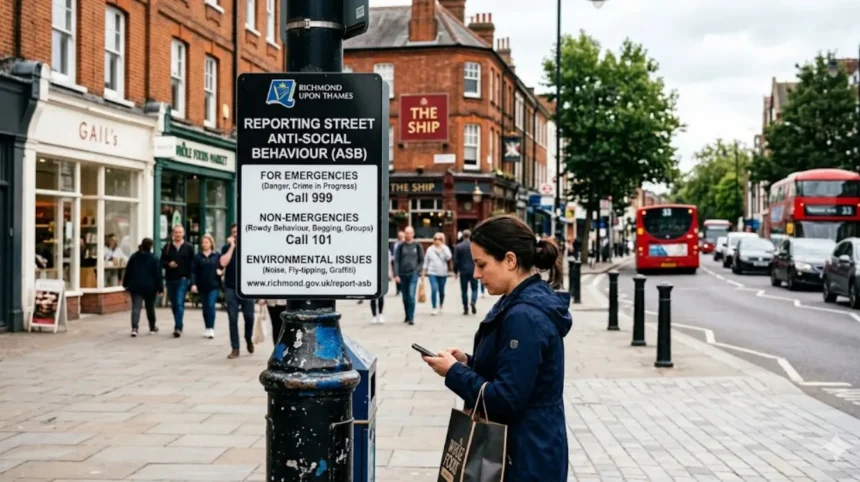
Street anti-social behaviour, or street ASB, in Richmond upon Thames should be reported to the right body depending on the risk, location, and type of behaviour. In an emergency or if a crime is happening right now, call 999; for non-emergencies, call 101 or report online to the Metropolitan Police, while council services handle certain local nuisance and parks issues.
- What counts as street ASB
- When to call 999
- When to use 101
- How Richmond Council fits in
- Noise on the street
- Drug use and dealing
- Begging, anti-social drinking, and rough sleeping concerns
- Graffiti, littering, and public damage
- What details to include
- Keep a record
- What is the Community Trigger
- How street ASB is handled locally
- Best route by issue
- Why reporting matters
- Final takeaway
What counts as street ASB
Street ASB is usually behaviour in public spaces that causes harassment, alarm, distress, nuisance, or disruption. In Richmond upon Thames, council guidance points to issues such as drug use or dealing in public, begging, anti-social drinking, graffiti, littering, bins, camping in council-owned green spaces, and other public-space nuisance.
The legal and policy framework behind this response comes from the Anti-social Behaviour, Crime and Policing Act 2014 and the Home Office statutory guidance, which empower local agencies to respond to harm or nuisance in ways that are proportionate and victim-focused.
When to call 999
Call 999 immediately if someone is in danger, a crime is in progress, or the situation could escalate quickly. National guidance says 999 is for immediate danger or active crime, and Richmond’s own reporting page uses the same standard for emergencies and crimes in parks, streets, and open spaces.
Examples include a violent incident, threats with a weapon, a suspected assault in progress, or someone being attacked or seriously threatened in the street. If you are unsure but think there is an immediate risk to life or safety, it is better to call 999 than wait.
When to use 101
Use 101 for street ASB that is serious but not an emergency. The Metropolitan Police and GOV.UK both direct non-emergency ASB reports, including nuisance noise, vandalism, drunken rowdiness, harassment, and similar incidents, to 101 or an online police report.
This matters because repeated reporting helps police and partners identify patterns, hotspots, and repeat offenders. Richmond’s community safety approach also relies on partnership working with the police and other agencies rather than the council dealing directly with every case itself.
How Richmond Council fits in
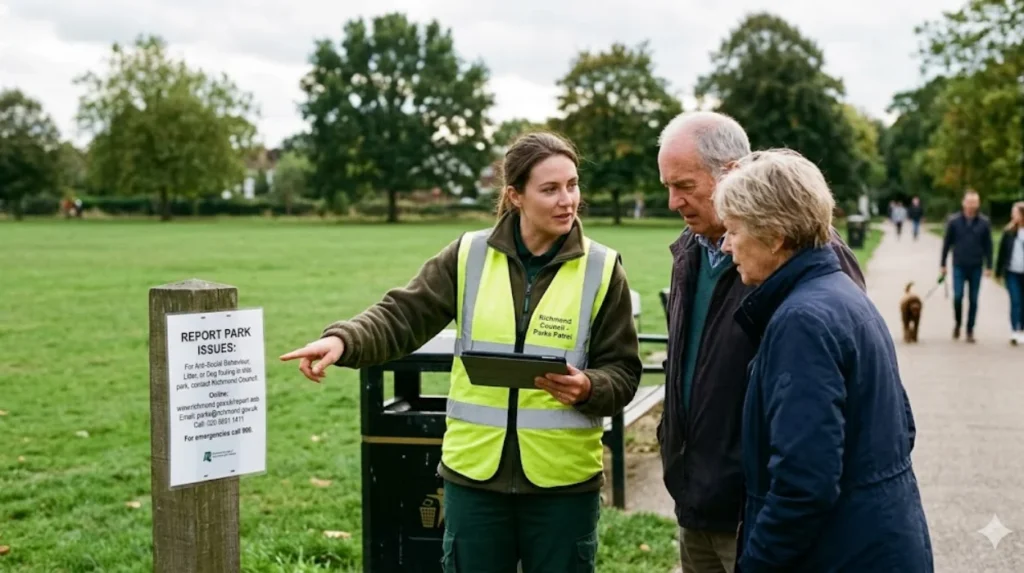
Richmond Council is the right contact for some street-related problems, especially where the issue is tied to council-managed spaces or environmental nuisance. The council says you can report ASB in council-owned parks and green spaces, as well as issues such as dogs, littering, drug paraphernalia, bins, and camping in those spaces.
For parks and green spaces, the council provides an online reporting route, a phone number, and an email address. It also notes that Bushy Park and Richmond Park are managed by The Royal Parks, so issues there should go to the police for emergencies or non-emergencies rather than to the council’s parks team.
Noise on the street
Public noise nuisance, including loud music from vehicles or groups in public spaces, should be reported to the police rather than treated as a private neighbour nuisance. Richmond’s reporting guidance specifically says public noise from loud music in vehicles or groups in public spaces should go to 101 or the police online reporting route, with 999 reserved for emergencies.
If the issue is not street noise but domestic or commercial nuisance, Richmond Council has a separate nuisance reporting form and says weekend noise between 8pm and 3am on Friday or Saturday night can be reported to its out-of-hours noise service on 07944 038 495. That distinction is important because the correct reporting route depends on where the problem is happening and who is causing it.
Drug use and dealing
If you see drug dealing, buying, or taking drugs in public places in Richmond upon Thames, the council advises calling 101 for non-emergencies or using the police online reporting route. For emergencies or immediate danger, call 999, and you can also pass information anonymously to Crimestoppers on 0800 555 111.
Anonymous reporting can be useful when you want to help police build intelligence without identifying yourself. National guidance also recognises that reporting patterns of ASB is important because repeat incidents can justify stronger enforcement or partnership action.
Begging, anti-social drinking, and rough sleeping concerns
Richmond’s public guidance treats begging and anti-social drinking as matters that should be reported to the police when they are causing a public-order or safety problem. For non-emergencies, the council says to call 101 or report online, and for emergencies or crimes in progress, call 999.
It is worth separating ASB from vulnerability. In practice, agencies may need to respond with both enforcement and support, especially where the person involved may be homeless, intoxicated, or in crisis, because the Home Office guidance stresses proportionate, victim-focused responses.
Graffiti, littering, and public damage
Graffiti can be reported to Richmond Council online or by phone, and the council also says graffiti can be reported to the police. For other street disorder such as littering, bins, or camping in council-owned parks or green spaces, the council says residents should report the issue through its own channels.
If the problem is vandalism or criminal damage, the police are usually the primary contact, especially where the damage is recent, repeated, or linked to threats or intimidation. Reporting quickly helps preserve evidence and gives officers a better chance of tracing offenders.
What details to include
When you report street ASB, include the exact location, the time and date, what happened, how many people were involved, vehicle details if relevant, and whether anyone was threatened or injured. The more precise the information, the easier it is for police or council teams to spot recurring patterns and decide whether the case needs local partnership action.
If you can do so safely, keep notes of repeated incidents. Richmond Council’s nuisance process says it may need diary information before investigating some complaints, which reflects a wider practice in ASB and nuisance enforcement of collecting evidence over time.
Keep a record
A written log can make a big difference in persistent street ASB cases. Richmond’s ASB Case Review page explains that victims who have repeatedly reported problems can ask for a review when the threshold is met, and the statutory guidance says agencies should consider the persistence of the behaviour, the harm caused, and whether prior responses were adequate.
That means dates, times, locations, photos, video if safely obtained, screenshots of messages, and copies of reference numbers can all be useful. Even where a single incident feels minor, repeated reporting can turn isolated events into a clear pattern that agencies can act on.
What is the Community Trigger
Richmond upon Thames uses the ASB Case Review, also known as the Community Trigger, for victims who have persistently reported ASB but feel nothing effective has been done. The council says the automatic threshold is met when there are at least three qualifying complaints about the same anti-social behaviour, with time limits applying to both the complaints and the review request.
The national guidance explains that this review mechanism is a safeguard for victims, not a blame exercise. Its purpose is to bring police, council, health, and housing partners together to review the case and decide whether additional action is possible.
How street ASB is handled locally
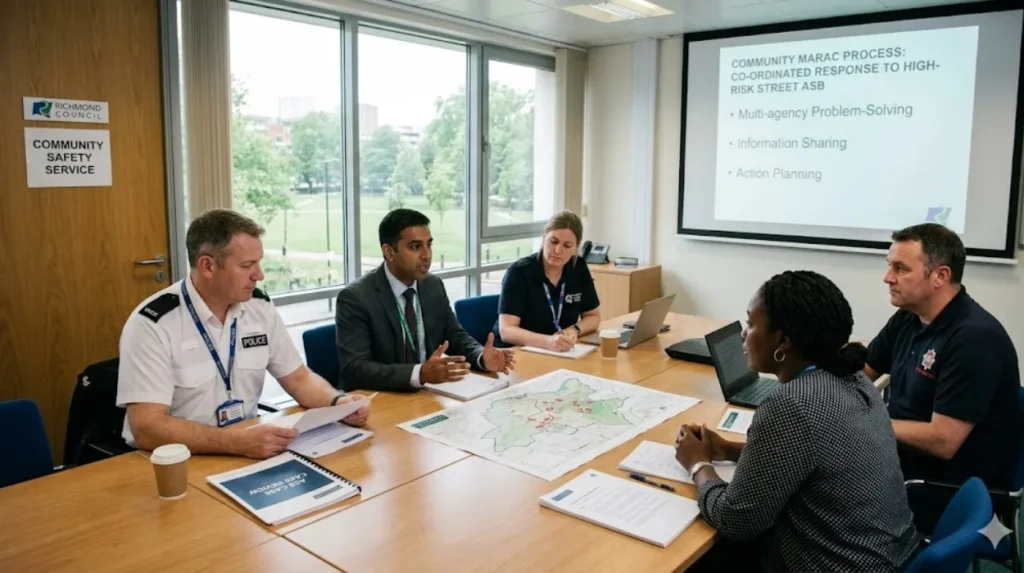
Richmond Council says its Community Safety Service does not usually deal directly with the public on every case, because it works with police and other agencies to address higher-risk behaviour. The council also says it uses multi-agency problem-solving through a Community MARAC process to consider how ASB can be investigated and resolved fairly and effectively.
That local model reflects the national approach set out by the Home Office, which encourages local flexibility and partnership working so agencies can respond to the specific behaviour causing harm or nuisance. In practical terms, this means reporting is not just about making a complaint; it is how you start a joined-up response.
Best route by issue
For street ASB in Richmond upon Thames, the safest rule is simple: call 999 for emergencies, 101 for non-emergencies, and use Richmond Council’s reporting channels for council-managed parks, graffiti, and some nuisance issues. If the problem is in a Royal Park, contact the police rather than the council because Bushy Park and Richmond Park are managed separately.
If you are dealing with repeated incidents and existing reports have not solved the problem, use the ASB Case Review route once the local threshold is met. That is the formal escalation path designed to push agencies to look again at what is happening and whether more can be done.
Why reporting matters
Street ASB often feels small at first, but repeated reporting is what turns isolated trouble into actionable evidence. Government guidance says local agencies need information about persistence, harm, and impact so they can choose proportionate tools and support victims properly.
In Richmond, that can mean the difference between a one-off complaint and a coordinated response involving police, council teams, and housing or health partners. The borough’s own guidance shows that Richmond expects residents to report early, keep records, and use the correct pathway for the type of incident they are experiencing.
Final takeaway
If you need to report street ASB in Richmond upon Thames, start by judging the risk: 999 for immediate danger, 101 for non-emergency incidents, and Richmond Council’s reporting routes for council-managed parks, graffiti, and selected nuisance problems. If the behaviour continues after multiple reports, the ASB Case Review gives residents a formal way to ask for a fresh multi-agency review.