Key points
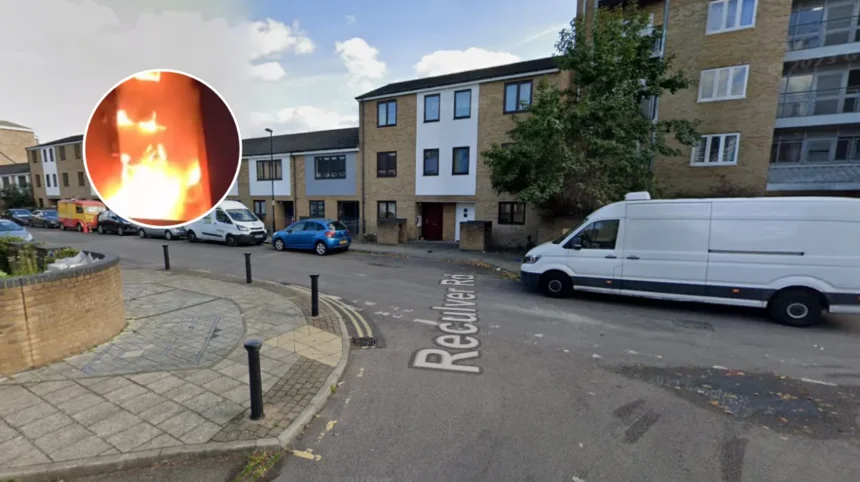
- A woman has been seriously injured after jumping from a third‑floor balcony at a flat in Reculver Road, Lewisham, to escape a fire believed to have been caused by a charging e‑bike battery.
- The London Fire Brigade was called at 11:14 am on Monday, 13 April 2026, and the blaze was brought under control by 11:45 am.
- Part of the hallway of the flat was damaged by the fire, and the woman leapt from the balcony as smoke spread through the property.
- Firefighters assisted the woman before she was taken to the hospital by the London Ambulance Service with injuries believed to be serious but not life‑threatening.
- A man was also led to safety from the same flat and treated at the scene for smoke inhalation.
- London Fire Brigade officials say the fire is believed to have been caused by the “catastrophic failure” of an e‑bike lithium‑ion battery that had been charging in the hallway for about 12 hours.
- The Deputy Assistant Commissioner for Prevention & Protection, Richard Field, has warned residents not to charge e‑bikes or e‑scooters on their escape routes, such as hallways or by front doors.
Lewisham (South London News) April 14, 2026, after reports of a blaze in a third‑floor flat. By the time firefighters arrived, part of the hallway had already been damaged by fire, and thick smoke was spreading through the property.
As reported by a London Fire Brigade spokesperson in the Brigade’s own incident summary, the woman became trapped in her bedroom as smoke poured in and, believing there was no safe escape via the hallway, opened the window and jumped onto the ground from the third‑floor balcony. Firefighters immediately assisted her at the scene before paramedics from the London Ambulance Service took her to hospital with “a serious injury” resulting from the fall.
The same Brigade statement notes that a man was also in the flat at the time and was led out safely by firefighters; he was treated at the scene for smoke inhalation but did not require hospitalisation.
What caused the fire in the Lewisham flat?
According to the London Fire Brigade, the fire is believed to have been caused by the “catastrophic failure” of an e‑bike lithium‑ion battery that had been charging in the hallway for approximately 12 hours prior to the blaze. In its official incident write‑up, the Brigade explained that the battery had been left in the hallway on charge, on the same route residents would normally use to exit the flat.
In a statement included in the Brigade’s website report, Deputy Assistant Commissioner for Prevention & Protection Richard Field said:
“This incident highlights why you should always ensure your escape route is clear and why we recommend to never charge your e‑bike or e‑scooter on your means of escape, such as a hallway or by your front door.”
He added that working smoke alarms had helped alert the occupants quickly, but by the time the woman tried to leave via the hallway the smoke had already blocked that route, forcing her to exit through the balcony.
How did emergency services respond?
The London Fire Brigade said crews arrived within minutes of the 11:14 am call and were able to bring the fire under control by 11:45 am, indicating that the blaze was contained to part of the hallway and did not engulf the entire flat.
The Brigade’s own account notes that firefighters helped the woman after her jump and then handed her over to the London Ambulance Service, which transported her to the hospital for further assessment and treatment. A second person was treated at the scene for smoke inhalation and did not require hospital transfer, according to the same report.
Media coverage carried by the BBC, published on 14 April 2026, described the incident as a
“serious but not life‑threatening”
injury case and paraphrased the Brigade’s line that the fire was thought to have started from a “significant malfunction” of the e‑bike battery after about 12 hours on charge.
Coverage by Yahoo News UK, also on 14 April 2026, reported that the woman was taken to the hospital with a serious injury after jumping from the third‑floor flat to escape the e‑bike battery fire, restating the London Fire Brigade’s causal assessment without adding further detail.
Background of the development
Stories of e‑bike and e‑scooter fires have been rising in London over the last few years. In a 2026 report republished by several outlets, the London Fire Brigade disclosed that it recorded 206 fires linked to e‑bikes and e‑scooters in 2025 alone, the highest annual total to date.
Brigade officials have repeatedly warned that lithium‑ion batteries in e‑bikes and e‑scooters can fail suddenly and with great intensity, especially when lower‑quality or unregulated batteries and chargers are used, or when they are left charging for long periods on escape routes such as hallways.
Previous incidents in Lewisham and other London boroughs have also been attributed to e‑bike or e‑scooter batteries, prompting repeated public safety messaging from the Brigade urging residents to store and charge such devices in safe, well‑ventilated locations away from escape routes and to use only properly certified equipment.
The Reculver Road case is now being cited by the London Fire Brigade as a concrete example of why its guidance matters. The Brigade’s published statement stresses that smoke alarms can buy time but do not eliminate risk if batteries are charged where people must pass through to escape.
Earlier local reports from 2023, also covering a Lewisham flat fire caused by an e‑bike lithium‑ion battery, quoted Brigade officials saying such fires
“develop so rapidly the situation can quickly become incredibly serious,”
and that many problem batteries come from online marketplaces that may not meet safety standards.
Predictions: How this development could affect residents and policymakers
For residents in Lewisham and other densely populated London boroughs, this incident may make existing guidance on e‑bike and e‑scooter charging more salient. The fact that one person felt forced to jump from a third‑floor balcony to escape smoke could prompt more households to review where they charge personal mobility devices and to ensure escape routes are kept clear.
Building‑management companies and housing associations may also respond by tightening rules on charging inside communal corridors or shared halls, echoing the Brigade’s repeated advice against using such areas as charging points.
Fire‑safety advocates and the London Fire Brigade have long called for stricter standards on lithium‑ion batteries, chargers, and e‑scooter conversion kits, including clearer labelling and recall mechanisms for defective products.
As reported by outlets covering the 2026 e‑bike and e‑scooter fire statistics, the Brigade has urged the government to use powers introduced in 2024—which allow online marketplaces to be held accountable for products sold on their platforms—to push for secondary legislation that would tighten safety requirements for these batteries.
If further incidents occur, this Lewisham case looks likely to be cited in future policy discussions as evidence that battery failures can directly threaten life, especially in flats where escape routes are limited and smoke can spread quickly.
For Londoners who rely on e‑bikes and e‑scooters for commuting or deliveries, the incident may heighten awareness of both the benefits and risks of these devices, potentially encouraging more cautious charging habits and closer attention to safety marking and manufacturer guidance.