Key Points
- The 121 Centre at 121 Railton Road, Brixton, South London, operated as a squatted autonomous social centre from 1981 to 1999, hosting a bookshop, cafe, rehearsal space, printing room, office, and meeting space.
- It served as headquarters for groups including Bad Attitude magazine, AnarQuist, Brixton Squatters’ Aid, and Anarchist Black Cross.
- In January 1999, squatters lost a court case against Lambeth Council’s possession claim, leading to an eviction order.
- Protests included an invasion of Lambeth Town Hall, street theatre, flyposting, billboard modifications, and publication of South London Stress magazine.
- Squatters barricaded the building and resisted eviction for nearly three months past the deadline.
- On 10 April 1999, over 500 people attended an all-day street party outside the centre to mark 86 days of resistance; Railton Road was barricaded with no police interference.
- The party featured sound systems with hip-hop, roots reggae, d’n’bass, ragga, punk bands, volleyball, face painting, info stalls, free food, fires, and a strip show from the balcony.
- Photographer Peter Marshall documented the event, capturing the end of an era.
- The centre was evicted on 12 August 1999 by six sheriff’s bailiffs and armed police, removing seven residents without resistance.
- Lambeth leader Jim Dickson stated the action cleared the borough of squatted property.
- Squatters like Tom from Norway and Kuru from Brazil commented on disillusionment and ongoing squatting.
- The building was later auctioned and converted to private flats by 2003.
Brixton (South London News) April 14, 2026
- Key Points
- What Was the 121 Centre in Brixton?
- Why Did Lambeth Council Seek Eviction of the 121 Centre?
- How Did Squatters Resist the Eviction Order?
- What Happened at the Railton Road Street Party on 10 April 1999?
- Did Police Intervene During the Street Party?
- When and How Was the 121 Centre Finally Evicted?
- Background of the 121 Centre Development
- Prediction: How This Development Can Affect the Squatting Community in South London
What Was the 121 Centre in Brixton?
Brixton, Lambeth, South London, 10 April 1999 – For 18 years, the three-storey building at 121 Railton Road had been the 121 Centre, a squatted autonomous social centre that provided vital community resources.
It functioned as a bookshop, cafe, gig and rehearsal space, printing facility, office, and meeting space, hosting punk gigs under the name ‘Dead by Dawn’, regular women’s cafe nights, and monthly Queer Nights organised by AnarQuist with vegan banquets, film nights, cabarets, zine-making, and disco parties.
As reported by contributors to Urban75, several campaign and community groups were based there, including the radical women’s magazine Bad Attitude, the anarcho-queer group AnarQuist, Brixton Squatters’ Aid, and the prisoner support group Anarchist Black Cross.
The centre maintained a low profile and became one of London’s longest-lasting squats, drawing supporters from anarchists, hunt saboteurs, and radical campaigners.
Why Did Lambeth Council Seek Eviction of the 121 Centre?
The end began in January 1999 when squatters lost a court case against Lambeth Council’s claim for possession of the premises, resulting in an eviction order.
According to Flashbak archives, the squatters responded with protests, including an ‘invasion’ of Lambeth Town Hall, street theatre productions, handing out flyers, and self-publishing the South London Stress magazine to highlight gentrification issues.
Urban75 reports detail a public campaign that involved flyposting, billboard modifications, and a ‘Drink-In’ protest against a new anti-street-drinking by-law.
Lambeth leader Jim Dickson later noted previous failed eviction attempts, including one met by nearly 70 protesters blocking the road and setting up barricades inside the building.
How Did Squatters Resist the Eviction Order?
As the eviction date approached, squatters barricaded themselves inside the 121 Centre, decorating it with banners and paint, and held out for nearly 90 days beyond the deadline using round-the-clock occupation, an emergency siren, and easy-to-assemble internal barricades.
They organised a highly efficient campaign from within, including a website and newsletter circulated among supporters.
Tom, a 22-year-old squatter from Norway, told the Evening Standard during the final eviction that residents had become disillusioned after a February police attempt, describing how bailiffs entered through second-floor windows without letting them put on shoes. Kuru, a 24-year-old squatter from Brazil, stated:
“What the police and the council are doing is just adding to the problem of homelessness in London. But they won’t succeed in stopping us from squatting because we’ll just go elsewhere.”
What Happened at the Railton Road Street Party on 10 April 1999?
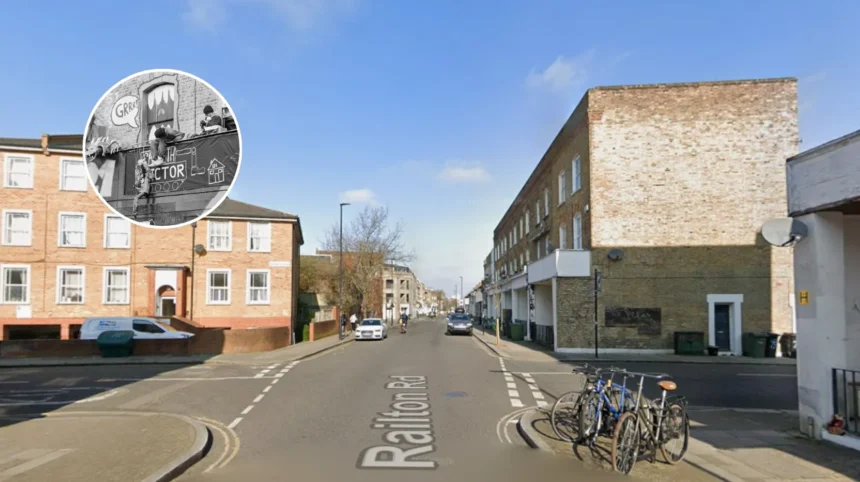
On 10 April 1999, occupiers held an all-day street party directly outside the 121 Centre to celebrate 86 days of resistance, attended by over 500 people.
With no police resistance, Railton Road was blocked off with barricades; sound systems played an eclectic mix from hip-hop and roots reggae to the Clash, d’n’bass, ragga, and punk bands.
Eyewitness Tom, as reported by Urban75, described the event starting at 2pm amid rain that cleared by 3pm:
“The sun came out and a honking sound system was set up… strong Ragga tunes… volleyball, face painting, info stalls, free food, punk bands, sofas to chill out on… a saucy strip show c/o 121 striptease crew from their own balcony.”
Fires were lit as night fell, with the party continuing until 11pm; locals watched with curiosity or indifference, while the off-licence and Harmony pub saw increased trade, and the neighbouring Snackmaster played reggae and served food.
Peter Marshall photographed the event for Flashbak, capturing the barricades and crowds on Railton Road, marking the end of an era for the centre.
Did Police Intervene During the Street Party?
Police kept an exceedingly low profile and did not walk into trouble on Railton Road, allowing the barricades and party to proceed without interference.
When and How Was the 121 Centre Finally Evicted?
The centre was evicted on 12 August 1999, more than seven months after barricading began. The Evening Standard reported:
“Six sheriff’s bailiffs, assisted by a specialist armed police force, entered the 121 Centre in Brixton’s Railton Road shortly after 6.30am and successfully removed the seven remaining illegal residents.”
Chief Inspector Martin Bagg confirmed bailiffs entered through upper-floor windows with no resistance from the small group woken that morning; over 150 police officers stood by. Lambeth leader Jim Dickson, who had been raided in his office by 30 protesters from the centre previously, said:
“We are systematically clearing up the borough and dealing with the legacy of the past. Our action today sends out a very clear message to the squatters – the council will keep taking action over squatted property until there is none left.”
The building was cleared of belongings, auctioned, and by 2003 converted into private flats amid rising property values.
Background of the 121 Centre Development
The 121 Centre originated in 1981 as a squatted collective on Railton Road, a street with a history of squatting and autonomy in Brixton. It evolved into a hub for anarchist and community activities, surviving multiple council challenges due to its low profile and strong networks.
The 1999 legal battle reflected broader tensions over property ownership and gentrification in South London, with the court’s decision upholding Lambeth’s claim after years of occupation. Resistance efforts, including the street party, highlighted the centre’s role in local radical politics from the 1980s onward.
Prediction: How This Development Can Affect the Squatting Community in South London
This development can lead to increased council actions against squats, as stated by Lambeth leader Jim Dickson, potentially reducing available autonomous spaces for groups like Anarchist Black Cross and Brixton Squatters’ Aid. Squatters such as Tom and Kuru indicated relocation to other sites, which may disperse community resources and heighten homelessness pressures in London.
Conversion to private flats signals gentrification impacts, limiting low-cost community hubs for local activists and residents in Brixton. The street party and campaign raised awareness, possibly inspiring future resistances but under stricter enforcement.