Key Points
- Galliard Homes, in partnership with Singapore‑based City Developments Limited (CDL), has won planning approval for a 1,500‑home residential scheme at Morden Wharf on the Greenwich Peninsula in south London.
- The approved scheme will deliver up to 12 blocks of apartments, with the Galliard‑led joint venture now expecting to complete the development by 2032.
- The housing mix now includes 20% “affordable” homes, or about 300 units, funded in part by Greater London Authority (GLA) grant arrangements introduced under London Mayor Sir Sadiq Khan’s updated housing measures.
- Within that 20%, the revised plan provides 168 flats for social rent and 82 “intermediate” homes for discounted rent, discounted sale, or shared‑ownership arrangements.
- Earlier proposals cut the affordable share from 35% to 10%, prompting the Greenwich Planning Board to defer a decision in February 2026; councillors only agreed after Galliard showed entitlement to GLA funding that restored the level to 20%.
- The project also includes around 186,000 sq ft of logistics and creative workspace and 50,000 sq ft of retail, food and beverage, and community and convenience uses, making it a mixed‑use waterfront development.
Galliard Homes (South London News) April 23, 2026 wins approval for 1,500‑home Greenwich scheme. Greenwich – Galliard Homes, in a joint venture with Singapore‑based City Developments Limited (CDL), has secured full planning approval for a 1,500‑home residential scheme at Morden Wharf on the Greenwich Peninsula in south London. As reported by the London Evening Standard’s planning coverage team, the revamped plans foresee completion of the riverside project by 2032, with up to 12 residential blocks forming the core of the scheme.
- Key Points
- How has the affordable‑housing offer changed?
- Why did councillors accept only 20% affordable homes?
- What else will the Morden Wharf project include?
- Background: How did the Morden Wharf scheme reach this stage?
- Prediction: What could this decision mean for local residents and the wider market?
The Evening Standard notes that the Morden Wharf project will rise from a 13.8‑acre former industrial site on the peninsula, which Galliard and CDL acquired from LandsecU+I and Morden College in 2023 after hybrid planning had already been granted for a broadly similar 1,500‑unit scheme. The latest validation by Greenwich Council’s Planning Board clears the way for Galliard to move from hybrid consent into detailed permission for the blocks, access routes, and public spaces.
How has the affordable‑housing offer changed?
As reported by Greenwich Wire journalist Alex Wickham, the original Galliard‑led proposal for Morden Wharf carried a 35% affordable‑housing target, a figure that had been advocated by community groups and local housing campaigners.
In February 2026, however, the developer told the council’s Planning Board that costs and tightening building regulations had forced it to slash that share to 10%, prompting the panel to defer a final decision while seeking “more concrete” assurances about affordable supply.
According to Yahoo News UK’s London‑based planning correspondent, the Planning Board’s deferment reflected “significant concern” that the reduction would erode the social‑value component of the scheme. In its April 2026 return, Galliard explained that the site now qualified under new GLA arrangements introduced by Mayor Sir Sadiq Khan, which enable developers to receive grant funding if they commit to delivering at least 20% affordable homes until 2030.
Writing for Greenwich Wire, journalist Alex Wickham states that the revised plan lifts the affordable share back to 20%, with 168 flats set aside for social rent and 82 “intermediate” homes for discounted rent, discounted sale, or shared ownership.
The council’s agenda document for the 14 April 2026 Planning Board meeting likewise confirms that at least 20% of the homes will be affordable, comprising roughly 68% social rent and 32% intermediate, and that mid‑ and late‑stage viability reviews will be removed in favour of an early‑stage review only.
Why did councillors accept only 20% affordable homes?
As explained by Greenwich Wire’s Alex Wickham, several councillors publicly expressed “unhappiness” at having to accept 20% as the affordable level, noting that this is below the 35% originally expected and below longstanding local expectations for major riverside developments.
He reports that some members argued that the 20% figure, while better than the 10% proposed in February, still falls short of the borough’s strategic housing needs, particularly for social‑rent and genuinely affordable one‑, two‑ and three‑bedroom units.
However, the same report notes that council officers and the GLA framework emphasise that the 20% mark, backed by grant funding, is intended as a temporary “floor” measure to “kickstart building” across London amid cost inflation and regulatory change.
The Evening Standard adds that officers told the Planning Board that the 20% level met the GLA’s current minimum requirement, and that removing mid‑ and late‑stage reviews would give the developer more certainty over the scheme’s financial model.
Councillors were also told that the new GLA regime would allow Morden Wharf to sidestep the more onerous mid‑ and late‑stage reviews traditionally used to test whether additional affordable units could be added later in the scheme’s life, which officers said had become a barrier to delivery on large sites. In light of those explanations, the Board voted to approve the remodelled scheme, subject to the 20% affordable minimum and the single early‑stage review.
What else will the Morden Wharf project include?
The BE News planning correspondent notes that the approved scheme will retain a mixed‑use blueprint first set out in the 2023 hybrid consent, with up to 12 residential blocks of differing heights – some approaching 36 storeys – arranged around public realm and riverside promenades.
The article, citing Galliard’s own project release, states that the development will also allocate around 186,000 sq ft for logistics and creative workspace, aiming to attract logistics firms, light‑industry operators, and creative‑sector tenants to the site.
According to the same report, a further 50,000 sq ft will be allocated to retail, food and beverage, community, and convenience uses, with the aim of supporting local employment and services as thousands of homes are brought forward.
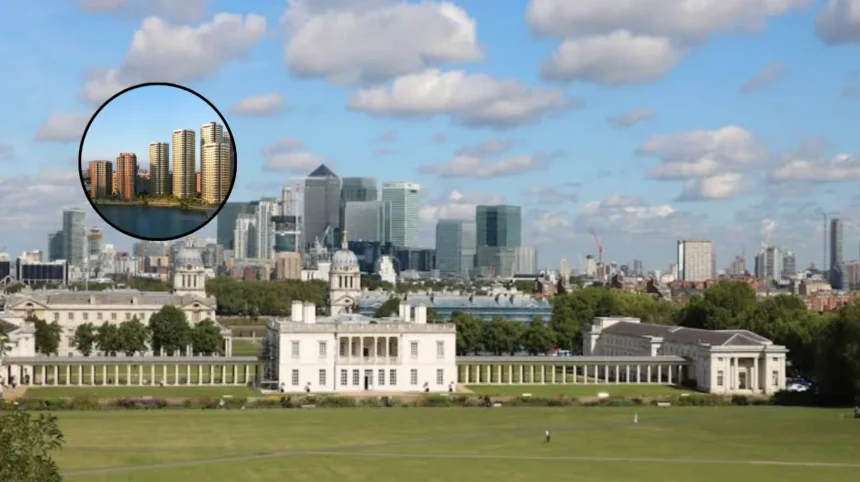
The company’s marketing materials, cited by the Evening Standard, describe the scheme as a “riverside lifestyle” offering, with views over the Thames and the Canary Wharf‑Docks skyline, and with new cycle links and improved pedestrian access planned into the wider peninsula network.
Local planning coverage on Greenwich Wire also highlights that the site’s history as a former industrial wharf will be acknowledged in the design, with some references to heritage features and new public spaces intended to invite riverside leisure use. However, the article stresses that these plans remain subject to detailed design‑code compliance and any future conditions that may be imposed by the GLA or the council during the start‑of‑construction phase.
Background: How did the Morden Wharf scheme reach this stage?
Morden Wharf was originally put forward as a 1,500‑home scheme by developer U+I, which obtained hybrid planning consent in 2023 before selling the site to a Galliard‑CDL joint venture later that year, as reported by From The Murky Depths’ planning blog.
At the time of acquisition, coverage by BE News noted that the new owners committed to a broadly similar 1,500‑unit scheme, with 12 blocks and ancillary mixed‑use floorspace, setting expectations of continuity in scale and form.
Reporting by Greenwich Wire in early 2026 outlined a key shift: the February 2026 submission, in which Galliard cited rising construction costs and regulatory changes as reasons to cut affordable housing from 35% to 10%, opened a period of political and community debate about the site’s social‑value content.
The council’s Planning Board’s decision to defer in February, carefully recorded in the borough’s public‑documents portal, was framed as a device to force the developer to engage with the GLA’s emerging flexibility on minimum affordable thresholds.
The subsequent 14 April 2026 approval, now landed at 20% affordable, reflects that interface between local‑authority planning gatekeeping and the mayor’s drive to unlock deliverable schemes across London. The result is a scheme that, while still contentious on the level of social and intermediate housing, is now formally cleared for construction, with indicative timelines pointing to a 2032 completion horizon.
Prediction: What could this decision mean for local residents and the wider market?
For local residents and existing Greenwich‑Peninsula households, the approval introduces the prospect of several thousand new homes coming online over the next six to seven years, bringing both extra demand for local services and potential pressure on congestion and public‑realm infrastructure, as suggested by local news coverage on Greenwich Wire and the Evening Standard.
The 20% affordable component, stronger than the March 2026 10% proposal but still below the earlier 35%, may modestly increase the number of social‑rent and intermediate‑tenure options, yet campaigners may argue that the shortfall against original targets still limits the scheme’s capacity to address the borough’s housing‑shortage pressures.
For the wider London housing and development market, the Morden Wharf decision may be read as a signal that large‑scale sites can move forward with a lower “floor” of affordable housing if they can access GLA grant funding and align with the mayor’s focus on mains‑grid‑ready land and quicker delivery, as described in the Evening Standard and Yahoo News UK coverage. Developers of other riverside and regeneration sites may look closely at how Galliard’s shift from 35% to 10% and back to 20% played out politically, in terms of how much discretion local councils are prepared to exercise when the GLA framework sets a lower minimum.