Key Points
- Biggin Hill sits in the London Borough of Bromley but retains a strong borderland feel because of its position on high ground and its surrounding green belt countryside.
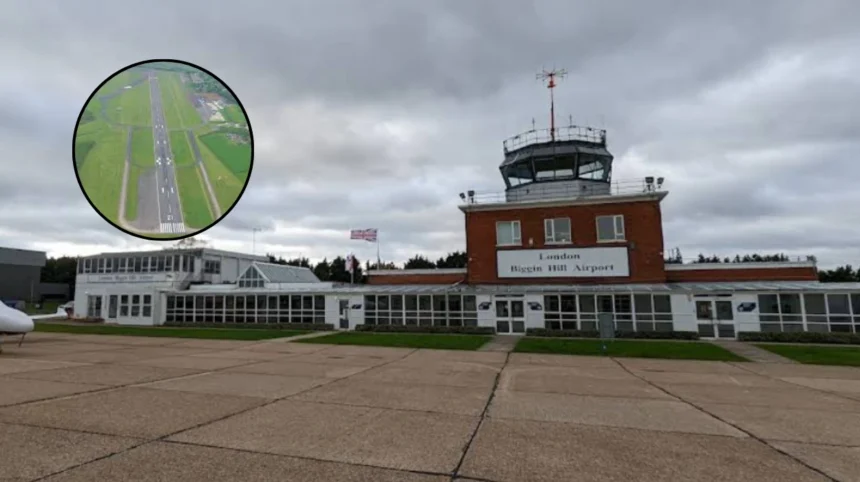
- The town is closely associated with aviation history, especially Biggin Hill Airport and its wartime role in the defence of London.
- The area developed in an unusual way, with early settlement shaped by weekend homes, small plots and speculative building rather than a railway-led suburban expansion.
- Biggin Hill has no railway station, and its limited transport links helped preserve its semi-rural character.
- Post-war planning and green belt policy shaped how the town grew, making it less dense than many other parts of suburban London.
Biggin Hill (South London News) April 30, 2026, and the surrounding hills have long stood apart from much of suburban London because the area developed slowly, without the rail connections that drove growth elsewhere. The town’s geography, transport limits and wartime aviation history have all helped shape its distinct identity.
Why does Biggin Hill feel different from other London suburbs?
As reported by the University of Greenwich’s Ideal Homes project, Biggin Hill began with an “unorthodox origin” because the first modern settlers were not wealthy commuters but ordinary workers seeking weekend retreats from London.
The same source says landowner Frederick Dougal and later owners sold off small building plots in the late 19th and early 20th centuries to encourage suburban development. That pattern gave the area a looser, more piecemeal form than the planned railway suburbs that grew elsewhere in Greater London.
The town’s setting reinforced that difference. Biggin Hill sits on the North Downs and is described by local historical sources as being surrounded by open countryside, with boundaries meeting Greater London, Kent and Surrey. Its high ground and rural edges have helped preserve a landscape that feels closer to downland than to inner suburban sprawl.
How did the lack of a railway shape the town?
According to the University of Greenwich’s railways case study, Biggin Hill’s “major drawback” was always its poor transport links, with “one road in and one road out.”
The same source says the town was never a realistic candidate for a mainline railway because of its location on the top of the North Downs. A proposed Tatsfield Light Railway was considered in 1898, but the scheme collapsed because the company could not raise the required funds.
That absence of rail access had lasting effects. Without a station, Biggin Hill did not become a typical commuter suburb and instead kept a more self-contained feel. The lack of rail investment also helped keep land prices lower in the early development period, which encouraged small-scale plot sales rather than large, dense housing schemes.
What role did aviation play in Biggin Hill’s identity?
Biggin Hill is best known nationally for its airfield, which became an operational fighter station on 1 December 1917, according to London Biggin Hill Airport’s heritage page.
The airport’s history is central to the town’s public image because of its role in defending London during the First and Second World Wars. That aviation legacy distinguishes it from many other south-east London settlements, where industry, rail or road growth played a bigger part.
The airport also added to the area’s distinctiveness after the war. The University of Greenwich notes that Biggin Hill was already built up in a different style from its neighbours, and that the RAF base strengthened its character. In practical terms, the airport kept the town associated with a specific national function rather than simply a residential role.
How did post-war planning affect Biggin Hill?
After the Second World War, planning policy became the main force shaping suburban growth, and the green belt curtailed the kind of outward spread seen before the war.
The University of Greenwich says the edge of the building at the outbreak of war effectively became the permanent boundary as green belt policy took hold. Biggin Hill was already partly developed, but it remained less dense and more open than many surrounding places.
Local history sources also show that planning for the area was handled with an eye to controlled growth. The Biggin Hill Residents Association says Kent County Council’s town map in the 1950s envisaged growth from a village population of about 4,300 to a small town of 16,000, with land use, schools, shops and infrastructure mapped out.
Those plans were later absorbed into wider borough planning frameworks after Biggin Hill became part of Greater London in 1965.
What has remained unchanged?
Even with new roads, housing estates and the expansion of the post-war decades, Biggin Hill has kept a semi-rural atmosphere that is unusual within London. The area still feels separate from the capital because of the countryside around it and the absence of rail-based growth. Its aviation heritage and topographical isolation continue to define how residents and visitors understand the place.
The town, therefore, occupies a specific position within south-east London: part urban, part rural, and strongly shaped by history rather than by rapid modern sprawl. That combination has made Biggin Hill recognisable beyond its borough boundaries.
Background of the development
Biggin Hill’s development began with speculative plot sales on former estate land, rather than with a railway station or large municipal housing programme. Early settlers often used the area as a weekend or holiday retreat, and many of the first buildings were simple shacks or smallholdings that were later replaced by more permanent homes. The town then grew more substantially in the post-war period, but green belt policy and the absence of rail links prevented it from becoming a dense suburban extension of London.
Prediction
For local residents, the most likely effect of this development history is that Biggin Hill will continue to balance modest growth with preservation of its open, semi-rural character. For commuters, the lack of rail access will probably keep the town less integrated into the wider London housing market than rail-served suburbs nearby. For visitors and aviation audiences, the airport and wartime heritage are likely to remain the main features that define the area’s public profile.