Broken or flickering street lights in Richmond upon Thames reduce night‑time safety and can create hazards for pedestrians, cyclists, and drivers across South London. The London Borough of Richmond upon Thames and Transport for London (TfL) maintain separate reporting channels depending on the road type. This guide explains how South London residents can report a street light fault quickly, what happens next, and how to tell whether a fault is dangerous or routine.
- What is street lighting and why does it matter?
- Where is Richmond upon Thames and how does it fit into South London?
- How do you report a street light fault in Richmond upon Thames?
- What counts as a dangerous street light fault in Richmond?
- How do you tell if a street light is on a Red Route or council‑maintained road?
- What information do you need before reporting a street light fault?
- How does the street lighting replacement programme affect repairs in Richmond?
- What happens after you report a street light fault?
- How do night‑time safety and crime change when street lights are faulty?
- What are the different types of street light faults residents see?
- How do you report a fault if the street light is in a park or open space?
- What role do property owners and developers play in street light faults?
- How can South London residents stay informed about ongoing street light works?
- How does reporting street light faults support long‑term safety in South London?
What is street lighting and why does it matter?
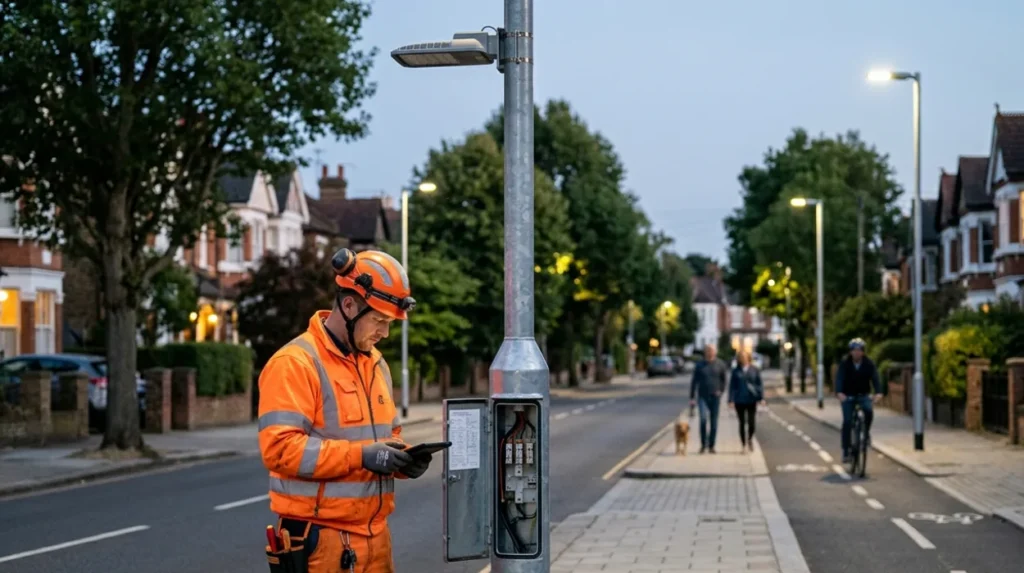
Street lighting in Richmond upon Thames includes all permanent public lights installed along roads, pavements, towpaths, and public open spaces. These systems are typically made of a metal lighting column, a lantern (the light‑housing unit), cables, and protective components such as inspection doors and fuses. Modern installation in the borough uses energy‑efficient LED street lights, which replaced older sodium‑vapour lamps as part of the street lighting replacement programme that began in 2025.
Good street lighting improves visibility after dark, reduces crime risk, and supports South London’s active travel network along roads, cycleways, and pedestrian routes. The borough’s street lighting contractor monitors faults using remote‑control systems on newer LED columns, which track energy use and detect outages automatically. When a street light is faulty, the council treats it as a highway safety issue and prioritises repairs within a defined working‑day window.
Where is Richmond upon Thames and how does it fit into South London?
Richmond upon Thames is a London borough in the south‑west of Greater London, bordered by Hounslow, Hammersmith and Fulham, Wandsworth, and Kingston upon Thames. Key residential and town‑centre areas in the borough include Richmond, Twickenham, Hampton, Barnes, and Mortlake. Many of these neighbourhoods adjoin South London boroughs such as Wandsworth and Kingston, and residents often travel across borough boundaries along the A316, A205, and the A306.
For reporting street light faults, the exact boundary or road‑status matters. Roads classified as “Red Routes” (usually the A316, A205, and similar arterial routes) are maintained by TfL, not the local borough. Other local streets, residential roads, parks, and towpaths fall under Richmond upon Thames’ highways and street‑lighting remit, so reports must go to the council’s fault‑reporting system or directly to the street‑lighting team.
How do you report a street light fault in Richmond upon Thames?
Residents report most street light faults in Richmond upon Thames through the official online fault‑reporting form on the Richmond Council website. The council has a dedicated “Report a fault with a street light” page that guides users to this form and provides a map‑based tool to pinpoint the exact column. The form is available 24/7 and can be completed on desktop or mobile devices. All reports require a description of the problem, the street name and location, and an optional contact phone number in case the engineer needs clarification.
You can also contact the street light contractor by phone at 020 8891 1411 outside of normal office hours for non‑urgent but persistent issues, though the online form is the standard route for planned repairs. The council states that it aims to inspect and repair routine faults within five working days, subject to the type of electrical issue. For recurring or multiple faults on the same road, residents are encouraged to report each light separately so the system logs every column correctly.
What counts as a dangerous street light fault in Richmond?
A dangerous street light fault includes any situation where the lighting column, wiring, or ancillary parts are physically unstable or pose an immediate electrical hazard. Examples include a column that is leaning or fallen, missing inspection doors exposing live parts, sparking or smoking from the lantern or base, hanging lantern units or brackets, and obvious exposed wires at ground level.
In these cases, the Richmond Council website instructs residents not to complete the general online form. Instead, people must call the council’s 24‑hour number 020 8891 1411 immediately and describe the location and nature of the danger. The council may then place temporary traffic‑cone protection or warning barriers, disconnect the column remotely if it is on the new LED‑management system, and arrange emergency repairs within shortest feasible time. Residents should never attempt to move, cover, or touch exposed wires or damaged columns.
How do you tell if a street light is on a Red Route or council‑maintained road?
Red Routes are major roads in London where Transport for London is responsible for maintenance, including street lighting. In Richmond upon Thames, the A316 and A205 are the main Red Route corridors. These roads carry high‑capacity traffic, often include bus lanes, and are signed as TfL‑managed routes.
For street light faults on these Red Routes, residents must report the issue directly to TfL using the TfL website or TfL’s fault‑reporting channels; reports sent to Richmond Council for Red‑Route lamps are automatically forwarded to TfL anyway. All other public highways, including local residential streets, side roads, and paths, are treated as council‑maintained roads for street lighting, so faults on those routes should be reported through the Richmond Council form or phone line.
What information do you need before reporting a street light fault?
Before submitting a report, it is helpful to gather the street name, the nearest property number or landmark, and the side of the road (for example, “opposite 45 The Avenue”). The council’s online form allows you to place a marker on an interactive map, which helps engineers identify the exact column by its asset number. Many street light columns display a small sticker or metal plate with an alphanumeric asset code, such as “RBRT123456”, which speeds up fault‑logging.
Residents are also encouraged to take a photograph of the faulty light, showing the column, the lantern, and any visible damage or exposed components. These images help the street lighting team confirm the nature of the fault and decide whether it is a simple lamp‑replacement or a more complex electrical rectification. If the light is flickering, cycling on and off, or showing unusual colours, note this in the description as well, because it can indicate ballast or LED‑driver failure rather than a simple blown lamp.
How does the street lighting replacement programme affect repairs in Richmond?
Richmond upon Thames has a borough‑wide street lighting replacement programme that replaces life‑expired lighting columns with new mild‑steel columns and modern LED street lights. This programme began in 2025 and covers both residential streets and principal roads carrying buses and higher traffic volumes. Each new LED column connects to a central management system that monitors energy use and detects outages automatically, reducing the need for manual inspection.
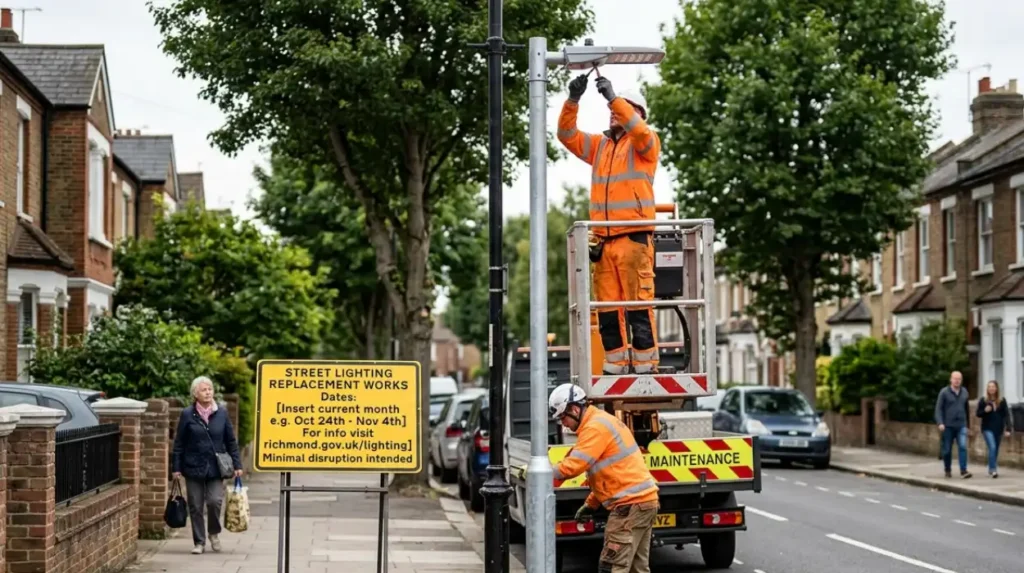
On roads where columns are part of this replacement schedule, the council often suspends individual repairs if the column is scheduled for full replacement within a defined work window. Planned works are announced via notices attached to the column at least one week before works begin, stating the dates and whether the entire road or only part of it will be affected. During these replacement periods, residents may see temporary lighting or reduced lighting in some areas, but the final installed LED units typically provide brighter, more uniform light and lower long‑term energy costs.
What happens after you report a street light fault?
Once a resident submits the online fault report, the council’s street lighting team receives a digital job ticket that includes the location, description, and any uploaded photos. The contractor then assigns an engineer to inspect the column on site, usually within five working days for non‑dangerous faults. The inspection determines whether the fault is mechanical (for example, a damaged lantern or bracket), electrical (faulty cable, fuse, or switchgear), or related to the control system (for LED‑managed columns).
For simple lamp‑replacement or minor mechanical faults, repairs are often completed on the same visit. More complex electrical faults or issues with the underground cabling can take longer, sometimes extending beyond five working days depending on parts availability and traffic‑management requirements. The council may contact the reporter if access is difficult or if the location is unclear. In dangerous‑fault cases, the response window is shorter, with emergency crews dispatched to isolate power and secure the column before permanent repair.
How do night‑time safety and crime change when street lights are faulty?
Poor or missing street lighting in Richmond upon Thames and neighbouring South London areas can reduce visibility for drivers, cyclists, and pedestrians, increasing the risk of trips, falls, and collisions on unlit stretches. Research on urban lighting and road‑safety has shown that well‑lit streets can cut night‑time collision rates by single‑digit percentage points, particularly on residential and mixed‑traffic routes.
In terms of crime, systematic studies on street lighting tend to show modest reductions in some types of property crime and opportunistic theft when lighting is improved or restored, partly because better illumination increases natural surveillance by residents and passers‑by. However, modern policing and CCTV networks also play a large role, so repaired street lighting should be seen as one layer of a broader safety strategy rather than a standalone solution. For South London residents, reporting outages promptly supports both highway safety and local crime‑prevention efforts.
What are the different types of street light faults residents see?
Common street light faults in Richmond upon Thames include completely dark columns, flickering lights, or columns that cycle on and off repeatedly. Mechanical faults often involve damaged lanterns, cracked or missing glass covers, bent or broken brackets, and loose or hanging components. Electrical faults include blown fuses, damaged underground cables, failed ballasts or LED drivers, and tripped switches in the column’s inspection chamber.
Other issues include columns that are leaning or partially collapsed, missing or damaged inspection doors, exposed wiring, and induced faults where nearby building‑works or tree‑root damage have disturbed the column base. In some cases, residents report that only one side of a dual‑column pair is lit, indicating a localized fault on that specific column rather than a full‑circuit outage. Each of these fault types should be reported with a clear description so the engineer can bring the correct parts and tools.
How do you report a fault if the street light is in a park or open space?
Street lights in parks, cemeteries, and public open spaces in Richmond upon Thames are treated as part of the council’s street lighting remit when they are powered from the public highway network. Examples include lamps along pavements into parks, lighting on playing‑field perimeters, and lampposts on shared‑use paths.
Residents report these faults using the same online “Report a fault with a street light” form, selecting the park or open space as the location and describing the nearest entrance or landmark. The council may route the job to its parks or street‑lighting contractor depending on where the column is energised. If the fault is clearly dangerous (for example, a leaning column by a playground), the emergency phone line 020 8891 1411 should be used instead of the standard form.
What role do property owners and developers play in street light faults?
Private roads, driveways, and developments within Richmond upon Thames may have street‑lighting columns that are not part of the public highway system. These lights are usually the responsibility of the freeholder, management company, or the developer’s maintenance partner rather than the council. If such a light is faulty, residents or leaseholders should contact the managing agent or estate office, not the council’s street‑lighting team.
In some cases, new developments transfer ownership of certain lighting assets to the council once the build‑over is complete and the highways are adopted. The adoption process is governed by the Highways Act 1980 and related London‑specific regulations, under which the council formally takes responsibility for maintenance if the columns meet specified technical standards. If uncertainty exists whether a light is public or private, residents can phone the council’s fault‑reporting line and ask for clarification before escalating to the developer or estate manager.
How can South London residents stay informed about ongoing street light works?
Richmond Council publishes information about the street lighting replacement programme on a dedicated “Replacement street lights” page, which includes an online map showing where columns are being replaced and the type of lamp installed. The map covers both residential streets and principal roads, with each section tagged with planned work dates. Noticeboards in affected streets may also display temporary works signs explaining the schedule and expected impact.
Residents can also sign up for local council alerts or follow the borough’s official communications channels, which sometimes mention major lighting works affecting key routes in South London. Contractors typically work between 8:00 am and 5:00 pm on adoptable roads, minimising disruption to evening traffic and night‑time visibility. If a resident is concerned about temporary darkness during a replacement, they can contact the council shortly before the scheduled work to request confirmation of the timeline and any mitigation measures such as temporary lighting.
How does reporting street light faults support long‑term safety in South London?
Regular reporting of street light faults in Richmond upon Thames helps maintain a consistent level of night‑time visibility across South London’s residential and transport corridors. When every dark or flickering light is logged, the council and its contractors can track fault patterns, prioritise circuits with higher failure rates, and allocate resources more efficiently. Over time this leads to fewer prolonged outages and quicker response to emerging issues.
From a wider perspective, reliable street lighting underpins South London’s active travel strategy by making footpaths and cycle routes safer after dark. As the borough continues to roll out LED columns and modern control systems, the baseline standard of lighting improves, and the burden on residents shifts from frequent repairs to more sustainable long‑term maintenance. By using the correct reporting channels for both council‑maintained roads and TfL‑managed Red Routes, South London residents actively contribute to safer, better‑lit streets for everyone.
What is street lighting and why does it matter?
Street lighting includes public lamps along roads, pavements, and open spaces. It improves visibility, reduces accident risk, and supports safer movement after dark.