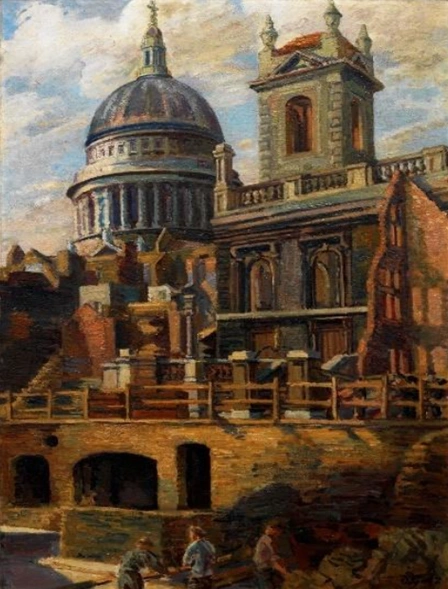
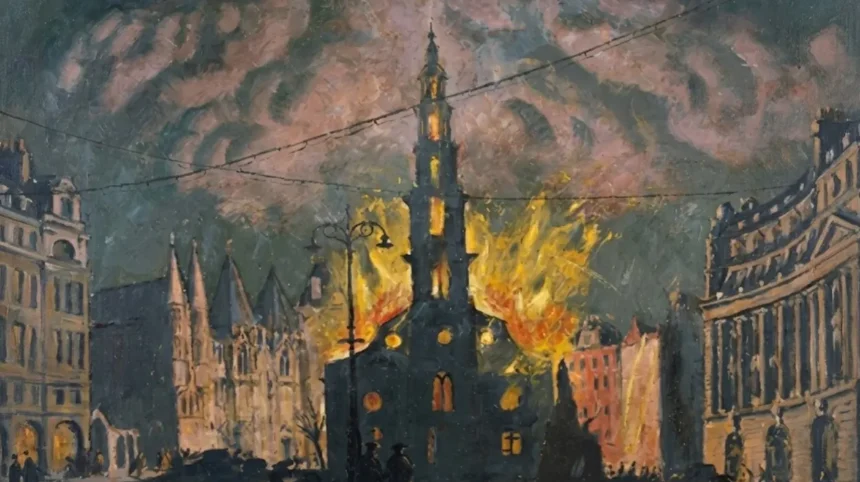
There is something quietly extraordinary about standing in Lambeth and looking back at Lambeth. That, in essence, is what Beauty and Destruction: Wartime London in Art invites you to do. Running from March to November 2026 at the Imperial War Museum, this free exhibition brings together over 45 works of art, photographs and personal testimonies to paint a portrait of London during the Second World War; not as a distant historical event, but as something that happened on these very streets. The exhibition, curated in part by IWM Apprentice Curator Esme Smith, takes as its starting point something deceptively simple: What did it actually feel like to live in this city during the Blitz?
Walk in and you are immediately greeted by a map of London that sets the scene, outlining the scale of the destruction, but also threading through it the voices of those who were there; from school children to canal workers, as it is, above all, the people’s story. The exhibition is organised around four themes, Travel, Thames, Street and Shelter, and within them, ordinary Londoners go about their lives. Children shelter in the underground. The Women’s Volunteer Service runs clothing exchanges. The river police patrol the Thames. The cumulative effect is of a city in motion, refusing to stop. For South London readers especially, the local connections run deep. Rubble from a house destroyed in nearby Walworth sits within the exhibition space. The experience of a schoolchild living in Vauxhall during the Blitz is given voice. The IWM itself was struck by over 40 incendiary bombs during the war, and in 1945 a V2 weapon fell just over a hundred metres from its front doors. This is not a museum displaying someone else’s history, it is a building that carries its own scars.
Smith describes the aim as wanting
“to introduce new visitors to London’s story, and transport Londoners to a city that feels both familiar and alien.”
For anyone who has walked through Lambeth, crossed Vauxhall Bridge, or taken the tube from Elephant and Castle, that sense of double vision, recognising a place while seeing it remade by destruction, is a genuinely powerful experience. Among the standout works is Eliot Hodgkin’s The Haberdashers’ Hall. The hall was destroyed in an air raid in December 1940, but by the time Hodgkin came to paint it in early 1945, rosebay willow herb- known colloquially as ‘bomb-weed’ had pushed up through the rubble and come into flower. It is an image of extraordinary quiet resilience: nature reclaiming the broken city, beauty insisting on itself amid ruin. Singling this out as a work that captures how
“moments of beauty and hope could be seen among the devastation,”
and it is difficult to disagree. It is the kind of painting that stays with you long after you leave the room. What sets Beauty and Destruction apart from many historical exhibitions is how hard it works to be genuinely accessible particularly for younger visitors. A dedicated family learning trail, available from the start of the exhibition, encourages children to look closely at the artwork, ask questions, and engage with the paintings rather than simply file past them. For older children and secondary school students, the educational possibilities go further still. Pointing out that spotting familiar places in the paintings helps young people
“connect emotionally with the city’s history, while encouraging them to think in more detail about life in wartime London.”
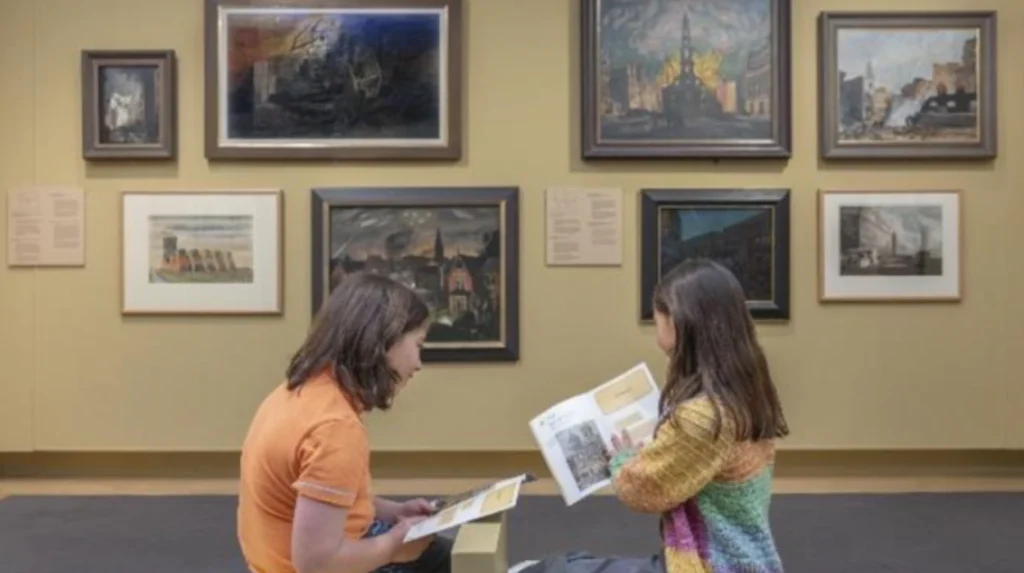
In an era when the Second World War is slipping beyond living memory, that emotional bridge matters enormously.
It would be easy to frame Beauty and Destruction as purely a history lesson. But it is clear that the exhibition is intended to speak to the present as much as the past. With cities around the world facing conflict and crisis today, the exhibition
“offers glimpses of hope alongside the depictions of destruction, exploring the role that artists play in helping us understand both historic and more recent events.”
Art, this exhibition argues, is not a passive record. It is the way communities make sense of what has happened to them and find the language to carry it forward.
Beauty and Destruction: Wartime London in Art is free and open to the public at the Imperial War Museum, Lambeth Road, SE1, until November 2026.