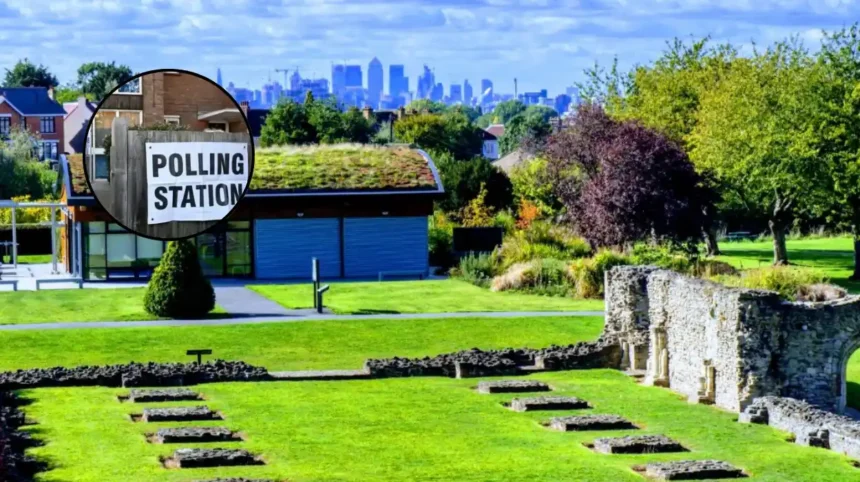
Key Points
- Bexley will hold local elections on 7 May 2026, with councillors elected across all 17 wards in the borough.
- The council said polling hours will run from 7 am to 10 pm, and voters can contact Electoral Services about registration or absent votes.
- All five major political parties have set out plans for the borough ahead of the vote.
- The Conservatives have controlled Bexley since 2006, but they face a close challenge from Reform UK, according to recent polling.
- YouGov polling cited in the coverage puts the Conservatives on 30 and Reform UK on 29, suggesting a very tight contest.
- PollCheck projected no overall majority, with Reform UK on 22 seats, Conservatives on 16 and Labour on 7, though those are projections rather than results.
- Labour says it wants to “renew” Bexley with more housing, road repairs, cleaner neighbourhoods, stronger communities and extra police.
- The Liberal Democrats say they want lower and more transparent council tax and business rates, more affordable homes, better accountability and net-zero planning.
- Reform UK says it wants to cut waste, carry out a financial audit and focus on value for residents.
- The Greens’ published local manifesto in the search results was not clearly available in full, so only limited verified details could be confirmed from the sources retrieved.
Bexley (South London News) May 6, 2026, with all 45 council seats across the borough due to be contested. The London Borough of Bexley said elections will be held in all 17 wards, with polling open from 7 am until 10pm on the day.
As reported by the BBC’s London team in an article published on 9 April 2026, Bexley has become a key Reform UK target, while the Conservatives are trying to hold on to power after two decades of dominance in the borough. ITV News also reported on 4 May 2026 that Reform UK is estimated to take the most votes in Havering and is making Bexley a very close fight with the Conservatives.
Recent polling has added to the sense of uncertainty. The BBC cited YouGov figures putting the Conservatives at 30 and Reform UK at 29, leaving little between the two parties in a borough that has long been considered a Conservative stronghold. PollCheck’s projection, published on 3 May 2026, went further by suggesting Reform UK could win 22 seats, the Conservatives 16 and Labour 7, with no party securing an overall majority.
What are the Conservatives saying?
The Conservatives are arguing that they have a financial plan to protect services and support residents, according to coverage from South East Londoner published on 27 April 2026. In that report, the party said it had “the only fully costed plan” to invest in services, oppose green belt development and back
The same general theme appears in broader reporting on the borough contest, where the Conservatives are presenting themselves as the party of continuity and stability after years in control.
The available search results did not provide a full standalone Conservative manifesto document for Bexley, so this account is limited to the wording captured in published coverage.
What does Reform UK want?
Reform UK is positioning itself as the main challenger in Bexley. In the BBC report, Reform candidate Miles Jones said the party’s approach in local government would focus on economising wherever possible, eliminating wasteful spending and giving residents value for money.
Jones also said Reform would need to carry out a thorough audit of the council’s finances before making firm commitments.
This matters because the party is presenting itself not just as an opposition force but as a possible future administration if it can turn polling strength into seats.
What is Labour promising?
Labour’s manifesto page for the 7 May 2026 election says the party wants to
“stop the managed decline of public services”
In Bexley and change the direction of the borough.
It says the election is an opportunity to build better housing, including good quality homes to buy, more family homes, genuinely affordable housing and council housing.
Labour’s published bullet points say a Labour council would build decent homes for all, fix potholes and improve roads and pavements, fight for extra police, make Bexley safe again, create cleaner and greener neighbourhoods, and strengthen communities.
In the language of the party’s own manifesto, Labour is framing the election around service quality, housing supply and neighbourhood standards.
What are the Liberal Democrats proposing?
The Bexley Liberal Democrats’ manifesto page says the party wants to keep council tax and business rates low and transparent, while consulting and informing residents on any changes.
It also says the party wants to ensure that any surplus is reinvested transparently and responsibly in frontline services.
On housing, the Liberal Democrats say they want to build genuinely affordable homes through a fast-track planning process that includes meaningful community consultation, at least 35% affordable housing and accessible homes for disabled residents.
They also say they want to pay care workers the Living Wage and put the borough on a path to net zero with a carbon budget and annual emissions targets.
What do the Greens say?
The search results did not return a clearly accessible Bexley-specific Green manifesto page with enough detail to quote safely in full.
A general Green Party manifesto source in the search results set out national themes such as climate action, public ownership in some sectors, stronger local government funding and fairer voting systems, but it was not a Bexley local-election document.
Because of that, only limited verified detail can be reported here without adding material that was not directly available in the retrieved sources. On the evidence collected, the Greens are among the parties standing in the contest, but the retrieved material does not provide a full borough-specific platform comparable to the Labour, Liberal Democrat or Reform UK material above.
Why is this contest so close?
Bexley has been controlled by the Conservatives since 2006, which makes the borough a significant test of whether that long run can continue.
The BBC said Reform UK has become Bexley’s top target in London, while ITV News said the borough is one of several outer-London councils where the result remains finely balanced.
The latest figures in the retrieved material point to a fragmented race rather than a straightforward two-party contest.
That means local issues such as council tax, housing, roads, neighbourhood services and the condition of public services are likely to carry real weight with voters.
How could the result shape Bexley?
If the Conservatives retain control, the campaign language in the retrieved sources suggests they would likely continue to stress spending discipline, service investment and opposition to green belt development.
If Reform UK makes the gains suggested by the polling and projections, it would be the first time the party has turned that level of attention into a major borough breakthrough in Bexley.
Labour would use a stronger result to argue that voters want change on housing, roads, policing and local services.
The Liberal Democrats would likely push their message on affordability, transparency and planning reform, while the Greens would aim to build support around environmental and social-policy concerns, although the retrieved sources did not provide a complete Bexley-specific manifesto for them.
Background of the development
Bexley’s local election fight sits inside a wider pattern of outer-London political change, where the Conservatives are under pressure from Reform UK as well as from Labour and smaller parties. The borough has been a Conservative-run council for most of the modern era since 2006, but the latest polling suggests that stability is being tested more seriously than in previous cycles.
The election is also taking place against the normal framework of local government competition, with 45 seats and all wards contested on the same day. In that context, manifesto promises are being used not just as campaign literature but as direct signals to voters about what each party would prioritise if it gained control.
Prediction
For Bexley voters, this development could mean a more competitive council and a stronger focus on day-to-day local issues such as council tax, housing, roads, and neighbourhood services. If the polls and projections are broadly accurate, the election may produce no overall majority, which could lead to more negotiation, sharper scrutiny of spending and a less predictable council majority.