Key Points
- Croydon Council’s planning committee approved Trinity School’s expansion plans on Thursday, 30 April 2026.
- The project, costing £40 million and funded by the John Whitgift Foundation, includes a new three-storey sixth form block and a linked three-storey building with a fitness suite and classrooms.
- Pupil numbers will increase from 1,050 to 1,398 (a 40% rise) by 2031, with staff rising from 220 to 293.
- Trinity School in Shirley will admit girls to Year 6 and Year 7 from September 2027, achieving full co-education by 2031; girls have been in the sixth form since 2011.
- Plans involve demolishing staff accommodation, replacing the estates building, reconfiguring parking (with less parking and more trees), and enhancing drop-off areas.
- The chair of the planning committee, Councillor Michael Neal, described the scheme as “really, really good for the borough and for the children of the borough”.
- Residents raised privacy concerns over overlooking gardens and traffic issues; Conservative Councillor Jason Cummings called in the application.
- Labour Councillor Sean Fitzsimons criticised the travel plan as “flawed”.
- Headmaster Alasdair Kennedy welcomed the approval, noting it supports the school’s next chapter.
- Whitgift Foundation CEO Roisha Hughes expressed delight at the decision.
- The expansion responds partly to the 2025 closure of Old Palace girls’ school.
Shirley, Croydon (South London News) May 6, 2026 – Trinity School’s plans to expand with two new three-storey buildings received approval from Croydon Council’s planning committee last week, paving the way for the independent school to become fully co-educational by 2031 amid resident concerns over privacy and traffic.
- Key Points
- Why Was Trinity School’s Expansion Approved by Croydon Council?
- What New Buildings Are Part of the Trinity School Expansion?
- How Does This Support Trinity School’s Move to Co-Education?
- What Concerns Were Raised by Residents and Councillors?
- When and Why Is the Expansion Happening?
- Background of the Development
- Prediction: Impact on Local Families and Pupils
Why Was Trinity School’s Expansion Approved by Croydon Council?
The approval came at the planning committee meeting on Thursday, 30 April 2026, the final public session before local elections.
As reported by Inside Croydon, the committee granted permission for the £40 million development at Trinity School on Shirley Road/Addiscombe Road, subject to a legal agreement.
Councillor Michael Neal, chair of the planning committee, stated the scheme would be
“really, really good for the borough and for the children of the borough”.
He praised the layout, car parking reconfiguration, and the addition of 93 new trees.
The John Whitgift Foundation (JWF), owners of the school, brought forward the application to support co-educational ambitions, increasing capacity from 1,050 to 1,398 pupils by 2031. Girls will join Year 6 and Year 7 from September 2027.
What New Buildings Are Part of the Trinity School Expansion?
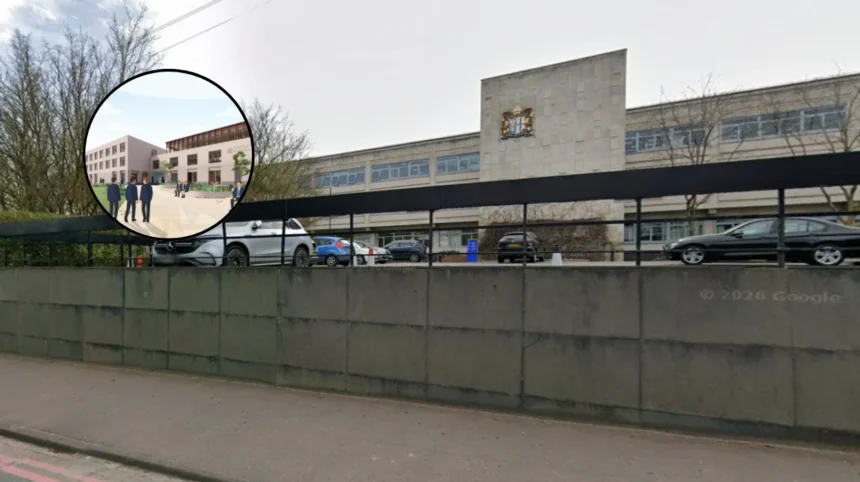
The approved plans feature a three-storey sixth form block with 10 new classrooms, a café, and study spaces, linked to a three-storey building housing a fitness suite, sports reception, changing facilities, and additional classrooms. These match the 1960s mid-century style of the main campus.
Demolition includes existing staff accommodation and the estates building, with alterations to the entrance layout, enhanced drop-off and pick-up areas, and reconfigured staff and visitor parking.
The project emphasises more trees and less parking overall.
As detailed in the school’s submission on Croydon Council’s planning portal (reference: 26/00331/FUL), the works are phased to minimise disruption. Floor plans highlight modern facilities for pupils and community partners.
How Does This Support Trinity School’s Move to Co-Education?
Trinity School, part of the Whitgift Foundation, announced co-educational plans in 2025, following girls’ admission to the sixth form since 2011. The expansion accommodates growth to around 1,400 pupils at £30,000 annual fees.
Headmaster Alasdair Kennedy said:
“We are very pleased to receive the green light on the works to support the gradual expansion of the school over the next five years. Being part of the local Shirley community is important to us, and we will continue to work with our neighbours as we plan works over the next two years.”
He added:
“While it has only been one year since we announced our plans to become fully co-educational, the sense of momentum within the school is growing. These new facilities will play an important role in supporting that next chapter and will benefit both current and future students across the whole school community.”
Roisha Hughes, chief executive of the John Whitgift Foundation, said she was “delighted” at the planning permission.
“Expanding Trinity and enhancing the environment in which our students learn, grow and socialise, will enable us to meet the needs of our current students and those joining us in the years ahead, and the impact will be felt for generations to come.”
The school’s website states:
“The plans support our long-term vision to welcome girls throughout the school, with girls joining Years 6 and 7 from 2027 and Trinity becoming fully co-educational by 2031.”
What Concerns Were Raised by Residents and Councillors?
Nearby residents objected over privacy, with new buildings potentially overlooking Addiscombe Road gardens, and increased traffic. Conservative Councillor Jason Cummings, representing Shirley South, called in the application.
Cummings remarked:
“I think it’s fair to say that the applicants’ statement that the residents’ concerns have been fully met… I wouldn’t be here and nor would the residents if they all felt that way.”
Labour Councillor Sean Fitzsimons raised issues with the travel plan, approved by Transport for London (TfL), calling it “flawed” due to public transport pressures and lack of safe cycling routes for 1,400 pupils.
The application faced party-line debates, with Conservatives and Labour councillors voicing support or reservations.
When and Why Is the Expansion Happening?
This marks the first major rebuild since Trinity moved to the 27-acre Shirley Park site 60 years ago, displacing from Croydon town centre for a shopping centre. Works are due to start later in 2026.
The move follows the 2025 closure of Old Palace girls’ school, run by the same foundation, to rebalance provision. The £40 million is fully funded by JWF, with no parental contributions.
Inside Croydon reported the foundation’s earlier £70 million loan and property sales to support such projects.
Background of the Development
Trinity School of John Whitgift, established in 1882 as Whitgift Middle School, became independent and adopted its current name in 1954. Located in Shirley Park, Croydon, it operates on a 27-acre site as a day school with a co-educational sixth form since 2011.
The John Whitgift Foundation, Croydon’s largest landowner, oversees Trinity alongside other schools. The co-ed transition addresses the Old Palace closure amid falling rolls and financial pressures. Planning submission occurred in February 2026, with public consultation.
The site previously hosted the school before its 1960s relocation.
Prediction: Impact on Local Families and Pupils
This development will increase school places for boys and girls in Croydon, particularly benefiting families seeking independent co-educational options from 2027, with full capacity by 2031. Local pupils gain access to enhanced facilities like the sixth form centre and fitness suite without fee hikes tied to construction.
Shirley residents may experience short-term disruption from construction but long-term changes in traffic from reconfigured parking and drop-off areas, alongside 93 new trees improving green space. Families reliant on public transport or cycling could face challenges if travel plans remain unaddressed, affecting daily commutes for expanded staff and pupils.