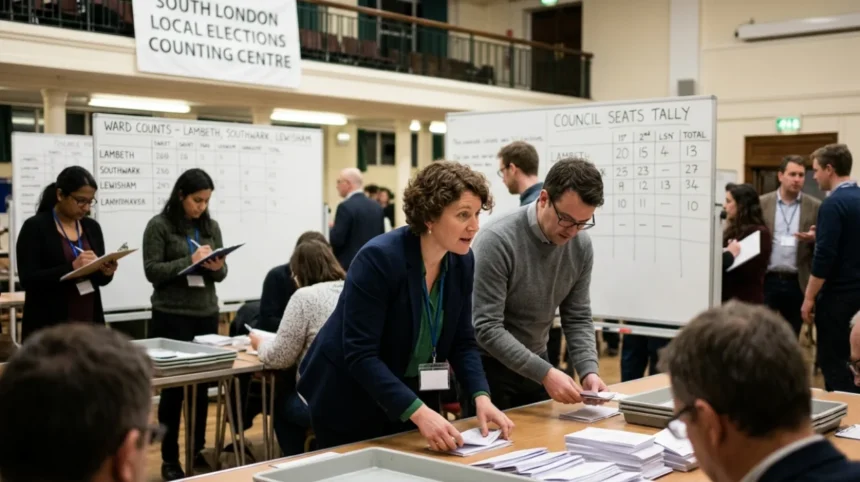
Elections in South London’s borough councils determine which political parties and individual councillors govern local services such as housing, schools, rubbish collection, planning, and adult‑care from town halls in Lambeth, Southwark, Lewisham, Croydon, Merton, Sutton, and Wandsworth. These local elections are held every year in a four‑year cycle, with different wards (small geographic areas) going to the polls to elect a total of more than 400 councillors across South London.
- What are South London local election results?
- How often do South London boroughs hold local elections?
- How are local councillors elected in South London wards?
- What happened in the 2026 South London local election results?
- How did specific South London boroughs perform in 2026?
- How do party control and no‑overall‑control work on South London councils?
- What are the main political parties in South London local elections?
- How do local election results affect South London residents?
- What role do independents and smaller parties play?
- How are local election results counted and declared?
- What data and statistics are available on South London local elections?
- How do boundary changes affect South London election results?
- What are the implications of recent South London local election results?
- How do local elections in South London compare to national elections?
- What should South London residents know about future local elections?
What are South London local election results?
South London local election results show which candidates and parties win councillor seats in each of the boroughs that sit south of the River Thames. They include both the party‑level outcome (which party or coalition controls the council) and the ward‑level outcome (exactly which individual candidates are elected in each small neighbourhood).
These elections use the first‑past‑the‑post system in multi‑member wards, meaning each ward elects two or three councillors, and voters mark a cross for one or more candidates depending on local rules. The party that wins a majority of seats forms the administration, appoints the council leader, and decides the council’s budget, planning rules, and social‑care priorities.
How often do South London boroughs hold local elections?
Most South London borough councils hold full or partial local elections every year, with the full council usually up for election every four years. For example, Lewisham holds elections by thirds, so roughly one‑third of its 54 seats are contested each year, while some boroughs such as Merton and Southwark hold elections for all seats in their four‑year cycle depending on boundary changes.
In 2026, local elections in South London took place on Thursday 7 May in all 32 London boroughs, including Lambeth, Southwark, Lewisham, Croydon, Merton, Sutton, and Wandsworth. Voter turnout in London‑wide contests, such as the mayoral and assembly elections, has averaged around 35–45 per cent in recent years, with similar underlying patterns in South London boroughs.
How are local councillors elected in South London wards?
In South London boroughs, each ward is a small geographic area for which voters elect at least one councillor; many wards elect two or three councillors per election. For example, Lewisham has 54 councillors across 17 wards, with most wards returning three councillors and a few returning two.
Under the first‑past‑the‑post system, parties or independents put up one candidate per seat in each ward, and voters choose their preferred candidate or candidates. The candidates with the highest vote totals in each ward win the seats, with the number of seats per ward defined by the Boundary Commission and recorded in the council’s electoral structure.
What happened in the 2026 South London local election results?
In the 7 May 2026 elections, South London saw more mixed control than before, with Labour losing outright control in some traditional strongholds while retaining control in others. The Green Party made gains in several boroughs, while the Liberal Democrats consolidated in Sutton and Richmond, and the Conservatives and Reform UK made advances in specific outer‑London boroughs adjacent to core South London areas.
In Lambeth, Labour lost overall control as the Greens surged, contributing to a shift to “no overall control” where no single party holds a majority. In Wandsworth, Labour similarly lost control after years in power, with the Conservatives becoming the largest party and the council moving into no‑overall‑control territory.
How did specific South London boroughs perform in 2026?
Several South London boroughs illustrate the broader 2026 trends. Lambeth ended up under no overall control after Labour lost its majority, while the Greens gained enough seats to deny Labour a working majority. In Lewisham, Labour generally held on to its majority, but the Greens and other opposition parties increased their representation relative to previous elections.
In Southwark, Labour retained control, confirming it as one of Labour’s core boroughs in South London, but with smaller majorities than in some previous cycles. In Croydon, the council moved further into no‑overall‑control territory, with Labour remaining the largest party but short of a majority, while the Conservatives, Liberal Democrats, and independents hold a spread of seats.
How do party control and no‑overall‑control work on South London councils?
In South London boroughs, “party control” means one party holds more than half of all council seats, allowing it to form the administration and appoint the council leader. If no party reaches a majority, the council is under “no overall control,” and groups must form coalitions or confidence‑and‑supply agreements, such as Green–Labour or Conservative–independent alliances, to pass budgets and key policies.
No‑overall‑control arrangements often lead to more negotiated decision‑making, because major planning decisions, housing schemes, and social‑care budgets require cross‑party support. Examples include recent years in Wandsworth and Croydon, where no single party holds a majority and policy outcomes depend on temporary alliances rather than automatic party‑line majorities.
What are the main political parties in South London local elections?
The main political parties standing in South London local elections are Labour, the Conservatives, the Liberal Democrats, the Green Party, and smaller parties such as Reform UK and independents. Labour and the Conservatives are the traditional national parties, while the Liberal Democrats and Greens often focus on local issues such as transport, housing density, and environmental policy.
In 2026, national‑level trends saw Labour defending many South London seats, the Conservatives making gains in some outer boroughs, the Liberal Democrats holding strong in Sutton and Richmond, and the Greens advancing in Lambeth and parts of Lewisham. Reform UK also gained seats in London‑wide districts adjacent to South London, such as Bexley and Havering, which can influence the broader political climate in the lower Ouse and Thames.
How do local election results affect South London residents?
Local election results in South London directly shape council budgets, planning decisions, housing allocations, licensing, environmental services, and social‑care provision. For example, a Labour‑controlled council may prioritise council‑home building and social‑rent schemes, while a Green‑dominated or coalition‑led council may emphasise cycling infrastructure, low‑traffic neighbourhoods, and nature‑based solutions to flooding.
Housing allocations, council‑tax setting, bin‑collection rounds, library openings, and street‑tree maintenance are all set by the council controlling party or ruling coalition. In South London boroughs such as Lambeth, Lewisham, and Southwark, local election results therefore influence how crowded or relaxed housing waiting lists are, how quickly planning applications in high‑density areas like Elephant & Castle or Deptford are processed, and how much investment goes into community centres and youth services.
What role do independents and smaller parties play?
Independent councillors and smaller parties such as Reform UK, local residents’ associations, and community‑based groups can hold deciding votes in South London councils under no‑overall‑control arrangements. For example, in some outer boroughs such as Wandsworth and Bexley, a few independent or Reform UK seats can determine whether a Conservative or Labour‑led administration can form.
In 2026, independents continued to hold seats in several London boroughs, including snapshots in Wandsworth, Sutton, and Merton, where they can negotiate on specific local issues like parking, schools, or fly‑tipping enforcement. Smaller parties and independents often focus on hyper‑local concerns, such as school‑place shortages in specific wards or traffic‑calming schemes in particular estates, which larger parties may not prioritise in city‑wide manifestos.
How are local election results counted and declared?
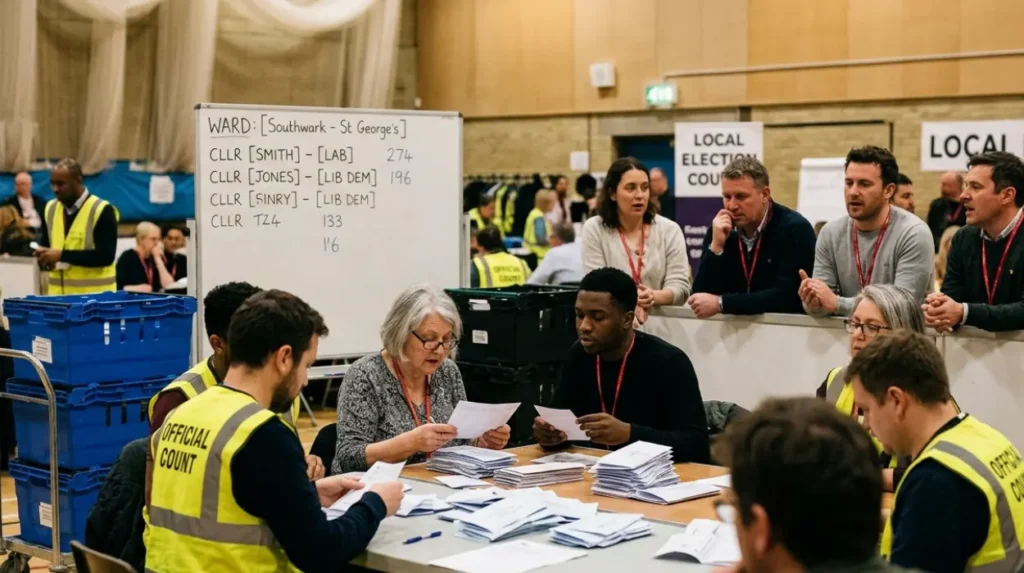
South London borough councils count votes over one or two nights following the 7 May election, using dedicated counting centres in venues such as leisure centres and sports halls. Election staff sort ballot papers into piles by candidate, count them manually or semi‑automatically, and then report results ward by ward to the council’s declaring officer, who announces which candidates are duly elected.
Results are usually declared for each ward in rapid succession, with the overall council outcome determined once all 50–70 seats across a borough are finalised. South London boroughs such as Lambeth, Southwark, Lewisham, and Croydon publish their detailed results on official council websites, often with downloadable PDFs or CSV‑style tables listing each ward, candidate, party, and vote count.
What data and statistics are available on South London local elections?
Detailed statistics on South London local elections include the number of seats won by each party, overall turnout percentages, and the proportion of postal and in‑person votes. For example, the Electoral Commission’s 2022 report on English local elections showed that turnout in London‑wide contests was around 33–34 per cent, with slightly lower turnout in borough‑level elections than in general elections.
More recent London‑wide mayoral contests in 2024 recorded turnout just above 40 per cent in many South London constituencies, indicating that about two‑fifths of registered voters actively participate when local and mayoral elections coincide. Academic and watchdog groups also analyse trends such as the rising share of Green and independent votes in inner‑London boroughs and the concentration of Labour support in outer‑South‑London estates.
How do boundary changes affect South London election results?
Boundary changes, recommended by the Local Government Boundary Commission for England, can alter the number of wards and seats in South London boroughs and shift the political balance. For example, recent boundary reviews have created new wards in fast‑growing areas such as around Croydon town centre or Lewisham’s riverside, changing the mix of housing types and electorates and therefore which parties are likely to win.
When wards are redrawn, the number of councillors per ward can change, and some wards are merged or split, affecting local party strategies. Boundary changes also influence how national party swings play out in South London; a small shift in vote share can translate into a different number of seats depending on whether the new wards are more Labour‑leaning inner‑city streets or more Conservative‑leaning suburban edges.
What are the implications of recent South London local election results?
Recent South London local election results show a trend toward more fragmented party control, with Labour still dominant in many boroughs but Greens and smaller parties gaining leverage. This fragmentation increases the role of coalitions, independents, and issue‑based alliances, especially in boroughs such as Lambeth, Croydon, and Wandsworth, where no party can rule alone.
For residents, this means policy outcomes are more likely to result from negotiation than from single‑party mandates, which can slow down some decisions but also increase the influence of local community groups. In practical terms, South London residents may see more pilot schemes, such as temporary low‑traffic neighbourhoods or expanded bike‑infrastructure, that require compromise between Labour‑leaning, Green‑leaning, and Conservative‑leaning councillors.
How do local elections in South London compare to national elections?
South London local elections differ from national general elections in that they are held annually or in staggered cycles for borough councils, rather than every five years for the House of Commons. Local elections also focus on council‑level issues such as bin collections, housing, schools, and local planning, whereas general elections primarily hinge on national issues such as taxation, defence, and healthcare.
However, national‑level political trends still influence South London local outcomes, with Labour’s performance nationally often reflected in gains or losses in boroughs such as Lewisham and Southwark, and Conservative or Green surges affecting outer‑South‑London boroughs. Turnout in local elections is also typically lower than in general elections, which means that shifts in just a few percentage points of voters can produce large swings in South London council compositions.
What should South London residents know about future local elections?
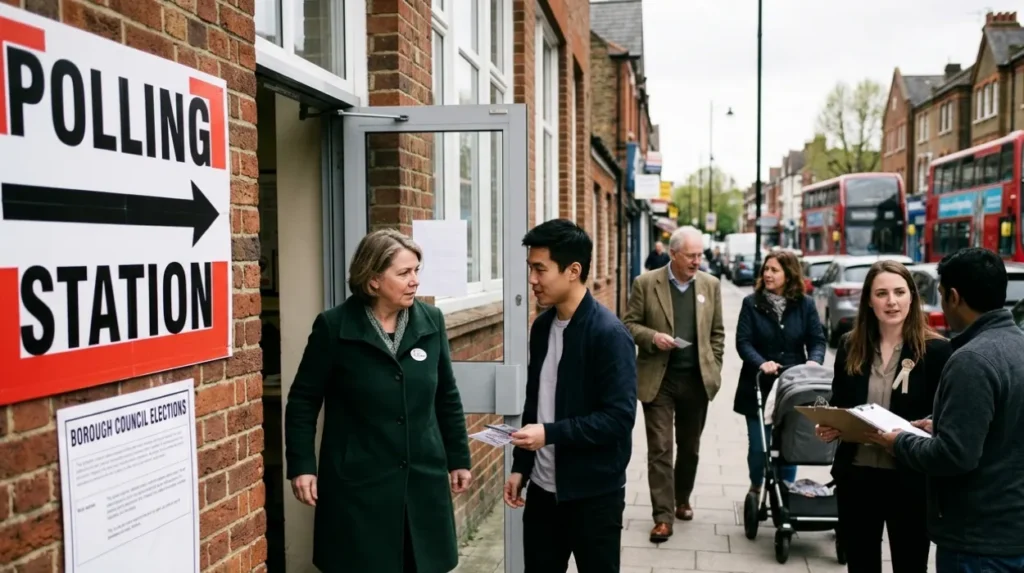
Future local elections in South London will continue to follow the same core structure, with each borough holding regular elections for councillor seats and, in some cases, directly elected mayors. Residents should monitor their council’s electoral cycle, register to vote, and pay attention to ward‑level manifestos, because local decisions on housing, transport, and community services have a direct, day‑to‑day impact.
Over the next few election cycles, South London residents can expect more fragmented results, rising influence for Greens and independents, and continued debate over housing density, transport infrastructure, and climate‑change policies. Understanding how election results translate into council control, budget choices, and local planning decisions helps South London voters use their votes more effectively in the years ahead.
What are South London local election results?
South London local election results show which political parties and candidates win seats on borough councils across areas like Lambeth, Southwark, Lewisham, and Croydon. These results determine who controls local services such as housing, planning permission, schools, bin collections, and social care.