Key Points
- Silver Jubilee Milestone: Thames Christian School in Wandsworth has officially celebrated its 25th anniversary, marking a quarter-century since opening its doors in September 2000.
- Large Gathering: The milestone event attracted nearly 200 attendees, drawing together a diverse crowd of current and former pupils, parents, academic staff, and school trustees.
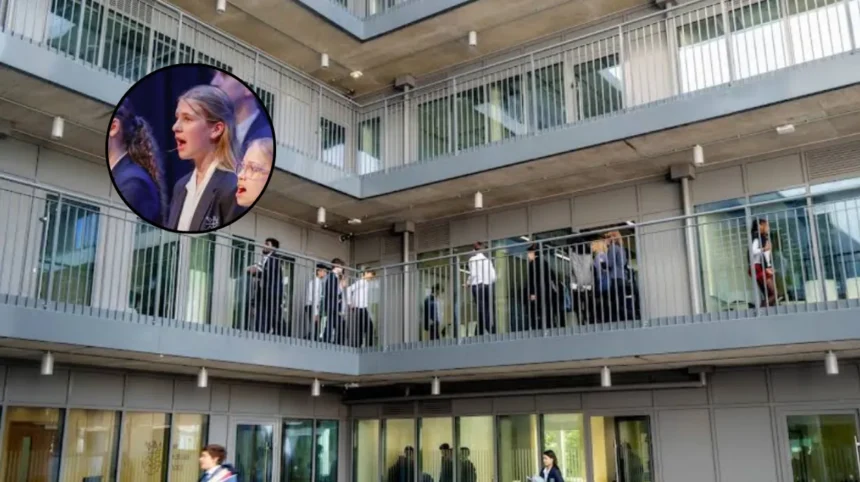
- Award-Winning Venue: The service and subsequent reception were hosted within the institution’s newly constructed, RIBA award-winning campus located adjacent to Clapham Junction railway station.
- Event Activities: The commemorative ceremony featured traditional hymns, localized prayers, retrospective interviews with the founders, musical performances by past and present pupils, a heritage photo exhibition, and custom crest-branded cupcakes.
- Strategic Growth Initiatives: To coincide with the silver jubilee, the school executive leadership announced the launch of a newly restructured parents association and a formal alumnus network to permanently bridge past and present cohorts.
Wandsworth (South London News) May 23, 2026 – A prominent independent secondary school in south-west London has officially marked its 25th anniversary with a high-profile commemorative service and an upscale community reception. Thames Christian School, situated in the London Borough of Wandsworth, brought together approximately 200 distinguished guests to celebrate its silver jubilee. The congregation included a wide array of current and former students, supportive parents, past and present teachers, and members of the school’s board of trustees, all gathering to honor twenty-five years of independent education.
- Key Points
- What occurred during the 25th anniversary service and reception?
- Who are the founders and what did they say about the school’s evolution?
- What new institutional associations were launched at the silver jubilee?
- Background of Thames Christian School
- Predictions for the Wandsworth Community and Independent Sector
- The Neurodiverse and SEND Student Population
The dual-part celebration was hosted inside the school’s state-of-the-art, Royal Institute of British Architects (RIBA) award-winning campus infrastructure, located immediately adjacent to the bustling Clapham Junction mainline railway station. The event was designed to blend traditional religious thanksgiving with historical reflection, incorporating an array of hymns, focused prayers, and live on-stage interviews detailing the operational evolution of the establishment.
To augment the experiential nature of the anniversary, attendees were treated to bespoke musical and theatrical performances delivered by successive generations of pupils, alongside an archival exhibition showcasing vintage photographs, local press clippings, and academic records tracking the facility’s growth from a minor local college into a premier co-educational facility.
What occurred during the 25th anniversary service and reception?
As reported by journalist Robyn Bennett of the Wandsworth Times, the silver jubilee event served as a major communal anchor, deliberately designed to look backward at historical achievements while cementing modern expansions.
The proceedings commenced with a structured thanksgiving service that directly highlighted the school’s non-denominational Christian foundation. Current pupils shared the stage with returning alumni to execute a series of classical and contemporary musical numbers, while clergy and staff led the 200-strong audience in communal hymns and prayers focused on future structural prosperity.
Following the formal service, the crowd transitioned into a catered reception featuring custom-baked commemorative cupcakes meticulously decorated with the school’s official heraldic crest. A central feature of the reception layout was a physical pop-up museum.
This exhibition displayed a curation of administrative records, architectural blueprints of their moving phases, and student photographs dating back to the turn of the millennium.
The curated items allowed returning families and long-serving educators to trace the material progression of the institution’s physical and cultural identity.
Who are the founders and what did they say about the school’s evolution?
The institution was originally co-founded twenty-six years ago via a formal public declaration outlining an ambitious educational model. According to editorial records compiled within The Good Schools Guide, the school was originally established in the year 2000 as “Thames Christian College” by the husband-and-wife educational team of Dr Stephen Holsgrove and Catherine Holsgrove.
The pioneering duo initially commenced educational delivery within a modest, retrofitted local library building, welcoming an initial intake of just 12 registered pupils. Over the intervening decades, Dr Holsgrove has maintained direct continuity of leadership, serving continuously as the institution’s Headmaster.
Reflecting on the grand journey during his keynote address at the event, Headteacher Dr Stephen Holsgrove stated that:
“We are thrilled to be celebrating our silver jubilee and this anniversary is very special to us. It was wonderful to welcome back and reunite so many former members of our school community and, for some, their first visit back to the school.”
Dr Holsgrove further detailed the philosophical resilience of the academy amidst shifting societal dynamics, adding that:
“While the world has changed considerably since we opened, and our student numbers have since grown many times over, our mission and approach have remained constant. We provide a warm and inclusive learning environment with a Christian ethos to children aged 11 to 18, to help them grow up as confident and caring young adults able to navigate for life.”
What new institutional associations were launched at the silver jubilee?
Beyond historical reflection, the administrative leadership utilized the platform of the 25th anniversary to deploy forward-looking organizational networks intended to strengthen community governance. As detailed by Robyn Bennett of the Wandsworth Times, the executive board has formalized two separate community initiatives during the anniversary year to support the expanding pupil baseline.
The first initiative involves the complete restructuring and launch of a brand-new parents association. This entity is designed to operate under fresh, non-staff leadership and will be directly buttressed by dedicated parent representatives selected from every active year group.
The second development is the official ratification of a highly formalized alumnus association. This network has been architected to provide an enduring digital and physical infrastructure for former pupils, ensuring they remain permanently linked to corporate school developments, career mentoring pipelines, and peer networks long after completing their secondary or sixth-form examinations.
Explore More Wandsworth News
Ernest Bevin Academy Welcomes 98-Year-Old Former Pupil Ahead Centenary Celebrations Visit Event
Labour Loses Control to Conservatives in Wandsworth Election 2026
Background of Thames Christian School
To properly comprehend the importance of this silver jubilee, it is essential to examine the historical path and structural expansion of Thames Christian School over the past quarter-century.
Founded in September 2000 in Battersea, South-West London, the school emerged as a independent alternative within the competitive London day school market, specifically prioritizing a co-educational, non-denominational Christian framework.
Its initial manifest focused heavily on providing an “artisanal education” tailored to individual student needs, deliberately integrating mainstream neurotypical learners alongside neurodiverse pupils via an extensively resourced Special Educational Needs and Disabilities (SEND) team recognized by the Council for the Registration of Schools Teaching Dyslexic Pupils (CReSTeD).
For the bulk of its operational history, the school operated with constrained student volumes within localized facilities. However, its modern era was catalyzed by a major relocation to a brand-new, purpose-built multi-storey campus at 12 Grant Road near Clapham Junction.
This architectural complex subsequently secured a prestigious Royal Institute of British Architects (RIBA) award for its optimization of urban educational space. The expanded footprint allowed the school to systematically scale its student capacity toward a ceiling of 300 to 400 pupils, moving away from its historic average of roughly 169 to 200 active registrations.
Crucially, this physical expansion paved the way for the realization of a long-term goal: the introduction of a formal Sixth Form department, which officially launched in September 2023. This addition transformed the school from a standard 11–16 secondary school into a comprehensive 11–18 through-school.
According to official data published by the Independent Schools Year Book (ISYB) and corporate records from the Independent Schools Council (ISC), this silver jubilee coincides with the release of the school’s first-ever set of terminal A-Level results. The initial graduating cohorts achieved an academic return, with 39% of all A-Level entries securing upper-tier $A^*/A$ grades and 85% landing within the competitive $A^*/C$ parameters.
These marks enabled 36% of the school’s initial leavers to secure immediate placement within elite Russell Group universities. Concurrently, the school maintains a strong performance profile at the GCSE tier, with long-term data points reflecting a 70% achievement rate within the 9–7 grade boundaries, outstripping the baseline independent school national average of 48.4%.
Predictions for the Wandsworth Community and Independent Sector
The continuous expansion and structural stabilization of Thames Christian School following its 25th anniversary is poised to influence several key segments of the local and regional educational audience.
For families residing within Wandsworth, Battersea, and the wider South London transport corridors, the maturation of Thames Christian School provides a robust, long-term alternative to traditional, highly selective independent institutions.
The permanent embedding of the Sixth Form provision means parents no longer face the disruptive prospect of transitioning their children to secondary colleges at age 16. Furthermore, because the institution specifically balances traditional academic curriculum alongside modern technological literacy—evidenced by the school recently securing “Silver AI Status” from the Good Future Foundation—local students will increasingly enter the higher education market equipped with distinct competencies in critical thinking alongside artificial intelligence navigation.
The Neurodiverse and SEND Student Population
As the school expands its financial footprint via its newly formed parent and alumni networks, its specialized, low-ratio classroom model (historically tracking at an efficient 6:1 pupil-to-teacher ratio) will become increasingly robust. This development offers a reliable pathway for families seeking mainstream educational integration for children with specific learning difficulties. The school’s unique ethos—which heavily blends creative arts, 3D design, and music production with core sciences—will continue to serve as a vital pastoral outlet, ensuring that non-traditional learners in South London can access top-tier tertiary placement without enduring exclusionary academic pressures.