Key Points
- An unborn baby has died following a high-speed vehicle collision during a Metropolitan Police pursuit in New Cross, South London.
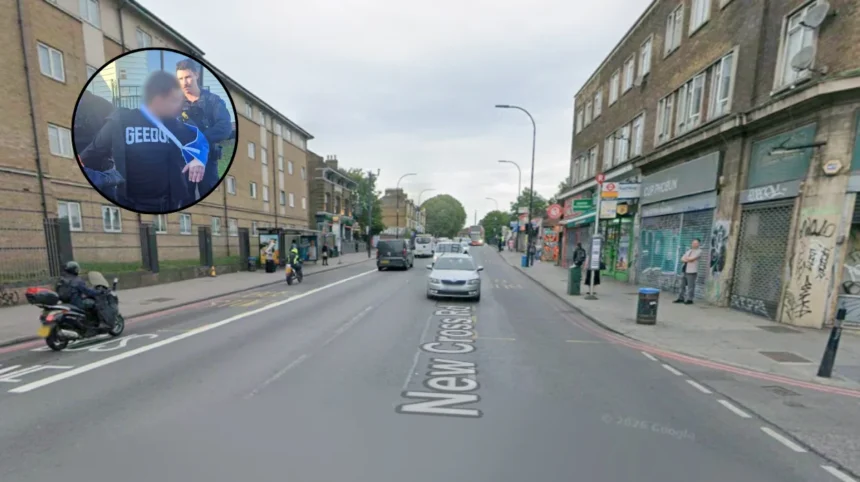
- The incident occurred on Lewisham Way at approximately 11:30 pm on Saturday, June 13, involving a suspected cloned vehicle and an innocent third-party car.
- The occupant of the second vehicle, a heavily pregnant woman in her 20s, was rushed to hospital, where medical staff were unable to save her unborn child; she remains in a stable condition.
- The woman’s partner, also in his 20s, sustained minor injuries that have been assessed as neither life-threatening nor life-changing.
- A 29-year-old male, identified as the driver of the fleeing vehicle, was arrested on multiple serious charges, including causing death by dangerous driving and possession of class A drugs.
- The Independent Office for Police Conduct (IOPC) has launched an independent investigation into the circumstances surrounding the pursuit.
New Cross (South London News) June 19, 2026 A heavily pregnant woman has tragically lost her unborn child after a car being pursued by Metropolitan Police officers ploughed into the vehicle she was travelling in on Lewisham Way, New Cross, on Saturday, June 13. The devastating late-night collision occurred at approximately 11:30 pm after a suspect vehicle, which had failed to stop for emergency personnel due to displaying suspected cloned registration plates, struck an oncoming vehicle occupied by a young couple in their 20s. Following the impact, a 29-year-old male driver was arrested at the scene on a spectrum of criminal charges, including causing death by dangerous driving.
Emergency medical workers from the London Ambulance Service rushed the critically injured pregnant passenger to a nearby hospital facility. Despite extensive emergency interventions by medical teams, the unborn infant could not be saved.
The mother remains hospitalised in a stable condition, while her partner, who was operating the vehicle at the time of the crash, was treated for injuries that have since been classified by medical personnel as neither life-threatening nor life-changing.
The Metropolitan Police Service has confirmed that the pursuit was formally authorised after the suspect driver refused to comply with initial orders to pull over.
In compliance with statutory legal frameworks governing serious road traffic incidents involving emergency vehicles, the Metropolitan Police has issued a mandatory referral to the Independent Office for Police Conduct (IOPC).
The independent watchdog has subsequently initiated a formal probe to scrutinise whether the tactical pursuit adhered strictly to safety protocols and regulatory standards.
What Happened on Lewisham Way?
The incident unfolded in the late evening hours of Saturday when operational police officers noticed a vehicle carrying registration plates flagged as potentially cloned. As reported by Shaun Wilson of the Evening Standard, the authorities attempted to execute a routine traffic stop on the suspect vehicle.
However, the driver immediately failed to pull over, prompting officers to initiate an authorised vehicular pursuit along Lewisham Way.
Seconds into the pursuit, the fleeing car lost control and collided violently with an oncoming vehicle. According to video footage obtained and verified by journalists at Metro, the aftermath of the scene showed severe structural damage to both vehicles immediately following the high-energy impact.
The innocent vehicle was being driven by a man in his 20s, while his heavily pregnant partner sat in the front passenger seat.
Witnesses at the scene reported a significant deployment of emergency services, with local roads cordoned off for several hours as specialist collision investigators documented the wreckage and debris scattered across the road surface.
What Statements Have Been Issued by the Authorities?
As reported by Shaun Wilson of the Evening Standard, Detective Inspector Suzanne Quinton, representing the Metropolitan Police Service’s Serious Collision Investigation Unit, issued an official statement addressing the profound gravity of the incident:
“Our thoughts are with the mother and father involved, and their family following the tragic loss of their child. Our investigation continues. We would ask anyone with information or footage that could help to please come forward.”
The Metropolitan Police continues to appeal to members of the public, local businesses, and motorists who may have been in the vicinity of New Cross or Lewisham Way at 11:30 pm on Saturday. Investigators are particularly keen to secure dashcam footage, doorbell camera recordings, or closed-circuit television (CCTV) records that could definitively map out the trajectories of both vehicles prior to the impact.
What Are the Specific Charges Against the Driver?
The driver of the fleeing vehicle, identified as a 29-year-old male, sustained minor injuries during the collision and was treated under police guard at a local medical facility. His injuries were explicitly deemed neither life-threatening nor life-changing by doctors.
Following his discharge from medical care, he was formally processed into police custody. As detailed by police logs published via the Evening Standard, the suspect has been arrested on suspicion of five distinct offenses:
- Causing death by dangerous driving
- Causing serious injury by dangerous driving
- Theft of a motor vehicle
- Failure to stop for police officers
- Possession of class A drugs
The individual remains detained at a South London police station as detectives compile the evidentiary file for the Crown Prosecution Service (CPS).
Background of Police Pursuit Regulations in the United Kingdom
The regulatory framework governing police vehicle pursuits within the United Kingdom is strictly managed under the Authorised Professional Practice (APP) guidelines, which are issued by the College of Policing. These guidelines dictate that an officer must balance the immediate need to apprehend a suspect against the potential risk posed to public safety.
When an individual fails to stop for an emergency vehicle, officers must obtain explicit radio authorization from a control room supervisor before initiating a tactical pursuit.
Historically, pursuits involving suspected cloned plates have drawn significant scrutiny due to the high-density nature of urban environments like South London.
Cloned plates—where a vehicle illegally displays the registration mark of an identical legitimate vehicle—are frequently utilised by criminal networks to obscure vehicle theft, drug trafficking, or violent offenses.
The Independent Office for Police Conduct (IOPC) is legally mandated to investigate any incident where a police pursuit results in a fatality or severe injury to a member of the public.
The watchdog’s role is to analyze telemetry data, radio recordings, and dashcam videos to determine if the pursuing officers maintained a proportionate risk assessment or if the pursuit should have been abandoned due to escalating danger to pedestrians and third-party motorists.
Prediction: How This Development Can Affect Urban Road Users and Emergency Policing
This tragic event is highly likely to trigger a renewed national debate regarding the safety thresholds of inner-city police pursuits, directly affecting motorists, pedestrians, and emergency service personnel across Greater London.
For the general public and urban road users, this development will likely result in increased demands for stricter legislative limits on high-speed chases in residential or high-density commercial zones.
Public pressure may force the Home Office to revise pursuit criteria, potentially banning pursuits for non-violent property offenses—such as suspected cloned plates or vehicle theft—when conducted in narrow, built-up corridors like Lewisham Way.
For emergency service personnel and the Metropolitan Police, the upcoming IOPC findings will likely induce a more risk-averse operational posture.
Officers may face heightened bureaucratic restrictions and stricter real-time monitoring from command centers, leading to an increase in the early termination of pursuits. While this could lower the statistical frequency of third-party collisions, police federations have previously cautioned that overly restrictive pursuit rules can embolden criminal elements, who may increasingly utilize failed-to-stop tactics knowing that emergency services are constrained from giving chase.