Key Points
- Five-Year Closure Ends: The historic Model Market at Lewisham Shopping Centre, which has been shuttered since September 2021 following the collapse of its former operator, is officially set to reopen in late summer 2026.
- New Operator Appointed: Landsec, the commercial property developer and owner of Lewisham Shopping Centre, has officially named the independent German Kraft Brewery as the master operator to spearhead the venue’s revival.
- All-Day Community Hub: The site is being transformed into a multi-use social hub that will transition from morning coffee and co-working spaces into an evening destination featuring street food, craft beer, live music, and creative retail.
- Diverse Representation Mandate: Under an agreement between Lewisham Council and Landsec, the revived market has committed to a social inclusion mandate requiring at least 50% of the independent businesses on-site to be led by underrepresented entrepreneurs, including women, Black and global majority founders, and individuals from low-income backgrounds.
- Wider Regeneration Impact: The project serves as an early milestone in Landsec’s broader multi-million-pound master plan to regenerate Lewisham Shopping Centre and the surrounding town centre into a modern hub containing new homes, public green spaces, and commercial infrastructure.
Lewisham (South London News) June 22, 2026 – The long-abandoned Model Market at Lewisham Shopping Centre is set to undergo a comprehensive revival and reopen to the public in late summer 2026, ending a five-year period of vacancy since its sudden closure in 2021. Commercial property giant and site owner Landsec has formally appointed independent beverage and hospitality firm German Kraft Brewery to assume operational control and manage the day-to-day programming of the venue. The site is currently being physically redeveloped into an all-day social destination that combines casual dining, creative workspace, micro-retail, and cultural entertainment. This commercial development serves as an early tactical phase within Landsec’s larger, long-term master plan to transform the shopping centre and the surrounding urban footprint of the Lewisham town centre into a modern mixed-use district.
- Key Points
- Why Is the Model Market Returning to Lewisham After a Five-Year Shut Down?
- Who Is German Kraft Brewery and What Is Their Operational Plan?
- How Are Corporate Owners and Local Management Reacting to the Partnership?
- What Inclusion Mandates Have Been Enforced by Lewisham Council?
- Background of the Model Market and Lewisham Regeneration
- Predictions: How This Development Can Affect Local Residents and Small Businesses
- Employment Generation and Night-Time Economy for Residents
- Commercial Competition and Urban Displacement Risks
Why Is the Model Market Returning to Lewisham After a Five-Year Shut Down?
The sudden cessation of activities at the Model Market in September 2021 left a prominent physical and economic void in the heart of the Lewisham town centre.
The location had established itself as a highly popular night-time street food market since 2014, drawing substantial weekend footfall to south-east London. However, operations ceased abruptly when its previous management company, Street Feast, went into liquidation amidst wider hospitality sector pressures.
For five years, the site remained locked and unutilised. The decision by property owner Landsec to resurrect the space is driven by a broader commercial strategy to introduce food-led, community-focused destinations across its nationwide real estate portfolio to increase visitor dwell time and stimulate local economies. Construction and refurbishment teams have already begun clearing the space and executing structural repairs ahead of the projected opening later this season.
Who Is German Kraft Brewery and What Is Their Operational Plan?
Originally established in 2017 at the Mercato Metropolitano food market in Elephant and Castle, German Kraft Brewery has built a commercial reputation across London for merging craft brewing practices with large-scale, high-energy communal hospitality concepts.
As reported by an uncredited staff writer for The Brewers Journal, German Kraft will transition its operations as its long-standing Elephant and Castle hub is scheduled to close at the end of the summer to make way for separate urban development projects.
In an official public announcement compiled by The Brewers Journal, Felix Bollen, the co-founder of German Kraft and parent hospitality group MOSAIK, expressed the company’s intention to replicate its previous community models:
“We’re excited to bring Model Market back to life as a next-generation social destination for Lewisham, a place that feels open, dynamic and deeply connected to the local community. We’ll be continuing the community social hub we ran in Elephant & Castle over the last nine years.”
In its capacity as master operator, German Kraft will establish an on-site taproom serving its distinct craft beers. Furthermore, the brewery will hold sole responsibility for curating the independent street food vendors, managing vendor rotations, and organizing daily entertainment programming.
According to official corporate literature released by Landsec, the physical architecture of the venue is being updated to act as a seamless all-day venue, starting with morning coffee options and co-working amenities, before transitioning into micro-dining, creative retail outlets, and night-time cultural events such as live DJ sets and pop-up art exhibitions.
How Are Corporate Owners and Local Management Reacting to the Partnership?
The alignment between property developers and independent operators has been framed by executives as a critical milestone for the commercial stability of the borough.
In an industry briefing published by Larder Magazine, Mark Warne, the Director of Hospitality and Leisure at Landsec, outlined the developer’s rationale for restoring the venue:
“Model Market has long been an important part of Lewisham’s social fabric, and its highly anticipated return will provide even more reasons to visit the town centre. Across our portfolio, we’re seeing growing demand for food-led destinations that bring together independent operators, culture and community… Together with German Kraft, we’re bringing this community-focused approach to Lewisham, creating opportunities for local businesses to grow and reach new audiences.”
Local site administrators have expressed similar commercial optimism regarding the selection of the operator. As documented by The London Post, Paul Redden, the Centre Director at Lewisham Shopping Centre, issued a statement praising the operator’s commercial history:
“We’re incredibly excited to be partnering with German Kraft to bring the new Model Market to Lewisham. German Kraft’s proven track record operating vibrant, successful venues means they know how to create an environment that’s welcoming, energetic, and full of character. We can’t wait to see it all come to life when the Model Market officially opens.”
What Inclusion Mandates Have Been Enforced by Lewisham Council?
Unlike standard commercial lettings, the resurrection of the Model Market incorporates specific social equity and local representation legalities.
According to a legislative reporting brief compiled by Lewisham Councillor James-J Walsh, Lewisham Council intervened during planning consultations to establish structural protections for local, independent start-ups.
As detailed in the public record by Councillor Walsh, Lewisham Council successfully negotiated a legally binding covenant with Landsec.
This agreement explicitly dictates that a minimum of 50% of the trading spaces within the newly designed Model Market must be allocated to businesses owned and operated by individuals from historically underrepresented backgrounds.
This targeted criteria includes female entrepreneurs, Black and global majority founders, and business owners originating from low-income socioeconomic backgrounds. The market has formally opened its digital application portal at www.modelmarket.london, inviting local chefs, craft makers, and community organisers to apply for long-term tenancies.
Background of the Model Market and Lewisham Regeneration
The Model Market possesses a distinct architectural and social lineage within south-east London dating back to the mid-20th century. Originally constructed in the 1950s, the space was initially conceived as a progressive, modern indoor-outdoor trading market.
During its post-war decades, it evolved into a vital economic engine for the local immigrant population, notoriously serving as an early commercial sanctuary for Black-owned businesses and traders who faced severe barriers to entry within traditional British commercial high streets at the time.
By the late 1990s and early 2000s, structural shifts in retail trends and consumer habits led to a severe downturn in footfall, causing the market to fall into physical disrepair and eventual abandonment.
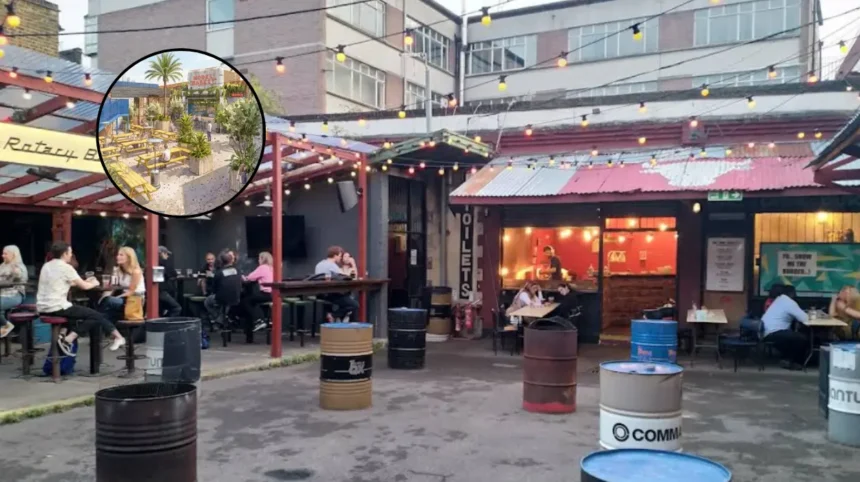
In 2014, the night-time hospitality group Street Feast acquired and modified the space, preserving its weathered, retro 1950s shopfronts and mid-century layout while introducing an entry-fee weekend street food and cocktail market model.
This iteration flourished as a premier nightlife anchor for the borough until the parent company collapsed during the economic disruptions of 2021.
The 2026 revival is structurally bound to a massive, multi-phase urban regeneration strategy for the Lewisham town centre. Lewisham Council and Landsec approved a comprehensive master plan that will eventually see the wholesale demolition and reconstruction of the main Lewisham Shopping Centre asset.
The overarching project is designed to replace aging 1970s retail infrastructure with a modernised shopping district, pedestrianized high streets, public green spaces, a revitalized flagship Lewisham Library, and thousands of new housing units.
The early revival of the Model Market is positioned as a strategic “anchor activation” to maintain footfall, support local employment, and prevent urban blight while the long-term, multi-year construction works advance across the rest of the town centre.
Predictions: How This Development Can Affect Local Residents and Small Businesses
The reopening of the Model Market is anticipated to introduce distinct economic, social, and logistical shifts that will directly alter the daily lives and operations of Lewisham residents and independent business owners.
For independent food and beverage traders, artisans, and start-up entrepreneurs within south-east London, this development acts as an immediate catalyst for growth.
The strict implementation of Lewisham Council’s 50% underrepresented vendor quota lowers the capital and structural barriers that typically block minoritized business owners from accessing premium retail locations. Local traders will gain immediate access to a high-footfall platform managed by an established developer, allowing them to test products, scale production, and build brand equity without committing to cost-prohibitive, long-term commercial leases elsewhere in London.
Employment Generation and Night-Time Economy for Residents
From a consumer and residential standpoint, local citizens will regain a centralized, multi-generational social infrastructure. The all-day design mitigates the loss of the community hub previously experienced in Elephant and Castle by providing remote workers, students, and local creatives with dedicated daytime co-working spaces.
Furthermore, the expansion of evening operations will generate immediate employment opportunities across hospitality, site security, facilities management, and event production for local jobseekers.
Commercial Competition and Urban Displacement Risks
Conversely, the influx of a highly coordinated corporate-backed hospitality venue could present negative externalities for pre-existing traditional high-street businesses. Smaller, independent brick-and-mortar cafes and restaurants situated along Lewisham High Street may face severe consumer diversion and heightened price competition as German Kraft concentrates footfall inside the shopping centre perimeter.
Additionally, while the market provides a temporary economic boost, its long-term integration into a broader luxury housing and retail development could accelerate local gentrification, driving up commercial commercial rents and indirectly displacing the vulnerable low-income demographics the council’s social mandates are intended to shield.