Key Points
- Official Enforcement Policy: Bexley Council has formally sanctioned the flying of St George’s flags on public buildings, lampposts, and roundabouts throughout the borough for the duration of the World Cup season.
- Safety Under Review: Independent public installations erected by residents will remain untouched by local authorities, provided they do not present an immediate health and safety risk or obstruct public highways.
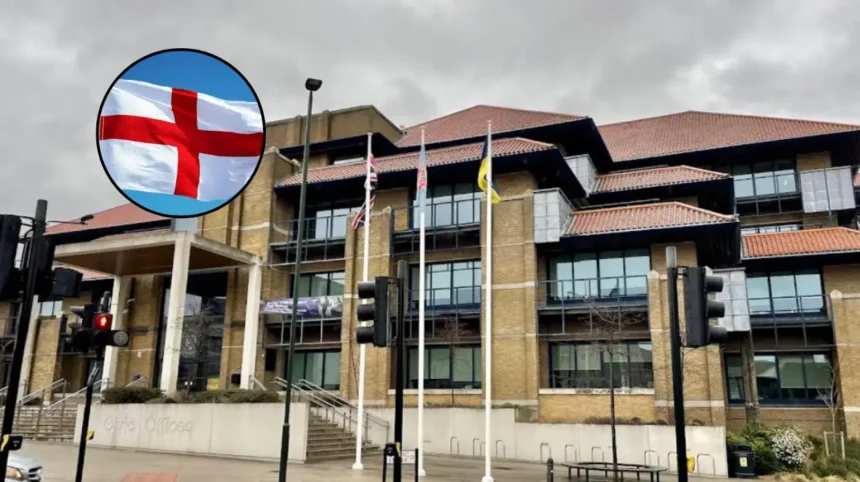
- Civic Flag Schedule: The official flag at the Civic Office was hoisted on Wednesday, June 17, 2026. It will be temporarily replaced to observe Armed Forces Day and the Civic Parade, before being raised again on June 28, 2026.
- Political Endorsement: Bexley Council Leader David Leaf publicly endorsed the initiative, stating that football serves as a vital mechanism to bring local communities together.
- Historical Precedent: The local policy aligns with and responds to the legacy of ‘Operation Raise the Colours’, a grassroots national online movement that began last autumn to promote the widespread display of national flags.
Bexley (South London News) June 22, 2026 — Residents across the London Borough of Bexley have been granted official permission to fly the St George’s flag on public infrastructure, including lampposts and buildings, throughout the current World Cup tournament. Local authority leaders confirmed on Wednesday that any national flags erected by the public will be permitted to remain in place, shifting away from restrictive structural regulations, provided the displays do not compromise public safety. The announcement coincided with the council raising the national flag at its own Civic Office to mark the launch of England’s opening World Cup fixture, signaling an official campaign of civic solidarity with the national football team.
- Key Points
- Why Has Bexley Council Approved the Borough-Wide Display of St George’s Flags?
- What Statements Have Local Government Leaders Made Regarding the Initiative?
- Under What Circumstances Will the Local Authority Intervene to Remove Flags?
- What Is the Historical Background of the ‘Operation Raise the Colours’ Movement?
- How Will This Flag Policy Predictably Affect Local Residents and Businesses?
- Community Cohesion and Public Spaces
- Local Government and Public Safety Costs
Why Has Bexley Council Approved the Borough-Wide Display of St George’s Flags?
The decision to allow widespread visual displays stems from a direct policy directive by local authorities to promote civic pride and community cohesion during major international sporting events. Rather than enforcing strict planning regulations regarding unauthorized attachments to street furniture, the council has opted for a permissive approach.
Under this directive, flags installed on roundabouts, municipal buildings, and streetlights will be insulated from removal by highway maintenance teams, provided they are securely anchored and do not block lines of sight for motorists or pose physical dangers to pedestrians.
The official display at the central Civic Office commenced on Wednesday, June 17, 2026, establishing a structured timeline for municipal properties. Local government administrators have outlined that this display will be dynamic rather than static.
The St George’s flag will fly continuously until it is briefly lowered to accommodate the alternative flags required for Armed Forces Day. Following the conclusion of the scheduled Civic Parade on June 28, 2026, the national football display will be promptly reinstated to cover the remainder of England’s competitive run in the tournament.
What Statements Have Local Government Leaders Made Regarding the Initiative?
As reported by political correspondents tracking local government policy in Greater London, elected officials have heavily emphasized the social utility of tournament celebrations.
Bexley Council Leader David Leaf issued an official statement outlining the administration’s philosophical and logistical backing of the public display. Councillor Leaf stated:
“We’re getting behind the England team by flying the St George’s Flag on our borough’s flag poles. Football should bring people together, and I hope we’ll be celebrating England scoring goals and winning matches in sports clubs, pubs and homes across Bexley this summer.”
The statement positions the council’s regulatory leniency as a deliberate attempt to foster localized economic and social recovery through shared sporting experiences. By explicitly naming sports clubs, public houses, and domestic residences, the leadership indicated an awareness of the community-wide footprint of the tournament, aligning municipal enforcement directly with public sentiment.
Under What Circumstances Will the Local Authority Intervene to Remove Flags?
Despite the broad permissions granted by the local state, the policy contains specific legal and physical thresholds regarding intervention. Structural engineers and highway inspectors operating on behalf of Bexley Council retain the statutory right to dismantle any public display deemed a liability.
The primary metric for removal remains strictly bound to health and safety protocols. According to administrative briefings from the council, flags that obscure regulatory street signage, interfere with low-clearance traffic zones, block municipal closed-circuit television (CCTV) cameras, or show signs of structural degradation that could cause them to fall into active traffic lanes will be removed immediately. Outside of these explicit risk categories, the council has mandated that street cleaning and maintenance crews leave community-installed decorations intact.
What Is the Historical Background of the ‘Operation Raise the Colours’ Movement?
The current regulatory stance adopted by Bexley Council is deeply rooted in a broader national phenomenon that emerged during the previous calendar year. At the start of last autumn, a grassroots, digitally driven campaign known as “Operation Raise the Colours” gained significant traction across various online platforms throughout England.
The movement encouraged citizens to bypass formal bureaucratic channels and independently decorate public spaces—such as roundabouts, arterial roads, civic buildings, and residential lampposts—with national iconography.
Originally initiated as a decentralized social media campaign, Operation Raise the Colours sought to normalize the everyday visibility of the St George’s cross outside of conventional sporting calendars. While the movement faced fragmented responses across different English municipalities—with some local authorities strictly removing the flags due to structural breach of highways acts—it established a visible precedent for public space utilization.
Bexley Council’s contemporary policy represents a formalized accommodation of this specific public trend, translating what began as an unauthorized populist movement into an organized, state-sanctioned civic display for the duration of the summer tournament.
Explore More Bexley Council News
Bexley Council Fails Dementia Patient: Compensation Ordered (Bexley, 2026)
Conservatives Hold Bexley Council as Reform Gains Seats Bexley 2026
How Will This Flag Policy Predictably Affect Local Residents and Businesses?
The implementation of this permissive flag policy is expected to have measurable social and commercial ramifications for the population of the London Borough of Bexley, particularly regarding local commerce, public order, and neighborhood dynamics.
For local business operators, particularly publicans and sports club managers, the visible sanctioning of national displays creates a highly favorable trading environment.
The explicit endorsement from council leadership provides public houses with the regulatory confidence to expand their venue branding externally.
This public visibility is predicted to drive footfall and consumer spending within the borough’s evening economy, as match-day environments extend from private living rooms into highly visible, decorated commercial hubs.
Community Cohesion and Public Spaces
From a social perspective, the policy is designed to catalyze community cohesion by utilizing football as a common denominator. However, the presence of unregulated flag installations may also introduce localized friction.
While the visual uniform display is intended to generate a festive atmosphere, historical precedents suggest that dense concentrations of national symbols in highly diverse suburban boroughs can occasionally generate varying interpretations regarding inclusivity.
Local Government and Public Safety Costs
Furthermore, the policy shifts an operational monitoring burden onto municipal safety inspectors. Because the council has committed to leaving flags up unless they pose a hazard, highway teams will need to conduct more frequent structural assessments of street furniture to ensure that independently mounted flags do not degrade during adverse summer weather conditions, ensuring that public safety is maintained without incurring heavy enforcement costs.