Key Points
- Event Activation: Lambeth hosted its community-led ‘Cakes & Cargo Bikes’ experiential event in Brockwell Park to promote sustainable, family-oriented micro-mobility options.
- Explosive Market Growth: While standard, non-assisted adult bicycle sales across the United Kingdom remain stagnant, e-cargo bike sales have surged dramatically by 36% year-on-year according to national data from the Bicycle Association.
- Borough Strategy Realisation: The initiative operates as a key psychological and logistical tool under Lambeth Council’s overarching multi-year ‘Big Shift’ programme and Kerbside Strategy aimed at drastically decreasing local vehicle emissions.
- Practical Utility: Local parents report that front-loading box and longtail electric bicycles serve as highly competitive, stress-free alternatives to traditional motor vehicles for school runs, domestic shopping trips, and general recreation.
- Economic Incentives: The rise in uptake is heavily accelerated by escalating operational car costs alongside council-backed subsidies, such as local hour-long free rental tokens via the regional ‘OurBike’ network app.
Lambeth (South London News) July 18, 2026, became the epicentre of a sweeping municipal shift in urban transportation as local families gathered for the ‘Cakes & Cargo Bikes’ demonstration event, an initiative designed to showcase the practical realities of replacing family cars with heavy-duty electric bicycles. Amidst an environment of rising fuel expenses, expanding low-emission infrastructure, and an institutional drive toward municipal net-zero targets, the free event provided hundreds of curious residents with a hands-on environment to test elite micro-mobility hardware, engage directly with seasoned multi-child cycling advocates, and navigate specialized cargo lane models.
- Key Points
- Is the E-Cargo Bike Officially Replacing the Second Family Car in South London?
- What Do Local Advocates and Council Leaders Say About the Big Shift in Transport?
- How Are Local Subsidies and Try-Before-You-Bike Schemes Overcoming Cost Barriers?
- Background of the Particular Development
- Prediction: How This Development Can Affect Lambeth Families and Local Residents
The experiential project falls under a broader, multi-layered transport framework initiated by Lambeth Council, intended to directly mitigate localized urban congestion, combat toxic air quality parameters, and systematically normalize ultra-low-carbon vehicular transit for domestic and light-commercial purposes across South London.
Is the E-Cargo Bike Officially Replacing the Second Family Car in South London?
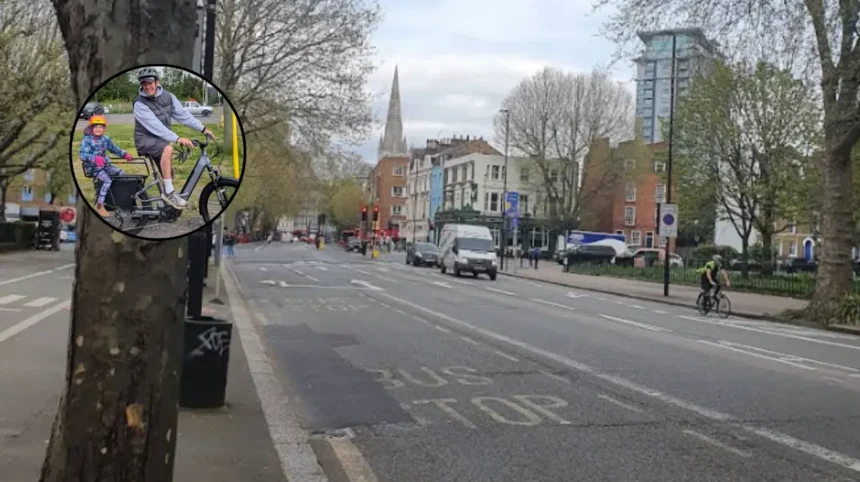
As reported by local authorities overseeing the event logistics within Brockwell Park, the rapid visibility of front-loading box configurations and elongated longtail chassis frames carrying multiple children represents a structural evolution in everyday regional commuting.
According to comprehensive market intelligence compiled by the Bicycle Association, standard pedal cycle retail metrics across the broader United Kingdom have flatlined in recent quarters, whereas domestic commercial and residential acquisitions of electric cargo-carrying models have experienced a substantial year-on-year volumetric inflation of 36 per cent.
Organisers at the Brockwell Park event explicitly noted that this explosive micro-mobility trajectory is actively reshaping the morning school run, supermarket supply gathering, and weekend leisure transits within Lambeth’s increasingly restricted thoroughfares.
Through a series of informational updates published via the regional municipal network, organisers highlighted that the free community assembly, operating between the hours of 10:00 am and 12:00 pm, targeted families seeking an authentic, transparent look at the practicalities of cargo-bike ownership.
Attendees were given unfettered trial access to varied mechanical frames, alongside objective peer guidance regarding strict child passenger safety protocols, heavy-load stability management, weatherproofing accessories, and secure overnight public parking options.
What Do Local Advocates and Council Leaders Say About the Big Shift in Transport?
The cultural and logistical transition is heavily underscored by multi-year infrastructure pipelines curated by local government. In an analytical assessment compiled by transport reporters at Love Lambeth, the borough’s ‘Big Shift’ initiative has systematically introduced thousands of residents to active travel mechanisms over a sustained multi-year rollout.
Writing for the official municipal news platform, researchers noted that the regional framework has successfully delivered over 150 localized Car Free Days alongside the facilitation of greater than 6,000 distinct hours of e-cargo tracking for private individuals and commercial entities alike.
The systemic integration of these vehicles is heavily dependent on peer reassurance and community-level visibility. Commenting on her foundational entry into active transit, local parent Claire detailed how a previous iteration of the council’s outreach events permanently altered her domestic logistics pipeline:
“I attended a Cakes & Cargo Bike event in early 2024 to explore my options. Despite the rain, lots of parents came along with different bikes, so I was able to try several models. Talking to other families gave me invaluable buying advice and practical riding tips. Shortly afterwards I bought my own e-cargo bike and haven’t looked back. It has transformed the school and nursery run, helped us explore more of our local area, and made everyday life so much easier. I wouldn’t be without it.”
From an institutional standpoint, the geopolitical push behind these events remains highly coordinated. In a public statement preserved by the Lambeth Climate Partnership, Deputy Leader Councillor Rezina Chowdhury, the Cabinet Member for Sustainable Lambeth and Clean Air, affirmed that the deployment of accessible utility cycling alternatives directly services a larger legislative mandate:
“Since OurBike launched in Lambeth, we have seen more residents and businesses use the bikes to transport goods and move around the borough without needing a motor vehicle. We are clear in our commitment to reduce overall vehicle journeys in Lambeth, and we are supporting our residents and businesses to make the transition to more active forms of travel a bit easier and that work for everyone.”
How Are Local Subsidies and Try-Before-You-Bike Schemes Overcoming Cost Barriers?
Financial accessibility remains one of the primary obstacles to widespread commercial uptake, given that high-capacity electric cargo units frequently command substantial upfront retail premiums.
To counteract this economic friction, Lambeth Council has partnered extensively with specialized public-sector social enterprises like Peddle My Wheels to manage the systemic ‘Try Before You Bike’ scheme.
Under this active framework, residents are permitted to thoroughly field-test premium hybrid, adaptive, or e-cargo configurations for an inclusive monthly operational fee starting at £30, with all prior rental expenditures directly deducted from the total acquisition cost should the user choose to finalize a permanent purchase through interest-free financing.
Complementing this infrastructure is the expanding ‘OurBike’ community cargo sharing application, which maintains active, strategically distributed hubs across ten distinct high-footfall locations in the borough, including Brixton Hill, Herne Hill, Stockwell Park, and Vauxhall.
Local administrative logs show that to incentivize the transition away from fossil-fuel-reliant vans and private passenger cars, new residential registrants are automatically credited with 60 minutes of entirely cost-free operation, whereas local commercial enterprises receive a 180-minute free operating buffer before a subsidized base rate of 75p per 15 minutes applies.
Furthermore, to secure operational confidence among beginners, the council finances customized, route-specific safety training handled by cycling specialists, allowing users to safely master the spatial mechanics of extended frames alongside their standard daily trajectories.
Background of the Particular Development
The expansion of the e-cargo bike footprint in Lambeth is the deliberate consequence of the long-term, award-winning ‘Big Shift’ Programme and the pioneering Lambeth Kerbside Strategy.
Launched contextually to address the reality that transportation remains one of the largest single contributors to carbon emissions within South London, the initiatives represent a fundamental philosophical pivot in urban planning:
reallocating valuable street real estate away from stationary private motor vehicles and dedicating it back to high-efficiency public spaces and sustainable travel modes.
Historically, urban bicycle uptake was severely bottlenecked by two distinct systemic deficits: the prohibitive upfront capital costs of specialized cargo machinery and a pervasive public anxiety regarding road safety and geometric balancing.
By structurally integrating localized community events like ‘Cakes & Cargo Bikes’ with heavily subsidized hardware networks like OurBike and financial safety nets via Peddle My Wheels, the local government has created an ecosystem where the logistical barriers to entry are systematically removed.
This dual-track approach—combining intensive infrastructure engineering (such as protected cycle lanes and low-traffic healthy neighbourhoods) with soft-power community engagement—earned Lambeth the prestigious Mode Shift Best Community Engagement Project award.
It sets a highly replicable, empirical blueprint for metropolitan councils across Greater London seeking to actively enforce air quality compliance while simultaneously mitigating the ongoing cost-of-living crisis for young urban families.
Explore More Lambeth News
Lambeth Council orders urgent financial review Lambeth 2026
Greens Hold Clapham Park, Lose Streatham St Leonard’s in Lambeth 2026
Prediction: How This Development Can Affect Lambeth Families and Local Residents
The continued expansion of e-cargo bike infrastructure and the positive reinforcement generated by community initiatives like the Brockwell Park showcase are poised to fundamentally reshape daily life for Lambeth families over the coming decade.
As U.K. automotive operating costs continue to escalate alongside stricter localized low-emission zoning mandates, families utilizing these adaptive vehicles will likely experience immediate relief in household expenditure, effectively bypassing traditional outlays for fuel, vehicular insurance, parking permits, and maintenance.
Logistically, the systemic normalization of front-loading and longtail electric designs will radically decouple family schedules from urban traffic gridlock. Parents will increasingly achieve predictable, standardized transit times for multi-stop school and nursery runs by leveraging dedicated cycling corridors, dramatically lowering morning domestic stress levels.
Furthermore, as the visual density of cargo bikes reaches a critical mass on local streets, it will naturally drive a self-reinforcing safety cycle; increased driver awareness and sustained community demand will compel urban planners to accelerate the installation of protected micro-mobility lanes and secure, secure on-street residential bike hangars.
Ultimately, this structural evolution will transition the e-cargo bike from an alternative lifestyle choice into the default, universally accessible baseline for urban family mobility across South London.