Lambeth provides several public riverside locations for watching River Thames traffic, with the strongest viewing areas concentrated along Albert Embankment, Lambeth Bridge, Westminster Bridge and the South Bank. Visitors can see River Bus services, sightseeing boats, passenger craft, rowing activity and other working vessels.
- Where is the best place in Lambeth to watch River Thames traffic?
- What can visitors see from Lambeth Bridge?
- Is Albert Embankment good for watching boats near Westminster?
- Can visitors watch River Bus services from Lambeth?
- What is the best place near Westminster Bridge for river watching?
- Can visitors watch river traffic from Vauxhall and St George Wharf?
- How does the tide affect river traffic around Lambeth?
- Which types of boats can visitors see on the Thames at Lambeth?
- What historic features can visitors see while watching the river?
- Is Lambeth’s riverside suitable for a longer boat-watching walk?
- When is the best time to watch river traffic in Lambeth?
- How can visitors combine river traffic watching with other Lambeth attractions?
- What should visitors know before watching boats on the Lambeth Thames?
- Why is Lambeth important for understanding London’s river traffic?
The River Thames is tidal through central London. The section beside Lambeth forms part of the Thames Tideway, the tidal reach managed for navigation by the Port of London Authority (PLA). The PLA describes the Tideway as the busiest inland waterway in the UK, with tidal currents, bridges, piers and moorings shaping vessel movements.
Lambeth’s river frontage is particularly useful for visitors because the riverside path combines open views with bridges, public spaces, piers, historic buildings and major landmarks. Lambeth Council identifies the Albert Embankment as containing some of the borough’s best public vantage points for appreciating the Westminster World Heritage Site.
The best approach is to treat the river as a moving transport corridor rather than simply a scenic backdrop. Boats use defined navigational routes, respond to tides and currents, and pass beneath bridges and alongside piers according to river conditions and operational requirements.
Where is the best place in Lambeth to watch River Thames traffic?
Albert Embankment is one of the best public places in Lambeth for watching Thames traffic because its riverside walk provides open views towards Westminster, Lambeth Bridge and the central London river corridor. The public walkway also connects several useful viewing points.
Albert Embankment runs along Lambeth’s Thames frontage between the Vauxhall area and Westminster Bridge. Lambeth Council’s conservation-area documentation identifies the embankment as a significant part of the local river landscape and notes its public viewpoints towards Westminster.
The riverside path is particularly useful because visitors do not need to remain at one fixed viewing position. Walking along the embankment changes the angle towards the river and gives different perspectives of passing vessels.
The stretch between Lambeth Bridge and Westminster Bridge is especially relevant. It faces the Palace of Westminster across the Thames and includes long sections of publicly accessible riverside space.
The Albert Embankment conservation area was first designated in 2001. Its boundary follows the River Thames frontage and includes the embankment walk, retaining walls, open spaces and historic and modern development.
Albert Embankment also contains Albert Embankment Gardens, a chain of small open spaces between Vauxhall and Waterloo along the Thames. Lambeth Council states that these gardens are open 24 hours a day.
This makes the area suitable for visitors who want to combine boat watching with a longer South London walking route.
What can visitors see from Lambeth Bridge?
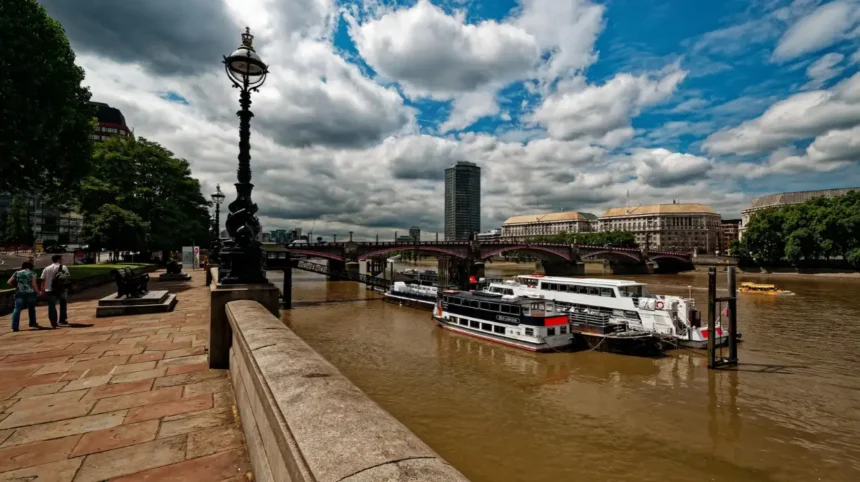
Lambeth Bridge provides an elevated crossing point over the Thames where visitors can observe vessels travelling upstream and downstream while also seeing Westminster, Lambeth Palace and the river frontage. Its position makes it useful for understanding how river traffic moves through central London.
Lambeth Bridge crosses the Thames between Lambeth and Westminster. The present bridge opened in 1932 and was designed by engineer Sir George William Humphreys with Sir Reginald Blomfield and George Topham Forrest as consulting architects. Historic England lists it at Grade II.
The bridge is useful for river watching because its elevated pedestrian areas provide a different perspective from the embankment below. Visitors can see the river corridor rather than viewing individual boats against the opposite bank alone.
The bridge also sits at an important historic crossing point. Historic England records river crossings at this location since the 13th century. Before the modern bridges, a horse ferry operated between Lambeth and Millbank under the control of the Archbishop of Canterbury, whose residence was Lambeth Palace.
The first permanent Lambeth Bridge opened in 1862. That structure was later replaced by the present bridge, which opened in July 1932.
The bridge therefore combines three useful elements for visitors: a high viewing position, a direct view along the river and a historic connection with London’s river crossings.
As you watch modern River Thames traffic from this crossing, you are standing at a location shaped by centuries of movement between Lambeth and Westminster. Read about the full to understand its origins.
Is Albert Embankment good for watching boats near Westminster?
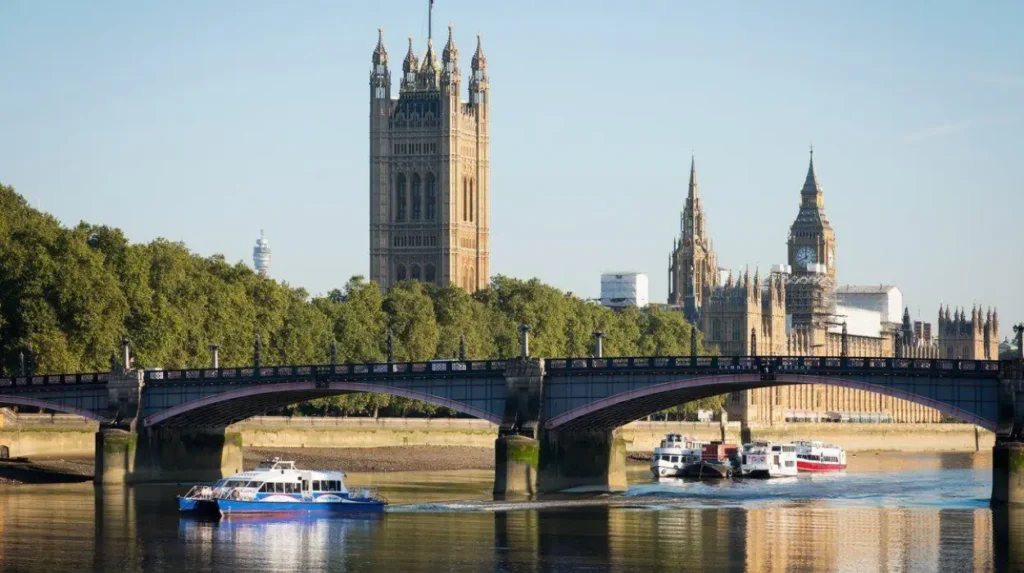
Albert Embankment is particularly effective for watching boats near Westminster because the riverside path runs beside a broad section of the Thames and faces Westminster Bridge, the Palace of Westminster and the central London river corridor. Passing vessels remain visible along much of the walkway.
The Lambeth section of Albert Embankment was developed during the Victorian period. Lambeth Council records that the embankment was constructed between 1866 and 1870. The riverside walk opened in 1868.
This development transformed the former waterfront. Historic England records that Lower Fore Street was demolished during construction of the Albert Embankment in the late 1860s. The area had previously contained densely occupied riverside housing and industrial activity.
Today, the embankment creates a continuous public relationship with the river.
The river itself remains strongly tidal. At low tide, the foreshore can expose mud and shingle. Lambeth Council’s conservation appraisal records exposed areas reaching substantial dimensions in parts of the Albert Embankment frontage.
The changing water level affects the appearance of the river and the position of vessels relative to the riverbank.
Visitors should therefore expect the same location to look different at different stages of the tide. The boats remain part of a navigable tidal system rather than moving on a fixed water level.
Can visitors watch River Bus services from Lambeth?
Visitors can watch River Bus services from Lambeth’s riverside locations, particularly around the central London river corridor. Uber Boat by Thames Clippers operates services linking central London piers, including nearby Vauxhall, London Eye and Westminster locations.
Uber Boat by Thames Clippers operates London’s River Bus network and currently serves 24 piers across London. Its routes connect locations from Putney in west London to Barking Riverside in east London.
Vauxhall (St George Wharf) Pier is within Lambeth and is located on Riverside Walk, SW8 2LE. The operator lists it as a Central Zone pier.
London Eye (Waterloo) Pier is also part of the central river network. It is located beside Westminster Bridge Road and serves the South Bank area.
These piers give visitors two ways to experience river activity.
The first is passive observation from the riverside. Visitors can watch River Buses approach, depart and travel through the central London section.
The second is active river travel. Visitors can board a River Bus and experience the same traffic corridor from the water.
The operator provides live departure information and a journey planner through its current ticketing system. Its app also provides real-time vessel tracking through the “Where’s My Clipper?” feature.
This information is useful for visitors who want to time their riverside walk around scheduled passenger services.
What is the best place near Westminster Bridge for river watching?
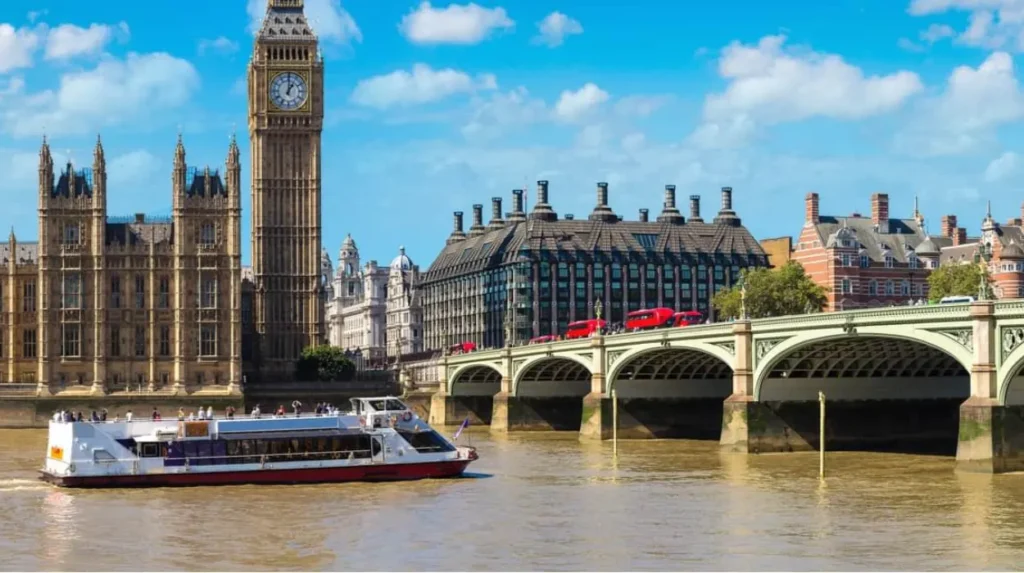
The Lambeth side of Westminster Bridge provides a strong river-watching position because visitors can see vessels moving through one of central London’s busiest landmark areas while also viewing the Palace of Westminster, Westminster Bridge and the wider Thames corridor.
Westminster Bridge connects Lambeth with Westminster and stands immediately north of the Albert Embankment river frontage.
Lambeth Council identifies Westminster Bridge as one of the important river prospects in this part of London. Its planning documentation also recognises views from the South Bank and from the bridge towards the Thames.
The location is particularly useful for visitors who want to combine river traffic with landmark viewing.
From the Lambeth side, the river forms the foreground to views of the Palace of Westminster. Boats moving across this section therefore remain visually connected with some of London’s most recognisable civic buildings.
The surrounding riverside also provides access to other South Bank attractions.
Visitors should remain on designated pedestrian areas and avoid obstructing bridge approaches. The bridge is a transport structure as well as a viewing point, so pedestrian movement and road traffic remain important considerations.
Can visitors watch river traffic from Vauxhall and St George Wharf?
Vauxhall and St George Wharf provide a southern Lambeth river-watching location where visitors can observe Thames traffic closer to the Vauxhall section of the river. The area also contains a working River Bus pier, making scheduled passenger movements easy to identify.
Vauxhall (St George Wharf) Pier is listed by Uber Boat by Thames Clippers at Riverside Walk, SW8 2LE. It forms part of the central section of the River Bus network.
The location is useful for visitors exploring the Thames between central London and the western sections of the river.
St George Wharf also sits close to Vauxhall’s transport connections. This makes the area practical for visitors who want to incorporate river observation into a wider South London itinerary.
The River Bus is only one category of river activity. The Thames Tideway also carries recreational and other vessels, while rowing activity forms an important part of the wider tidal-river environment.
The PLA’s Tideway Code identifies specific traffic patterns, pinch points, bridges, piers, moorings, tidal streams and other navigational features along the tidal Thames.
The river therefore operates as a regulated transport environment with different vessel types using the same waterway.
How does the tide affect river traffic around Lambeth?
The tide changes water level, current strength and navigation conditions around Lambeth because this section of the Thames is tidal. River traffic responds to tidal streams, bridge conditions, pier access and other navigational factors controlled within the wider Tideway system.
The tidal Thames is not a static waterway. Water levels rise and fall, while tidal streams influence vessel movement.
The Port of London Authority states that the Tideway is a fast-flowing and heavily used inland waterway. Bridges, piers and moorings create additional navigational complexity.
The Tideway Code distinguishes between ebb tide, flood tide and tidal stream. It also identifies factors that affect tidal conditions, including wind, the Thames Barrier, neap tides and other river-flow conditions.
For visitors, the practical result is simple. A boat travelling in one direction does not always appear to move at the same speed relative to the riverbank.
Low water also changes the visible foreshore. Lambeth Council’s Albert Embankment appraisal records exposed mud flats and shingle banks during low tide.
River Bus operations also respond to tidal conditions. Thames Clippers states that extremely low tides can affect docking and reduce river traffic capacity.
This means that tide information is relevant when planning a dedicated boat-watching visit.
Which types of boats can visitors see on the Thames at Lambeth?
Visitors can encounter passenger River Buses, sightseeing vessels, recreational craft, rowing boats and other working vessels along the Lambeth section of the Thames. The exact traffic mix changes with location, time, tide, river activity and scheduled services.
Passenger River Buses are among the easiest vessels for visitors to identify because their services operate to published timetables.
Recreational craft form another category. Rowing boats and paddled craft use the tidal Thames under specific navigation guidance. The PLA and its partners developed the Tideway Code for rowing and paddling on the tidal Thames.
Sightseeing boats also form part of London’s river tourism network. Their routes concentrate around central London landmarks and major visitor destinations.
Working vessels are another part of the river environment. The Thames is not exclusively a tourist waterway. Commercial and service-related movements remain part of the broader Port of London navigation system.
The mixture makes Lambeth useful for visitors who want to understand the Thames as an active transport corridor.
Traffic patterns also vary between locations. The PLA’s navigation syllabus specifically identifies traffic patterns, traffic pinch points and the types and timing of traffic expected in different sections of the river.
What historic features can visitors see while watching the river?
Visitors watching the Thames from Lambeth can see historic bridges, embankments, Lambeth Palace and the Westminster river frontage. These features demonstrate how the river developed from a medieval crossing and industrial waterfront into a modern transport and public-realm corridor.
Lambeth Palace is a major historic landmark beside the Thames. It has been the London residence of the Archbishop of Canterbury for centuries.
Lambeth Bridge has a particularly direct connection with this history. Historic England records a medieval horse ferry operating between Lambeth and Millbank before the construction of permanent bridges.
The Albert Embankment represents a later transformation.
During the 19th century, the riverside changed through major engineering, infrastructure and public-health improvements. Construction of the embankment between 1866 and 1870 reshaped the Lambeth waterfront.
Historic England records the former industrial character of Lambeth during the first half of the 19th century, including pottery production associated with Doulton and Company.
Visitors can therefore observe present-day river traffic within a landscape that contains evidence of several different phases of London’s development.
The bridges are particularly useful reference points because they divide the central river corridor into recognisable sections.
Is Lambeth’s riverside suitable for a longer boat-watching walk?
Lambeth’s riverside is well suited to a longer boat-watching walk because public riverside routes connect Vauxhall, Albert Embankment, Lambeth Bridge and Westminster Bridge. Visitors can change viewpoints while remaining close to the Thames for much of the route.
The Albert Embankment conservation area extends along Lambeth’s Thames frontage and includes the riverside walk and open spaces.
Albert Embankment Gardens add additional public space along the wider riverside corridor. Lambeth Council describes them as a chain of small open spaces running between Vauxhall and Waterloo beside the Thames.
A practical walking sequence starts around Vauxhall and moves north towards Lambeth Bridge. The route then continues towards Westminster Bridge.
This approach gives visitors different viewing angles.
At Vauxhall, the river has a more open western perspective. Around Lambeth Bridge, the bridge itself becomes a major visual reference point. Further north, the Westminster section brings the Palace of Westminster and Westminster Bridge into view.
The route also connects with South Bank attractions and central London transport links.
Visitors who want to spend several hours beside the river can therefore combine boat observation with architecture, parks, public spaces and landmark viewing without treating the activity as a separate excursion.
When is the best time to watch river traffic in Lambeth?
The most useful time depends on the type of river activity visitors want to observe. Scheduled River Bus movements are easiest to plan around published timetables, while tidal changes, weather and river events affect the wider mix of vessels seen from Lambeth.
For scheduled passenger boats, visitors should check the current River Bus timetable before travelling. Thames Clippers provides weekday, weekend and bank-holiday timetables through its journey-planning service.
The operator also provides live departure information through its app and at relevant piers.
For general river watching, tide conditions provide another useful planning factor.
Low tide exposes sections of the foreshore and changes the visual relationship between the river, embankment and vessels. The tidal system also affects navigation conditions and pier operations.
Weather affects visibility as well. Fog can interrupt River Bus operations, while strong river conditions and other operational factors can affect services. Thames Clippers publishes service alerts for such circumstances.
Visitors should therefore distinguish between scheduled traffic and general river activity. Timetables help predict passenger boats. Tide and operational information provide broader context.
How can visitors combine river traffic watching with other Lambeth attractions?
Visitors can combine river traffic watching with South Bank landmarks, Albert Embankment Gardens, Lambeth Palace surroundings, Westminster Bridge and Vauxhall. This creates a continuous riverside itinerary rather than requiring separate journeys between boat-watching locations.
Albert Embankment provides the strongest continuous connection between public space and the river.
Visitors can walk beside the Thames, pause at viewing points and continue towards Lambeth Bridge. From there, Westminster Bridge provides another major perspective.
The South Bank section also provides access to major cultural and entertainment attractions. The London Eye (Waterloo) Pier is part of the River Bus network and is located beside the South Bank visitor area.
Vauxhall provides a different starting point. Visitors can begin near St George Wharf and follow the river north towards central London.
This arrangement makes river traffic watching compatible with short visits and longer itineraries.
A visitor with one hour can focus on Lambeth Bridge and Albert Embankment. A visitor with several hours can connect Vauxhall, Albert Embankment, Lambeth Bridge and Westminster Bridge.
The river therefore functions as both an attraction and a route through Lambeth.
Explore More Area Guide
Best Early Morning Walks in Lambeth, South London
Independent Food Shops in Lambeth: Brixton, Markets & Grocers
What should visitors know before watching boats on the Lambeth Thames?
Visitors should use public paths and designated viewing areas, remain clear of operational piers, follow temporary restrictions and avoid entering the foreshore or water. The Thames is a tidal working waterway with strong currents, changing water levels and active navigation.
The Port of London Authority describes the Tideway as a challenging navigational environment because of its fast-flowing tide, bridges, piers and moorings.
Visitors should never treat the river as ordinary open water.
The foreshore also requires caution. Exposed areas at low tide can contain mud, uneven surfaces and other hazards. The presence of a visible riverbank does not indicate that the area is suitable for casual access.
Pier areas require additional awareness because passenger vessels approach and depart from designated landing points.
Current operational conditions also matter. Thames Clippers states that service disruption can result from tidal conditions, river congestion, pier congestion, technical issues and riverside activities.
Visitors should check current service information before planning a journey around a specific boat.
Temporary closures can also affect sections of the riverside walkway. Lambeth Council has previously used temporary orders for specific sections of the Albert Embankment riverside walk during organised activities.
These conditions do not prevent river watching. They simply make it important to use established public routes and current information.
Why is Lambeth important for understanding London’s river traffic?
Lambeth is important for understanding London’s river traffic because its Thames frontage combines public embankments, historic crossings, passenger piers, major landmarks and a tidal navigation corridor. Visitors can observe modern boats while seeing the infrastructure and history that shaped London’s riverside.
The borough’s river frontage represents several stages of London’s relationship with the Thames.
Medieval movement relied on ferries and landing places. The Victorian period introduced major embankment engineering and industrial change. The 20th century added modern bridges and expanded urban transport infrastructure. The present river supports passenger services, tourism, recreation and working navigation.
Lambeth’s position opposite Westminster also makes it unusually strong for viewing central London’s river landscape.
Lambeth Council’s planning documents identify river prospects around Westminster Bridge and Lambeth Bridge, while the Albert Embankment conservation area is recognised for public viewpoints towards the Westminster World Heritage Site.
The river itself remains dynamic.
Passenger services connect central London with locations across the capital. Uber Boat by Thames Clippers currently serves 24 piers, while its journey-planning tools provide live information for passengers.
At the same time, the PLA continues to manage the wider navigational environment of the tidal Thames through rules, guidance and navigation information.
For visitors, this makes Lambeth more than a place to photograph passing boats. It is a concentrated section of London’s river system where transport, history, engineering, public space and tourism meet.
Best Lambeth locations at a glance
For visitors specifically interested in observing Thames traffic, Albert Embankment provides the longest continuous riverside viewing opportunity. Lambeth Bridge provides an elevated perspective over the river. Westminster Bridge offers landmark-rich views of central London. Vauxhall and St George Wharf provide access to a working River Bus pier and the western section of Lambeth’s central Thames frontage.
Together, these locations provide a practical route for understanding the river from different viewpoints while remaining within Lambeth’s wider riverside environment.
Where is the best place to watch river traffic in Lambeth?
Albert Embankment is one of the best places to watch River Thames traffic in Lambeth. Its riverside walkway provides open views towards Lambeth Bridge, Westminster Bridge and the central London river corridor.