Key Points
- Homecoming Parade: The 1st Battalion, The Princess of Wales’s Royal Regiment (1 PWRR), fondly known as the “Tigers”, celebrated their official homecoming parade in Woolwich.
- Service Overseas: The ceremonial march marks the end of a two-year overseas deployment, which included service stationed at Dhekelia and Episkopi Barracks in Cyprus, operational duty in Kosovo, and exercises across the Middle East and North Africa.
- Parade Route: Troops assembled at the historic Royal Artillery Barracks before marching through the streets of Woolwich towards Woolwich Town Hall.
- Musical Escort: The battalion marched behind their Regimental Colours and were accompanied by the Regimental Band of 1 PWRR.
- Community Gathering: Local residents, military veterans, families, and Royal Borough of Greenwich councillors lined the streets to offer a warm welcome to the returning service members.
- Historic Garrison Connection: The event highlighted Woolwich’s longstanding military heritage as one of the United Kingdom’s primary historic garrison communities.
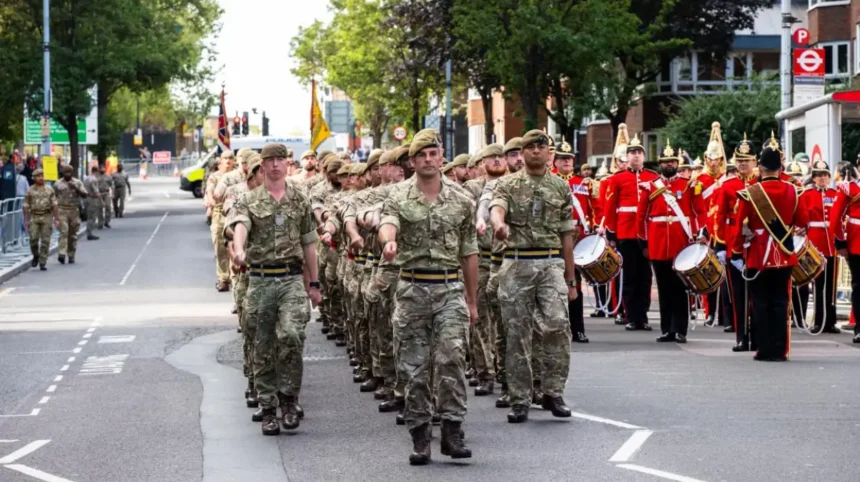
Woolwich (South London News) September 28, 2026 — Residents, veterans, and military families gathered across Woolwich on Thursday, 24 September, to welcome home the 1st Battalion, The Princess of Wales’s Royal Regiment (1 PWRR) following two years of operational service overseas. The troops assembled at the historic Royal Artillery Barracks before marching through the town streets to Woolwich Town Hall. Led by the Battalion’s Colours and accompanied by the Band of 1 PWRR, the parade drew well-wishers, local council officials, and veterans who lined the pavement to greet the returning soldiers as they officially marked their relocation back to London’s historic garrison town.
- Key Points
- How did the homecoming parade unfold in Woolwich?
- Why does the return of 1 PWRR carry special significance for Woolwich?
- Where had the 1st Battalion been deployed during their two-year tour?
- Background of the 1st Battalion, The Princess of Wales’s Royal Regiment
- Prediction: How will this military development affect the local Woolwich community and military families?
How did the homecoming parade unfold in Woolwich?
As detailed by military reporters covering the event for local news outlets, the soldiers formed up in full dress uniform at the Royal Artillery Barracks during the morning before stepping off along the designated parade route. The procession moved at a steady march through the centre of Woolwich, drawing applause and cheers from gathering crowds.
Leading the column were the Battalion’s Colours—the ceremonial battle flags bearing the regiment’s historic honours—alongside the Regimental Band and Corps of Drums of 1 PWRR, providing musical accompaniment. The procession concluded outside Woolwich Town Hall, where civic dignitaries, including Greenwich councillors and representatives of the armed forces community, formally received the officers and soldiers.
Why does the return of 1 PWRR carry special significance for Woolwich?
According to statements issued by the Royal Borough of Greenwich and local community organizers, the return of 1 PWRR holds substantial historic meaning for the local area. Woolwich has maintained a continuous connection to the British Armed Forces for over three centuries, functioning as one of the country’s main military centres, former home to the Royal Artillery, and site of major defense infrastructure.
The relocation of 1 PWRR back to Woolwich Barracks reinforces the town’s identity as a key UK garrison community. Veterans and community groups noted that events such as the homecoming parade help strengthen ties between the civilian population and active-duty military personnel based in south-east London.
Where had the 1st Battalion been deployed during their two-year tour?
As reported in British Army operational updates, the 1st Battalion, The Princess of Wales’s Royal Regiment, operates as a light role infantry battalion trained for dismounted close combat and rapid global deployment. Over the past two years, the unit was stationed primarily overseas in Cyprus, operating from Episkopi and Dhekelia Barracks.
During this period, elements of the battalion deployed to Kosovo as part of international peace-support missions, while simultaneously conducting military exercises, training operations, and security tasks across Northern Africa and the Middle East. Having completed their operational rotation, the battalion has now officially returned to the UK to take up residency at Woolwich.
Background of the 1st Battalion, The Princess of Wales’s Royal Regiment
The Princess of Wales’s Royal Regiment (PWRR)—nicknamed “The Tigers” due to their famous regimental badge and fierce combat heritage—is the oldest and senior English line infantry regiment of the British Army. Although the modern regiment was formed on 9 September 1992 through the amalgamation of the Queen’s Regiment and the Royal Hampshire Regiment, its direct historic lineage traces back through predecessor units to 1661, including the Tangier Regiment and the Trained Bands of London raised in 1572.
The 1st Battalion (1 PWRR) functions as a regular light role infantry unit, designed to deploy quickly on foot to anywhere in the world during operational crises. Over the decades since its formation, personnel from 1 PWRR have seen extensive action on operations in Northern Ireland, Bosnia, Kosovo, Iraq, and Afghanistan. Most recently, the battalion has maintained high operational readiness while serving as a key forward-deployed force in the Eastern Mediterranean. Their relocation to Woolwich Barracks in 2026 places them back in the capital as a core component of the British Army’s domestic light infantry capability.
Prediction: How will this military development affect the local Woolwich community and military families?
The permanent stationing of the 1st Battalion, The Princess of Wales’s Royal Regiment, at Woolwich Barracks is expected to have a tangible impact on several key groups across the local area:
- Local Economy and Town Centre Businesses: The arrival of hundreds of regular infantry soldiers and their support elements will directly boost local commerce. Retailers, hospitality venues, and service providers around Woolwich town centre are likely to experience increased trade from service personnel and visiting family members.
- Military Families and Local Services: The influx of service families relocating to the area will place additional operational demand on local public services, including primary healthcare providers, dental surgeries, and local schools. Housing and community infrastructure around the borough will adapt to accommodate the newly arrived families.
- Civic Pride and Community Cohesion: The regular presence of active-duty soldiers participating in public ceremonies, Remembrance events, and civic parades is expected to reinforce Woolwich’s historical heritage as a premier garrison town, strengthening mutual support networks between civilians, local charities, and veterans’ organisations.