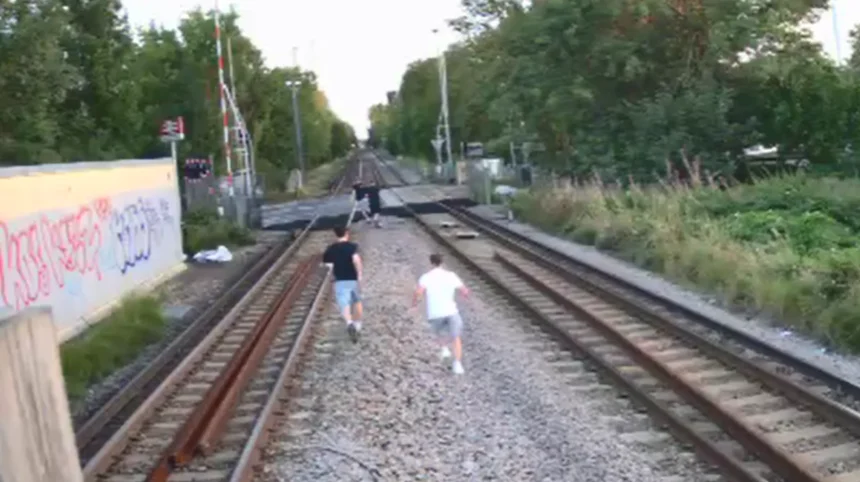
Key Points
- Severe Network Delays: Trespass incidents resulted in 9,437 minutes of passenger delays across the South Western Railway (SWR) network during the 2025/26 period, representing roughly six and a half days of lost operational time.
- National Disruption Standard: Across England, railway trespass, cable theft, and deliberate track obstruction accounted for more than 3,300 hours of delays in the same operational period.
- High Vandalism Ranking: The SWR line was identified as having the third-highest rate of vandalism and track obstruction among Network Rail’s 14 operational routes nationwide.
- Deliberate Track Hazards: Reported incidents included deliberately placed track debris and objects positioned directly on active running lines.
- High-Voltage Electrical Danger: Authorities highlighted the extreme hazard posed by SWR’s live third rail, which carries 750 volts of direct current capable of causing fatal or life-changing injuries.
London, UK (South London News) October 3, 2026 – Trespass incidents caused almost 10,000 minutes of delays to South Western Railway (SWR) services during the 2025/26 operating period, according to figures released jointly by Network Rail and the British Transport Police (BTP). The published data reveals that unauthorized access to railway lines resulted in 9,437 minutes of accumulated delays—the equivalent of approximately six and a half days of continuous disruption—severely impacting thousands of daily commuters and regional passengers across the network.
How severe is the rail trespass problem across the network?
The data published by Network Rail and the British Transport Police demonstrates that unauthorized interference on railway lines remains one of the largest single causes of network-wide travel disruption in England. Over the course of the 2025/26 period, the combined impact of illegal trespass, cable theft, and track obstruction generated more than 3,300 hours of total operational delays across English routes.
Within Network Rail’s 14 regional operational routes, the South Western Railway network registered the third-highest rate of vandalism and obstruction. Network reports confirm that several of these instances involved deliberate acts of sabotage, including debris and heavy objects being intentionally placed on active tracks to obstruct incoming train services.
What specific safety risks are associated with South Western Railway tracks?
Alongside the substantial operational delays, transport officials emphasized the extreme physical dangers unique to the South Western Railway network. A significant proportion of the SWR infrastructure relies on a ground-level third rail to supply operational electricity.
This third rail system carries a continuous charge of 750 volts of direct current (DC). Safety officers from Network Rail and the British Transport Police cautioned that direct contact with or proximity to the third rail frequently leads to severe electrical burns, life-changing personal injuries, or immediate fatalities. Unlike overhead power lines, the third rail is positioned directly alongside the running tracks, dramatically increasing the lethality risk for unauthorized individuals walking along the railway corridor.
Background of Railway Safety and Infrastructure Challenges
Rail infrastructure across the United Kingdom has faced ongoing operational challenges surrounding physical security, trespassing, and trackside vandalism. Network Rail, which manages the maintenance and safety of Britain’s track infrastructure, regularly collaborates with the British Transport Police to monitor hot-spot areas, deploy physical barriers, and install specialized surveillance equipment.
The South Western Railway network serves as a critical artery for the UK capital, carrying millions of passengers annually between London Waterloo and suburban or coastal destinations across Surrey, Hampshire, Dorset, Berkshire, and Wiltshire. Because SWR operates high-density commuter schedules, any single track intervention—such as an emergency power shutdown required when a trespasser is spotted near a live 750-volt third rail—causes an immediate compounding delay effect that ripples across dozens of connecting services and major terminus hubs.
Prediction: How Will This Development Affect Passengers and Infrastructure Management?
Impact on Commuters and Rail Passengers
In the immediate and medium term, high rates of trespass and deliberate obstruction will force railway operators to implement stricter safety protocols, resulting in more frequent precautionary speed restrictions and emergency power cuts. Passengers travelling on South Western Railway routes can anticipate potential secondary delays as drivers are required to proceed with extreme caution through high-risk corridors. Continued disruption of this scale may also prompt calls for increased fare compensation claims under delay-repay schemes, increasing operational pressure on service operators.
Impact on Infrastructure and Law Enforcement
To mitigate further financial losses and passenger frustration, Network Rail and the British Transport Police are likely to increase capital expenditure on physical trackside security measures. This will probably include:
- Installation of additional high-security fencing and anti-trespass grid panels at station ends and access points.
- Expanded deployment of thermal imaging drone patrols and remote CCTV monitoring across known vandalism hot spots.
- Targetted public educational campaigns warning of the lethal 750-volt third rail threat, particularly focused on school districts along the SWR route network.