Key Points:
- Two window cleaners were safely rescued by firefighters after their suspended cradle malfunctioned on the 15th storey of a London skyscraper.
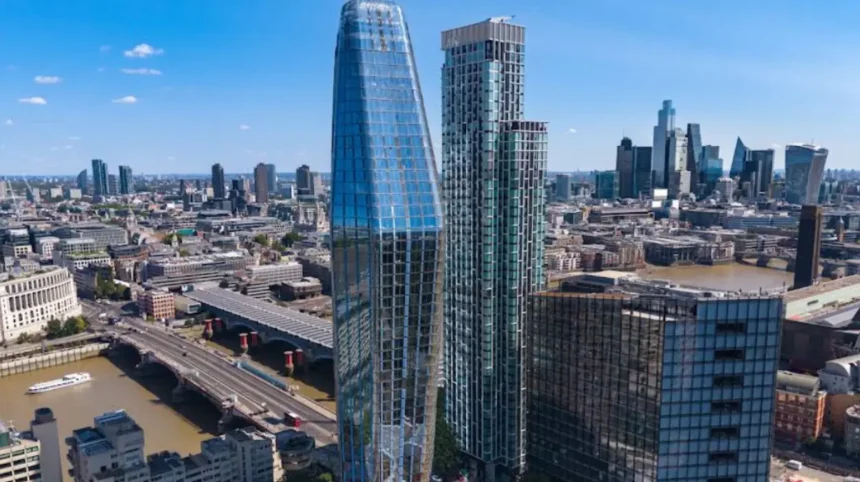
- The incident took place at One Blackfriars on Blackfriars Road in Southwark on Thursday evening.
- London Fire Brigade received the distress call shortly before 17:30 BST and resolved the incident within 45 minutes.
- Emergency responders deployed a 209 ft (64 m) turntable ladder, recognized as the tallest aerial appliance in Europe, to perform the high-altitude rescue.
- No injuries were reported among the maintenance workers or emergency personnel during the operation.
- London Fire Brigade highlighted the necessity of specialized tall-building equipment to maintain safety across London’s modern architectural landscape.
Southwark (South London News) October 9, 2026 — Emergency service personnel successfully rescued two maintenance workers after their suspended window-cleaning cradle suffered a mechanical failure on the 15th floor of a high-rise tower in south London. The operational response was launched on Thursday evening when the structural cradle became immobilized at an extreme height along the exterior facade of the building located on Blackfriars Road in Southwark. Responders from the London Fire Brigade arrived on the scene shortly before 17:30 BST and executed a precise rescue operation using advanced aerial equipment. Both workers were safely brought down to ground level within 45 minutes of the brigade’s arrival, with official assessments confirming that neither individual sustained any physical injuries during the ordeal.
- Key Points:
- What Occurred During the High-Altitude Malfunction at One Blackfriars?
- How Did Emergency Services Reach the Stranded Workers on the 15th Storey?
- What Official Statements Were Issued by the London Fire Brigade?
- Background of High-Rise Safety and Equipment Deployment in London
- Prediction: How This Development May Affect Structural Maintenance Contractors and Emergency Services
What Occurred During the High-Altitude Malfunction at One Blackfriars?
The incident unfolded along the exterior of One Blackfriars, a prominent 50-storey residential skyscraper situated within the London Borough of Southwark. While performing routine facade maintenance, the suspended platform carrying two window cleaners experienced an unexpected breakdown, leaving the cradle trapped motionless at the 15th-storey level.
Upon receiving emergency notification at approximately 17:25 BST, London Fire Brigade control officers dispatched specialized operational units and command personnel to the site on Blackfriars Road. Emergency teams immediately cordoned off the perimeter below the impacted section of the facade to establish a secure ground area and secure the surrounding streetscape while aerial deployment preparations were completed.
How Did Emergency Services Reach the Stranded Workers on the 15th Storey?
To extract the trapped personnel from the immobilized cradle, fire crews deployed a 209 ft (64-metre) turntable ladder appliance. This specific piece of machinery represents the tallest operational aerial unit currently utilized across European emergency services, engineered specifically to address high-rise structural emergencies up to 20 storeys above ground level.
Firefighters positioned the heavy turntable vehicle along Blackfriars Road, extending its telescopic ladder mechanism directly alongside the stranded 15th-floor platform. Specialized rescue officers climbed to the platform’s location to secure both workers before transferring them safely into the ladder’s personnel cage. The precise maneuvering allowed the firefighters to complete the entire high-altitude evacuation and return both workers to safety on the ground within 45 minutes of entering the scene.
What Official Statements Were Issued by the London Fire Brigade?
Following the successful completion of the operation, representatives from the London Fire Brigade issued formal statements detailing the operational execution and the importance of modern apparatus in high-density urban environments.
A spokesperson for the London Fire Brigade noted that the successful extraction was a clear demonstration of how emergency services utilize specialized tools to address complex structural layouts, stating,
“This is a great example of how the brigade uses its specialist equipment to meet the challenges of London’s built environment.”
Highlighting the ongoing logistical demands posed by the capital city’s expanding vertical architecture, the fire service further added,
“It is vital that we continue to have the right equipment to enable us to respond effectively and keep London’s communities safe.”
Beyond high-altitude occupant extractions, the brigade noted that the 209 ft turntable ladder serves multiple critical disaster-response functions across the capital, including targeted firefighting at high elevations and serving as an elevated command platform for incident commanders during complex urban emergencies.
Background of High-Rise Safety and Equipment Deployment in London
The architectural skyline of London has undergone significant vertical expansion over the past two decades, with Southwark and neighboring central boroughs seeing a marked increase in skyscrapers exceeding 100 metres in height. One Blackfriars itself stands at 170 metres (558 ft) tall, presenting unique operational scenarios for building maintenance contractors and emergency services alike. Suspended scaffolding systems, temporary platforms, and building maintenance units (BMUs) are subject to stringent safety regulations, including compulsory secondary fall-arrest gear, dual-cable hoisting mechanisms, and emergency braking systems designed to lock platforms in place should power failures or mechanical hitches occur.
Despite strict regulatory overhauls and regular preventative maintenance schedules, mechanical lockups, winch jams, and power delivery failures on external cradles remain an inherent operational risk for window cleaners working across high-rise developments. In response to the growing density of residential and commercial towers, the London Fire Brigade invested in ultra-tall aerial appliances, including 64-metre turntable ladders. These assets were specifically acquired to modernize the brigade’s fleet, ensuring firefighters can directly access upper floors without relying exclusively on internal building riser systems or internal evacuation routes during emergencies.
Prediction: How This Development May Affect Structural Maintenance Contractors and Emergency Services
This high-profile incident at One Blackfriars is likely to prompt immediate operational reviews among commercial building management firms and specialized facade maintenance contractors across the United Kingdom. Equipment service providers will likely face heightened scrutiny regarding the inspection intervals, safety certifications, and emergency descent mechanisms on suspended scaffolding systems. Facility managers across London’s high-rise sector may implement more rigorous pre-use check protocols and mandate enhanced back-up power equipment on cradles to minimize the likelihood of mid-operation lockouts.
Furthermore, the successful outcome of this rescue will reinforce strategic arguments within municipal authorities and fire service governance bodies regarding capital investment in ultra-high aerial apparatus. As major urban centres continue to build upward, the reliance on specialized equipment like the 64-metre turntable ladder will shape future procurement policies for urban fire services. Municipal planners and emergency coordinators will continue integrating these high-reaching assets into standard tactical planning to ensure rapid extraction capabilities remain aligned with the evolving density of the urban built environment.