Key Points
- Split Political Decision: Greenwich Council’s Planning Board has voted to approve a major multi-use redevelopment at Deptford Creek, coming two weeks after neighboring Lewisham Council rejected the identical cross-boundary application.
- Massive Scale Proposed: Designed by developer RER, the master plan requires demolishing existing structures, including the former Lewisham College site, to construct eight buildings ranging up to 30 storeys.
- Borough Distribution: The scheme proposes 802 residential units overall, divided into 548 homes in Lewisham and 254 in Greenwich, alongside 90,000 square feet of mixed-use educational and commercial space.
- No Immediate Weight: Greenwich Council’s approval carries no practical legal standing unless Lewisham’s initial refusal is formally overturned by regional or national planning authorities.
- Planning Hierarchy Next Steps: The proposal moves to Stage Two consideration by the Greater London Authority (GLA) and Mayor of London Sir Sadiq Khan; if bypassed, Housing Secretary Angela Rayner will consider intervention before Lewisham’s refusal becomes absolute.
- Multi-Year Construction Timeline: According to developer statements, full buildout could take up to six years once active work begins, which itself remains delayed by at least a year due to pending legal and administrative procedures.
- Public and Environmental Commitments: Plans propose opening restricted stretches of Deptford Creek to public access, planting over 200 trees, integrating a low-temperature communal heating network with roof-mounted solar panels (yielding ~64,000 kWh annually), and making a £1m local carbon-offset contribution.
Greenwich Council (South London News) October 21, 2026 — Greenwich Council has voted to grant planning permission for a large-scale residential and commercial development spanning Deptford Creek, creating a direct planning standoff with neighboring Lewisham Council, which formally voted against the same cross-border scheme two weeks prior.
- Key Points
- Why Has A Cross-Borough Dispute Arisen Over The Deptford Bridge Scheme?
- What Happens Next In The Planning Process For RER’s 30-Storey Master Plan?
- What Is The Proposed Timeline And Delivery Schedule For Construction?
- What Exactly Does The Deptford Bridge Redevelopment Plan Contain?
- How Does The Proposal Address Public Space And Environmental Sustainability?
- Background Of The Particular Development
- Prediction: How This Development Can Affect The Local Audience
Because the development footprint straddles the boundary line separating the two local authorities, the ultimate fate of the ambitious project now remains hanging in the balance, pending statutory intervention from the Greater London Authority or central government ministers.
Why Has A Cross-Borough Dispute Arisen Over The Deptford Bridge Scheme?
The site identified for the multi-million-pound regeneration scheme lies directly across the administrative divide between the London Borough of Lewisham and the Royal Borough of Greenwich. The majority of the designated land area, including the former Lewisham College campus, falls under Lewisham’s planning jurisdiction. To satisfy statutory requirements, developer RER submitted identical, co-dependent planning applications to both local councils.
During the Greenwich Planning Board proceedings, committee members were specifically instructed by planning officers to assess the merits of the proposal independently and not allow Lewisham Council’s prior rejection to sway their vote. Although Greenwich members resolved to back the application, municipal planning regulations dictate that an approval issued by one borough carries no legal force to initiate construction if the adjoining borough rejects its portion of the connected master plan.
What Happens Next In The Planning Process For RER’s 30-Storey Master Plan?
With two conflicting council decisions on record, the complex application must now follow a strict statutory escalation process through higher planning authorities.
First, the full proposal will be submitted to the Greater London Authority and Mayor of London Sir Sadiq Khan for Stage Two consideration. Under statutory powers, the Mayor holds the authority to uphold Lewisham’s refusal, override the decision, or officially “call in” the application to act as the primary planning authority and issue a final determination.
If regional city hall officials decide against taking over the application, the file will be escalated to central government for review by Housing Secretary Angela Rayner. Should the Secretary of State also decline to intervene, Lewisham Council will be legally authorized to issue its formal decision notice of refusal. Such a notice automatically nullifies Greenwich Council’s conditional approval. Upon the issuance of a final refusal, developer RER would retain the statutory right to launch a formal planning appeal through the national Planning Inspectorate.
What Is The Proposed Timeline And Delivery Schedule For Construction?
Addressing the prospective operational timetable, RER’s development manager Matthew Ham stated that if full planning permission is eventually secured, site completion could require up to six years from the commencement of physical construction.
Mr Ham further highlighted that actual ground-breaking on the site would likely be delayed by approximately twelve months following any eventual statutory approval, owing to the lengthy legal agreements, Section 106 negotiations, and administrative procedures required to finalize permissions across two separate local authority boundaries.
What Exactly Does The Deptford Bridge Redevelopment Plan Contain?
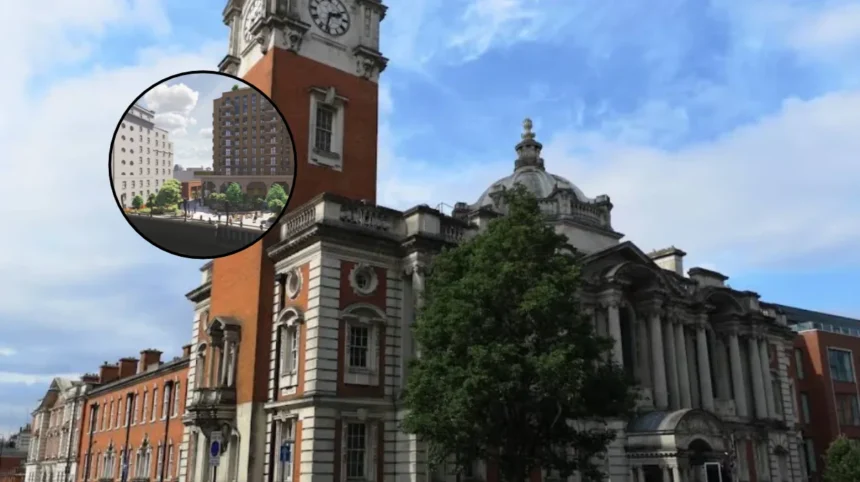
First submitted in March 2025, the extensive master plan outlines the complete demolition of existing on-site structures to make way for eight new buildings, with heights culminating in a flagship 30-storey high-rise.
In total, the scheme proposes the creation of 802 residential units. Reflecting the geographic split of the land, 548 of these housing units are planned within Lewisham’s boundary, while the remaining 254 units sit within Greenwich. Beyond housing, the design incorporates 90,000 square feet of multi-purpose, mixed-use space, specifically allocated for flexible commercial premises alongside dedicated educational facilities.
How Does The Proposal Address Public Space And Environmental Sustainability?
The developer’s public realm strategy focuses on transforming access to the local natural environment. Under the master plan, public pathways would be established along stretches of Deptford Creek that have historically been closed off to local residents, creating open access to the waterfront. The surrounding landscape design integrates the planting of over 200 trees throughout the development footprint.
On environmental sustainability, RER’s technical submittals state that heating across the complex would be supplied via a low-temperature communal heating network. Rooftop space across the eight structures would be fitted with solar photovoltaic panel arrays, which are projected to generate roughly 64,000 kilowatt-hours (kWh) of clean electricity annually. To balance residual operational carbon emissions, the developer has committed a £1 million financial offset contribution designated for local community and environmental organizations.
Background Of The Particular Development
The land surrounding Deptford Creek and Deptford Bridge has undergone rapid urban transformation over the past two decades, transitioning from industrial yards, maritime wharves, and educational facilities into high-density residential hubs. The site involved in RER’s application prominently features the former Lewisham College campus, an educational site that has sat largely vacant and underutilized following institutional restructuring and land sales.
Because Deptford Creek serves as the natural geographical boundary separating the Royal Borough of Greenwich from the London Borough of Lewisham, major redevelopments along the water corridor frequently trigger complex cross-boundary governance challenges. Both boroughs operate under distinct housing targets, local planning frameworks, and tall building guidelines set by their respective council cabinets.
Throughout the public consultation phase since the original March 2025 submission, the scheme generated significant debate among community groups, environmental guardians of the creek, and local politicians. Key points of discussion centered on:
- Building Density & Height: Concerns regarding the visual impact of the 30-storey tower on surrounding low-rise neighborhoods and historic heritage views.
- Affordable Housing Allocations: Debates over whether the proportion of genuinely affordable and social-rent housing met local policy expectations.
- Ecosystem Protections: Ensuring the tidal ecology and aquatic habitats of Deptford Creek remain protected during heavy structural work.
While Greenwich Council’s planning board ultimately judged the economic, housing, and public realm benefits sufficient to grant permission, Lewisham Council determined that the scale, height, and overall impact of the proposal on its side of the border did not align with its local planning priorities.
Prediction: How This Development Can Affect The Local Audience
The ongoing deadlock and ultimate resolution of the Deptford Bridge development will directly impact several key demographic groups within the immediate south-east London community:
1. Local Residents and Renters
For residents seeking housing in Greenwich and Lewisham, an eventual approval would inject 802 new homes into a severely constrained local housing market, potentially easing local supply pressures. However, if the Mayor of London or Planning Inspectorate upholds Lewisham’s refusal, the site could remain derelict for years, depriving the area of newly opened public spaces, riverside walkways, and tree-lined public realm improvements along Deptford Creek.
2. Local Businesses and Commercial Operators
The inclusion of 90,000 square feet of mixed-use commercial and educational space stands to increase footfall for existing Deptford Bridge and Greenwich traders. A finalized development would bring a permanent residential population to support local cafes, shops, and services. Conversely, extended delays caused by appeals or call-ins prolong uncertainty for local businesses awaiting economic regeneration in the Deptford Creek corridor.
3. Community Organizations and Local Infrastructure
Local civic and environmental groups stand to receive £1 million in direct carbon-offset funding, alongside enhanced public access to previously restricted riverfront areas. Should the development fail to progress through the appellate process, local community groups will miss out on this major financial contribution and the ecological upgrades promised by the scheme’s sustainability framework.