Lambeth occupies a strategic position on the southern side of the River Thames. Its riverside paths, bridges, gardens and public spaces provide direct views towards some of London’s most recognisable landmarks. The borough faces Westminster across the river, placing major historic buildings within a short visual distance.
- Where can you see the Houses of Parliament from Lambeth?
- Which Lambeth locations offer the best views of Big Ben?
- Can you see St Paul’s Cathedral from Lambeth?
- Where can you see Battersea Power Station from Lambeth?
- What can you see from the London Eye in Lambeth?
- Which Lambeth riverside walks are best for London landmark views?
- Are there historic viewpoints in Lambeth for seeing London landmarks?
- How should you plan a Lambeth landmark-viewing day?
- Why are Lambeth’s landmark views important for understanding London?
- What are the main London landmarks you can see from Lambeth?
- What makes Lambeth one of the best areas for London landmark views?
Several Lambeth locations are particularly useful for landmark spotting. Albert Embankment provides long riverside views towards the Palace of Westminster. Lambeth Bridge creates a strong perspective towards the Houses of Parliament and Victoria Tower. The Queen’s Walk near the London Eye provides views towards St Paul’s Cathedral. Vauxhall and Nine Elms provide different perspectives towards Battersea Power Station and the western Thames.
Lambeth Council formally identifies several important local views. Its Local Views Supplementary Planning Document includes views from Lambeth Palace towards the Houses of Parliament, from St Thomas’ Hospital towards Westminster, from the Queen’s Walk towards St Paul’s Cathedral and from the London Eye towards Waterloo and north Lambeth.
These protected and recognised views demonstrate that landmark viewing in Lambeth is not simply a matter of finding a high point. The relationship between the Thames, bridges, historic buildings and open spaces creates a network of viewpoints across the borough.
Where can you see the Houses of Parliament from Lambeth?
The Houses of Parliament are visible from several Lambeth riverside locations, with Lambeth Bridge, Albert Embankment, Lambeth Palace and the area around St Thomas’ Hospital providing particularly direct views across the Thames towards Westminster.
The Palace of Westminster is the historic parliamentary complex on the north bank of the River Thames. It contains the House of Commons and House of Lords and forms one of the most recognisable architectural groups in central London.
The clearest Lambeth viewpoints are concentrated along the river.
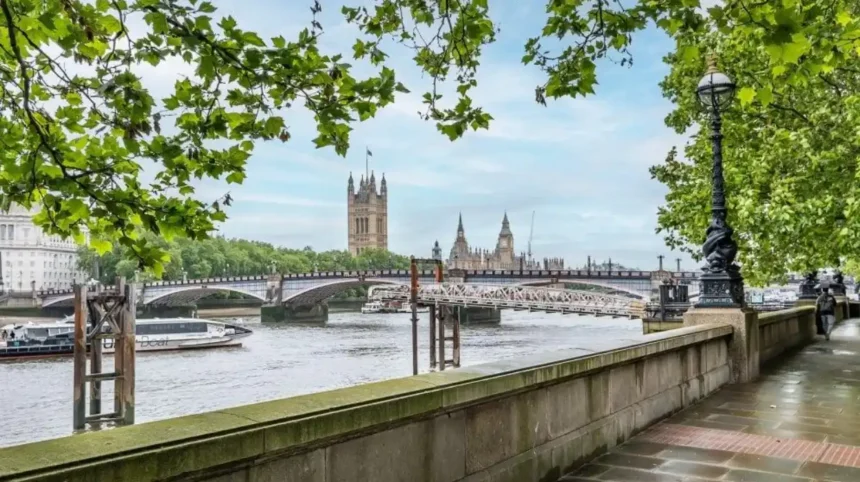
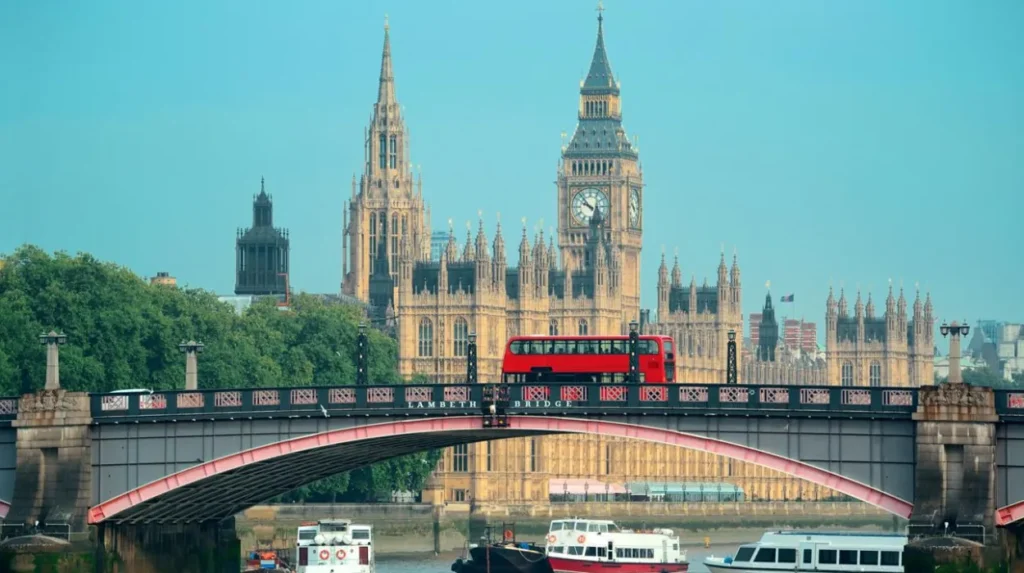
Lambeth Bridge provides a direct cross-river perspective. From the southern side, the Palace of Westminster rises beyond the Thames and Westminster Bridge. The position is particularly useful for understanding the relationship between the river, Parliament and the surrounding Westminster townscape.
Lambeth Council specifically identifies the view of the Palace of Westminster from Lambeth Bridge as an important metropolitan view. Its Albert Embankment documentation also identifies the Palace of Westminster from Albert Embankment as a significant view.
Albert Embankment provides a longer riverside viewing experience. The public route runs beside the Thames and includes the St Thomas’ Hospital complex, historic embankment structures and views across towards Westminster.
Lambeth Palace is another important viewpoint. The palace is the London residence of the Archbishop of Canterbury and stands beside the Thames close to Lambeth Bridge. Lambeth Council identifies views from the Lambeth Palace terrace towards the Houses of Parliament, including Victoria Tower.
For visitors interested in architecture and historical context, these viewpoints also connect modern sightseeing with centuries of development beside the Thames. As you explore the modern riverside, you are crossing land with a deep heritage. Read about the full [Lambeth historical background and heritage] to understand its origins.
The Elizabeth Tower, commonly associated with the name Big Ben, is particularly prominent from the Lambeth side of the river. The tower forms part of the Palace of Westminster and creates a recognisable focal point in views across Westminster Bridge and the Thames.
The best viewpoints are generally those where the river remains open in the foreground. This separation gives the Palace of Westminster greater visual prominence and makes the architectural relationship between both riverbanks easier to understand.
Which Lambeth locations offer the best views of Big Ben?
Lambeth Bridge, Albert Embankment and the riverside around Westminster Bridge provide some of Lambeth’s clearest perspectives towards Elizabeth Tower and the Palace of Westminster, with the River Thames creating an unobstructed foreground between both sides.
Elizabeth Tower is the clock tower at the north end of the Palace of Westminster. The tower was completed in 1859 and houses the Great Clock of Westminster. Big Ben is technically the name of the Great Bell inside the tower.
Lambeth Bridge is one of the most straightforward locations for viewing the tower from the south bank. The bridge crosses the Thames between Lambeth and Westminster and creates a direct visual axis towards the parliamentary district.
Albert Embankment is useful for visitors who want a longer viewing route rather than a single observation point. The embankment follows the Thames and contains several places where the Westminster skyline remains visible.
Lambeth Council describes Albert Embankment as containing some of the best public vantage points for appreciating the Westminster World Heritage Site. The conservation area extends along the River Thames frontage from the Wandsworth borough boundary to Westminster Bridge.
The riverside setting also changes the appearance of the landmark during the day. Morning light can illuminate Westminster from the east, while afternoon and evening conditions create different contrasts between the buildings and the river.
Westminster Bridge itself sits immediately beside the Palace of Westminster. From Lambeth’s southern approach, visitors can combine views of Elizabeth Tower, the Palace of Westminster and the bridge structure within one riverside composition.
The location also works well for visitors following a walking route. Lambeth Bridge, Albert Embankment, St Thomas’ Hospital and Westminster Bridge are connected by pedestrian routes beside the Thames.
This concentration of landmarks makes the area particularly useful for short sightseeing periods. A visitor staying elsewhere in London can reach the riverside, photograph several major landmarks and continue towards central Westminster without requiring a separate sightseeing excursion.
Can you see St Paul’s Cathedral from Lambeth?
Yes, St Paul’s Cathedral is visible from selected Lambeth riverside viewpoints, particularly along the Queen’s Walk between Waterloo Bridge and the borough boundary, where the cathedral forms a major landmark across the Thames.
St Paul’s Cathedral is the Anglican cathedral of the City of London. The present cathedral was designed by Sir Christopher Wren after the Great Fire of London destroyed the previous medieval cathedral in 1666. The current building was completed in the early eighteenth century.
The Lambeth view towards St Paul’s differs from the Westminster views because the cathedral sits farther east along the Thames. Its dome rises above surrounding buildings and provides a distinctive landmark for visitors walking along the South Bank.
Lambeth Council specifically protects a view towards St Paul’s Cathedral from the Queen’s Walk between Waterloo Bridge and the borough boundary.
The Queen’s Walk forms part of the riverside pedestrian route on the South Bank. It passes major attractions and cultural institutions while maintaining views across the Thames.
Waterloo Bridge is particularly important for understanding the geography of the view. The bridge crosses the river between Lambeth and Westminster before reaching the north-bank area around the Strand and Somerset House.
From the Lambeth side, St Paul’s Cathedral appears beyond the river corridor. The Thames provides a visual gap that helps distinguish the cathedral dome from the dense surrounding central London architecture.
This viewpoint is especially useful for visitors who want to combine landmark photography with a wider South Bank itinerary. The route connects attractions around County Hall, the London Eye and the riverside before continuing eastwards.
The view also demonstrates why London’s protected vistas are important. Landmark visibility depends on maintaining specific relationships between building height, open space, river corridors and viewing positions.
For digital nomads and business travellers, the Queen’s Walk is also practical because it sits within one of central London’s busiest visitor districts. Cafés, cultural venues, transport connections and public spaces are concentrated around the wider South Bank area.
Where can you see Battersea Power Station from Lambeth?
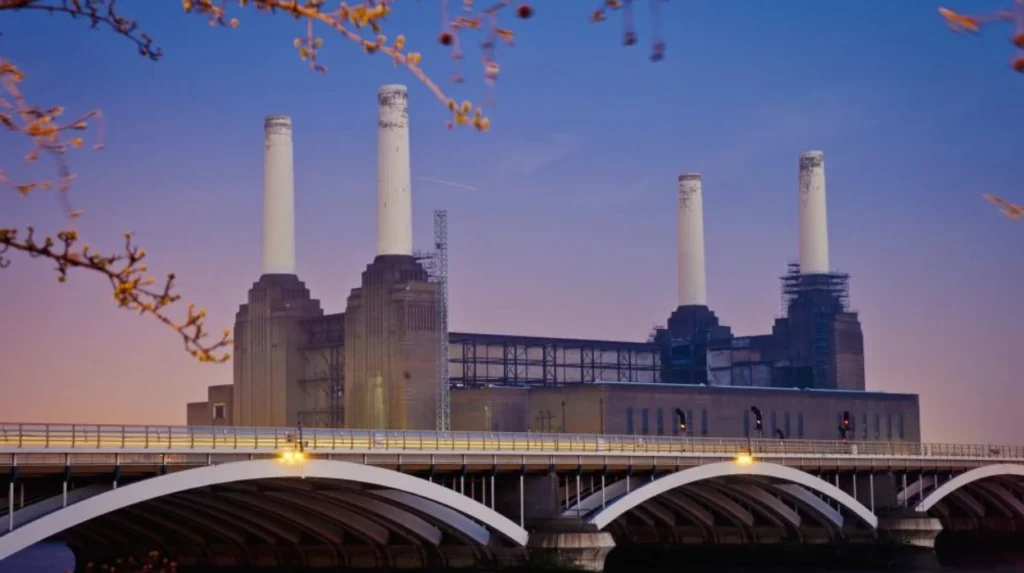
Battersea Power Station is visible from western Lambeth locations along the Thames, particularly around St George Wharf and Vauxhall, where riverside positions provide views towards the former power station and its distinctive four chimneys.
Battersea Power Station is a former coal-fired power station on the south bank of the Thames. Its four chimneys and monumental brick structure made it one of London’s most recognisable industrial buildings.
The building closed as a power station in 1983. It later became the centre of a major regeneration project incorporating commercial, residential, retail and public spaces.
Western Lambeth provides useful views towards the building because the Thames curves around this part of London. St George Wharf and nearby riverside locations provide perspectives towards Battersea and the western side of the capital.
Lambeth Council’s Local Views document specifically identifies a view from St George Wharf Pier towards Battersea Power Station.
The viewpoint has a different character from the Westminster-facing locations. Instead of looking towards a historic parliamentary complex, visitors see an industrial landmark associated with London’s twentieth-century infrastructure and subsequent regeneration.
The Thames remains central to the view. Riverside locations create a broad foreground, while Battersea Power Station forms the principal architectural feature beyond the water.
The area also works well for visitors interested in the transformation of London’s former industrial waterfront. Battersea Power Station now forms part of a large regeneration district extending around the riverside.
Vauxhall is another practical starting point. The neighbourhood has strong transport connections and sits close to the Thames, making it convenient for visitors travelling between central London and the western riverside.
The riverside viewpoint is particularly useful when exploring London on foot. Visitors can combine views towards Battersea Power Station with a walk through Vauxhall and along the Thames.
What can you see from the London Eye in Lambeth?
The London Eye provides a high-level 360-degree perspective over central London, including the Houses of Parliament, Elizabeth Tower, St Paul’s Cathedral, Buckingham Palace, Tate Modern and multiple Thames landmarks from its position on Lambeth’s South Bank.
The London Eye is a cantilevered observation wheel beside County Hall on the South Bank. It opened in 2000 and stands 135 metres high. The attraction has 32 passenger capsules and provides panoramic views across central London.
Its elevated position makes it fundamentally different from Lambeth’s riverside viewpoints.
A street-level viewpoint shows landmarks along a relatively narrow horizontal field. The London Eye provides a broad aerial perspective that reveals relationships between buildings, bridges, roads and the River Thames.
The official London Eye viewing guide identifies numerous landmarks visible from the attraction. These include Lambeth Palace, St Thomas’ Hospital, County Hall, MI6, Battersea Power Station, the Houses of Parliament, Elizabeth Tower, Westminster Abbey and Westminster Bridge.
The attraction also provides views towards St Paul’s Cathedral and Buckingham Palace. On a clear day, visibility can extend much farther across London. The London Eye states that views can reach approximately 40 kilometres in clear conditions.
A complete rotation takes about 30 minutes. This gives visitors enough time to identify landmarks from different angles while the capsule moves gradually around the wheel.
The London Eye is therefore useful for visitors who want a concentrated landmark-viewing experience. It does not require walking between multiple viewpoints.
The attraction is also particularly useful for first-time visitors. Its elevated position provides an immediate geographical overview of central London. Visitors can identify the Thames, Westminster, the City of London and several major landmarks from a single location.
The London Eye also has an important historical role within Lambeth’s modern skyline. It was originally conceived as a temporary Millennium structure but became a permanent part of London’s skyline following its continued popularity.
Which Lambeth riverside walks are best for London landmark views?
The most useful Lambeth riverside walks follow the Thames through Albert Embankment, Lambeth Bridge, the South Bank and the Queen’s Walk, connecting multiple viewing positions with Westminster, St Paul’s Cathedral, bridges and major riverside landmarks.
Lambeth’s relationship with the Thames is central to its landmark-viewing opportunities. The river creates open sightlines that are often unavailable on densely built urban streets.
Albert Embankment is one of the strongest starting points. The area contains a mixture of historic embankment structures, institutional buildings and modern development. Lambeth Council identifies the area as an important vantage point for Westminster.
A walk eastwards brings visitors towards Lambeth Bridge. From here, the Palace of Westminster becomes one of the principal views across the river.
Continuing towards Westminster Bridge creates another perspective. The bridge itself becomes part of the composition, while Elizabeth Tower and the Palace of Westminster remain visible beyond the Thames.
The route then connects with the South Bank and the London Eye. County Hall sits directly beside the observation wheel and forms another major historic building within the riverside landscape.
The Queen’s Walk continues eastwards. This section provides recognised views towards St Paul’s Cathedral. Lambeth Council identifies the view towards St Paul’s from the Queen’s Walk as an important local view.
The western Lambeth riverside offers a different route. Vauxhall and St George Wharf provide views towards Battersea Power Station and the changing western London skyline.
These routes demonstrate that Lambeth is not dependent on one single viewpoint. Its landmark visibility is distributed along the Thames corridor.
Visitors should also consider the direction of light when planning photography. The position of the sun changes throughout the day, affecting reflections on the river and the illumination of buildings.
Weather also affects long-distance visibility. Clear conditions reveal more distant buildings, while haze reduces contrast across the skyline.
Are there historic viewpoints in Lambeth for seeing London landmarks?
Lambeth’s historic viewpoints include Lambeth Palace, Lambeth Bridge and the Thames embankments, where views towards Westminster developed alongside centuries of riverside settlement, royal administration, religious institutions, hospitals, bridges and transport infrastructure.
Lambeth Palace is one of the most historically significant sites on the southern side of the Thames. It has been the London residence of the Archbishop of Canterbury for centuries and remains an important architectural landmark.
Its position beside the river creates direct visual connections with Westminster. Lambeth Council specifically identifies views from the palace terrace and garden towards the Houses of Parliament.
Lambeth Bridge adds another historic layer. The present bridge opened in 1932 and replaced an earlier bridge. Its location established an important connection between Lambeth and Westminster.
Albert Embankment also reflects London’s nineteenth-century transformation. The embankment includes historic walls, lamp standards and other features alongside later developments. Lambeth Council’s conservation-area documentation records the importance of these structures and their relationship with Westminster.
St Thomas’ Hospital is another important part of the riverside landscape. The hospital complex occupies a prominent position beside the Thames opposite Westminster.
Lambeth Council identifies a view from St Thomas’ Hospital garden towards the Westminster World Heritage Site and Westminster Bridge.
These locations show how London’s landmark views are closely connected to historic urban planning. The Thames provided transport, trade and administrative connections while also creating an open visual corridor between Lambeth and Westminster.
The result is a landscape where modern visitors can see historic buildings from locations that have retained their strategic importance over long periods.
How should you plan a Lambeth landmark-viewing day?
A Lambeth landmark-viewing day works best when visitors follow the Thames, beginning around Vauxhall or Albert Embankment, continuing through Lambeth Bridge and the South Bank, then reaching the Queen’s Walk for eastern views.
A practical route begins in western Lambeth around Vauxhall. Visitors can start near St George Wharf and look towards Battersea Power Station.
The route then continues eastwards along the Thames. Albert Embankment provides views towards Westminster and the Palace of Westminster.
Lambeth Bridge is the next major landmark-viewing point. It provides a direct perspective towards Westminster and connects the Lambeth riverside with the parliamentary district.
Visitors can then continue towards the South Bank and the London Eye. The observation wheel provides an elevated alternative to the street-level views experienced earlier.
The London Eye is particularly useful when time is limited. Its 135-metre height provides a broad view of central London from a single attraction.
After visiting the London Eye, the Queen’s Walk provides a pedestrian route towards views of St Paul’s Cathedral.
This sequence creates a geographical progression from western to central and eastern London. It also demonstrates how the Thames acts as the organising feature of the city’s central skyline.
For photography, visitors should allow time at each viewpoint rather than treating the locations as quick stops. The visual relationship between landmark, river and surrounding buildings changes with position.
For visitors with limited time between business meetings, the Albert Embankment and Lambeth Bridge section provides a compact landmark-viewing option. The London Eye and South Bank offer a concentrated alternative.
For residents, the riverside works as a repeatable walking route because the same landmarks appear differently under different weather and lighting conditions.
Why are Lambeth’s landmark views important for understanding London?
Lambeth’s landmark views reveal how London’s historic and modern districts connect across the River Thames, linking Westminster, the South Bank, the City, Vauxhall, Battersea and major architectural landmarks through protected visual corridors.
London’s skyline is not simply a collection of individual buildings. Its appearance depends on relationships between buildings, open spaces, rivers, bridges and viewing locations.
Lambeth demonstrates this principle particularly clearly.
The River Thames provides the main open corridor. Westminster lies directly across the water from central Lambeth. This creates strong views towards the Palace of Westminster, Elizabeth Tower and Westminster Bridge.
Further east, the same river corridor directs views towards St Paul’s Cathedral. Further west, it creates perspectives towards Battersea Power Station.
Lambeth Council’s planning documents formally recognise these relationships. Its Local Views Supplementary Planning Document identifies specific landmark silhouettes, river views and protected perspectives throughout the borough.
This planning approach helps preserve important visual relationships as London continues to develop.
The importance of these views also extends beyond tourism. They contribute to the identity of neighbourhoods, support architectural appreciation and help residents understand the geographical structure of central London.
For tourists, the viewpoints provide alternatives to visiting landmarks directly. A visitor does not need to enter the Palace of Westminster to appreciate its position within the London landscape.
For photographers, the river creates a natural foreground. For walkers, the viewpoints form connected routes. For business travellers, central Lambeth offers access to major landmarks during short periods of free time.
The combination of historic viewpoints and modern attractions makes Lambeth particularly significant within London’s visual geography.
What are the main London landmarks you can see from Lambeth?
Major landmarks visible from Lambeth include the Palace of Westminster, Elizabeth Tower, Westminster Bridge, St Paul’s Cathedral, Westminster Abbey, Lambeth Palace, Battersea Power Station, Tate Modern and other Thames-side buildings.
The Palace of Westminster is the principal landmark visible from central Lambeth. Its riverside position and Gothic Revival architecture make it particularly prominent across the Thames.
Elizabeth Tower provides the most recognisable vertical feature of the parliamentary complex. The tower is commonly called Big Ben, although that name properly refers to the Great Bell.
Westminster Bridge creates another important visual element. Its location beside Parliament makes it a frequent part of views from Albert Embankment and Lambeth Bridge.
Lambeth Palace provides a landmark on the Lambeth side itself. Its historic buildings and riverside setting distinguish it from the modern South Bank skyline.
St Paul’s Cathedral becomes more prominent when travelling east along the Queen’s Walk. Its dome provides a clear visual marker within the City of London skyline.
Battersea Power Station dominates views from western Lambeth. Its four chimneys and large brick structure distinguish it from London’s ecclesiastical and parliamentary landmarks.
The London Eye is itself a major modern landmark and provides views in the opposite direction. Its official viewing information lists numerous landmarks visible from its capsules, including Westminster, St Paul’s Cathedral, Battersea Power Station and Lambeth Palace.
Tate Modern is another important riverside landmark visible from elevated viewpoints and sections of the South Bank. Its former power-station architecture creates a strong connection between London’s industrial and cultural heritage.
Together, these landmarks demonstrate the range of London’s built environment. Lambeth provides views of political institutions, religious buildings, bridges, former industrial sites, cultural institutions and modern attractions.
What makes Lambeth one of the best areas for London landmark views?
Lambeth combines a central Thames location, open riverside spaces, historic bridges, protected viewpoints and elevated attractions, creating direct visual connections with Westminster, St Paul’s Cathedral, Battersea Power Station and other major London landmarks.
The primary advantage is geography. Lambeth sits directly south of the River Thames opposite Westminster and close to several central London districts.
The second advantage is the Thames itself. The river provides open space between the viewer and many major landmarks.
The third advantage is variety. Visitors can see landmarks from bridges, riverside paths, gardens, public spaces and the London Eye.
The fourth advantage is connectivity. The South Bank, Waterloo, Vauxhall and Westminster areas are linked by extensive public transport and walking routes.
The fifth advantage is historical depth. Lambeth Palace, St Thomas’ Hospital, Albert Embankment and the bridges demonstrate how the riverside has developed over centuries.
Lambeth Council’s formal recognition of important views confirms that these visual relationships have planning significance. The borough identifies landmark silhouettes and specific views towards Westminster, St Paul’s Cathedral, Battersea Power Station and other architectural features.
For visitors, this means a single Lambeth itinerary can provide several distinct perspectives of London.
A short walk can produce views of Westminster. A longer riverside route can add St Paul’s Cathedral. A western excursion can reveal Battersea Power Station. An elevated London Eye visit provides a panoramic overview.
Lambeth therefore functions as both a destination and a viewing platform for central London. Its importance comes from the combination of geography, heritage, public access and protected visual corridors.
The best places to see London landmarks from Lambeth are not confined to one viewpoint. They form a connected riverside network. Albert Embankment, Lambeth Bridge, Lambeth Palace, the Queen’s Walk, St George Wharf and the London Eye each reveal different parts of the capital.
For tourists, these locations provide a structured way to experience London’s skyline. For residents, they provide accessible walking and photography routes. For business travellers, they offer efficient sightseeing close to central transport connections.
The Thames remains the central organising feature. It separates Lambeth from Westminster while simultaneously connecting the landmarks on both sides. That relationship explains why Lambeth remains one of the most useful places from which to understand and photograph London’s landmark skyline.
What are the best places to see London landmarks from Lambeth?
The best places include Albert Embankment, Lambeth Bridge, Lambeth Palace, the Queen’s Walk, St George Wharf and the London Eye. These locations provide views towards Westminster, St Paul’s Cathedral, Battersea Power Station and other major landmarks.