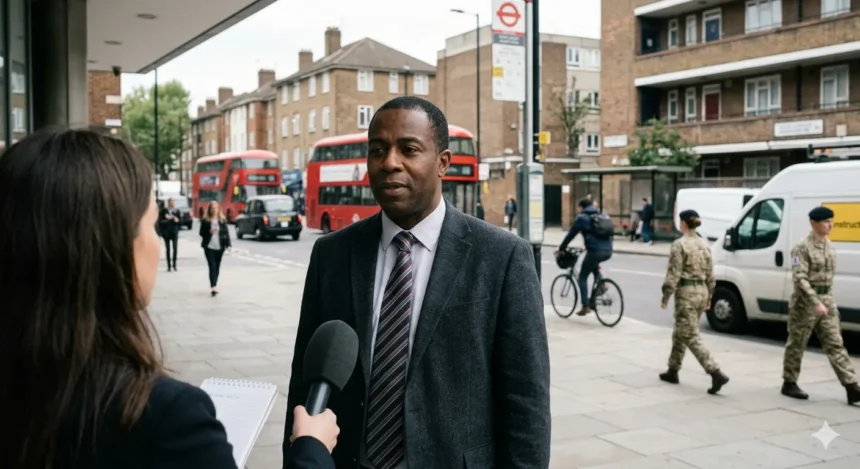
The Ministry of Defence is the United Kingdom government department responsible for defence policy, the armed forces, and national security, with its main London office at Whitehall, SW1A 2HB. In South London, its relevance appears through public-sector employment, defence-linked suppliers, transport access to central London, and wider national services that affect residents and workers across the city.
- What is the Ministry of Defence?
- Why does the MOD matter in South London?
- How did the MOD begin?
- What does the MOD do?
- What is the MOD structure?
- Where is the MOD in London?
- How many people work for the Armed Forces?
- What services does the MOD provide?
- How does the MOD affect jobs in South London?
- How does MOD procurement work?
- Why is the MOD important now?
- What should South London readers know?
What is the Ministry of Defence?
The Ministry of Defence is the UK ministerial department that sets and delivers defence policy, supports the Armed Forces, and oversees defence operations, procurement, and readiness. It works with 24 agencies and public bodies, and its headquarters is in Whitehall, London.
The MOD is one of the central departments of the UK state. Its published purpose is to protect the United Kingdom, its territories, values, and interests at home and overseas, while working with allies to support security and prosperity. That remit covers military operations, planning, logistics, capability development, and support for personnel and veterans.
The department also manages a large administrative structure. GOV.UK states that the MOD is supported by 24 agencies and public bodies, and its published pages list major functions such as services, guidance, research, statistics, procurement, and transparency reporting.
Why does the MOD matter in South London?
The MOD matters in South London because it affects jobs, public services, transport corridors, defence supply chains, and national decisions made in central London that shape local employment and security policy. The department’s Whitehall headquarters is within easy reach of South London commuters and organisations working with government.
South London residents encounter MOD activity in several ways. Public-sector and contractor jobs in defence often appear across London, including roles linked to policy, finance, logistics, engineering, and communications. London job listings for MOD-related work show that defence employment is not confined to one borough or one type of worker.
The MOD also influences the wider urban economy. Defence procurement and policy decisions affect suppliers, consultancies, technical firms, and service providers across the capital, including businesses with offices or staff in South London. The effect is indirect but real, because large government departments anchor demand for specialist skills and services.
How did the MOD begin?
The modern Ministry of Defence was formally established in 1947 under the Ministry of Defence Act 1946, although the office of Minister of Defence was created in 1940 during the Second World War. The department developed to coordinate the armed services under one central ministerial structure.
Before 1947, defence administration was split between the separate service departments. Wartime pressure pushed the UK government toward a single ministerial point of control, first through the Minister of Defence role and then through a permanent ministry after the war. This change reflected the need for unified strategy, budgeting, and command coordination.
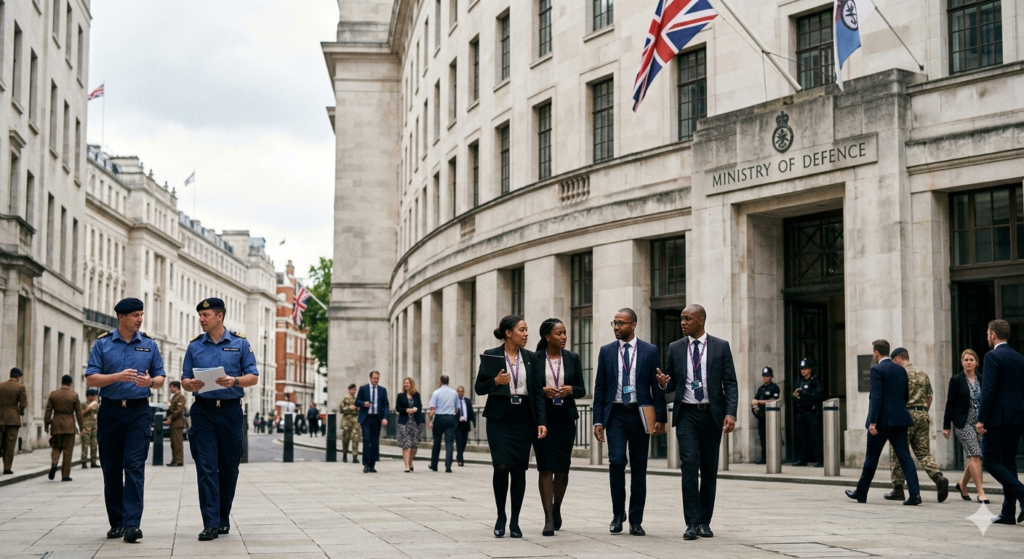
The MOD Main Building in Whitehall became the symbolic and administrative centre of this system. The building is a Grade I listed government office building and sits on a historic government site close to Parliament, which reinforces the department’s constitutional importance.
What does the MOD do?
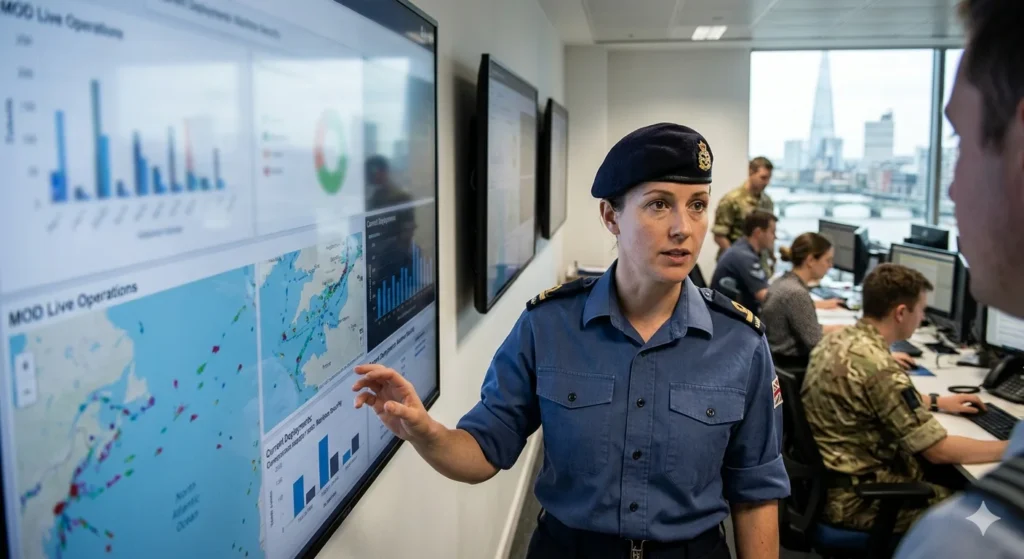
The MOD defends the UK, manages the Armed Forces, plans military readiness, oversees defence procurement, and supports operations, training, and logistics. It also publishes official statistics, guidance, policy papers, and transparency data for public accountability.
Its duties are broad and practical. Defence policy translates into decisions about force structure, equipment, personnel, nuclear capability, cyber operations, and international partnerships. The department also supports veterans’ services, records, pensions, and related public information services.
The MOD’s public activity is visible in its GOV.UK output. Its site lists press releases, guidance, research and statistics, policy papers, consultations, and FOI material. That range shows a department that is both operational and administrative, with responsibilities extending well beyond military command.
What is the MOD structure?
The MOD has a ministerial leadership layer, senior military leadership, management officials, and multiple agencies and public bodies. This structure connects political direction, military command, and technical delivery across defence planning and operations.
The department’s ministerial team includes the Secretary of State for Defence and several junior ministers. GOV.UK also lists senior military officials such as the Chief of the Defence Staff, service chiefs, and commanders for specialist commands. This arrangement places civilian control and military advice within the same departmental framework.
The MOD is also organised around major workstreams. Public sources describe top-level budgets such as operations, readiness, investment, and nuclear-related functions, while executive agencies include Defence Equipment and Support, the Defence Science and Technology Laboratory, the Submarine Delivery Agency, and the UK Hydrographic Office.
This structure matters because it separates policy, delivery, and oversight. A central department sets priorities, agencies deliver specialist functions, and public bodies handle technical or operational tasks that need dedicated administration. That design supports accountability and allows complex defence work to move through a defined chain of responsibility.
Where is the MOD in London?
The MOD’s principal London address is Whitehall, London, SW1A 2HB. Its Main Building is on Whitehall, near Parliament, and Defence Equipment & Support describes it as a historic Grade I listed building with around 90 people based there.
This location places the department at the centre of the UK government district. Whitehall is one of the country’s most important administrative streets, and the MOD sits among other core institutions involved in governance, security, and national decision-making.
For South London, the location is significant because Whitehall is easily connected by rail, Underground, bus, and road routes from southern boroughs. That makes the MOD relevant to professionals who commute into central London and to organisations that engage with government through meetings, contracts, and public policy work.
How many people work for the Armed Forces?
The UK Armed Forces had 182,050 service personnel at 1 January 2026, up by 1,270, or 0.7 percent, from 1 January 2025. The same statistics show 14,340 people joined and 13,500 left the Regular Armed Forces over the previous 12 months.
These figures matter because the MOD’s work is not abstract. It supports a large workforce that needs recruitment, training, equipment, housing, payroll, medical support, and administrative services. The personnel base also explains why the department publishes regular official statistics and why defence remains a major state function.
The January 2026 statistics also report a trained strength of 126,440 in the relevant trained categories and a reserve strength of 29,060 in the Trained Future Reserves 2020 measure. These figures show how the MOD manages not only active service personnel but also reserve capacity.
What services does the MOD provide?
The MOD provides services for veterans, military records, medals, pensions, complaints, confidential reporting, and freedom of information requests. It also publishes guidance, standards, and procurement information for public and industry use.
For individuals, the most visible services include the HM Armed Forces Veteran Card, military records of service, veterans’ support lines, and pensions guidance. These services matter for former personnel, families, employers, and organisations that need formal defence records or benefits information.
For the public and the press, the department provides contact routes for media enquiries, FOI requests, copyright licensing, vulnerability reporting, and other specialist issues. That public interface is important because the MOD handles matters that affect privacy, security, and legal access to information.
For industry, MOD information includes procurement and standards content. Defence procurement is a major part of the department’s role because it links government demand to suppliers of equipment, technology, engineering, and support services.
How does the MOD affect jobs in South London?
The MOD affects South London jobs through direct government roles, defence-related contractors, civil service posts, and supplier networks that support procurement, logistics, engineering, and administration. London listings show ongoing demand for MOD-related work across the capital.
The strongest effect is in specialist employment. London job listings linked to the MOD include policy, finance, skills, and stakeholder roles, while defence-related job boards also show vacancies connected to procurement and industry engagement. These patterns show that the department supports a broad professional ecosystem.
South London workers often access these roles through central-London commuting routes or hybrid working arrangements. Defence work also connects with local universities, training providers, IT firms, consultancies, and engineering companies that supply public-sector projects.
The benefit for the local economy is not limited to direct hiring. Large ministries create demand for cleaners, facilities staff, security, professional services, catering, IT support, and maintenance, which supports contracted work across Greater London, including southern boroughs.
How does MOD procurement work?
MOD procurement is the system through which the department buys equipment, services, and technical support for defence needs. It is central to readiness because the armed forces depend on regular acquisition, maintenance, and upgrade cycles.
Procurement covers items such as vehicles, aircraft support, cyber tools, communications systems, uniforms, accommodation services, and technical standards. The MOD publishes procurement information and spending data to support transparency and to help suppliers understand government demand.
This process also shapes the business environment in South London. Local firms that bid for government contracts must meet compliance standards, security requirements, delivery rules, and finance checks. That makes the MOD an important market for companies with the capacity to work in regulated public procurement.
The department’s structure helps procurement move from policy to delivery. Ministers set priorities, senior officials manage budgets, agencies carry out specialist tasks, and industry partners provide the goods and services needed by the armed forces.
Why is the MOD important now?
The MOD remains important because the UK faces modern security risks, including cyber threats, hostile states, military technology competition, and overseas instability. The department publishes current releases on deterrence, support for allies, and defence readiness.
Recent GOV.UK publications show active defence priorities, including support for Ukraine, air defence assistance, and UK maritime security operations. Those releases demonstrate that the department deals with live international security issues, not only historic military administration.
The modern MOD also has to maintain readiness while managing personnel numbers, equipment pipelines, housing, and industrial supply chains. The January 2026 personnel statistics show the scale of the workforce problem the department manages each quarter.
For South London readers, this relevance is practical. National security policy shapes public spending, recruitment, transportation, housing, and government contracting, all of which affect a metropolitan labour market like London’s. The MOD is therefore both a national institution and a local economic actor.
What should South London readers know?
South London readers should know that the MOD is a central government department based in Whitehall, that it runs a large defence system, and that it affects jobs, services, and contracts across London. It is a major public institution with direct and indirect local impact.
Its presence in the capital matters because central government decisions reach local communities through employment, supplier opportunities, veteran support, and public policy. For readers tracking South London news, the MOD sits within the network of institutions that influence the city’s economy and civic life.
Its scale also matters. The department supports 182,050 service personnel as of 1 January 2026 and operates through a large organisational structure with ministers, senior officers, agencies, and public bodies. That makes it one of the most significant departments in UK government.
What does the UK Ministry of Defence do?
The Ministry of Defence is responsible for protecting the UK’s security and interests. It oversees the armed forces, plans military operations, manages defence policy, and responds to national and international threats.