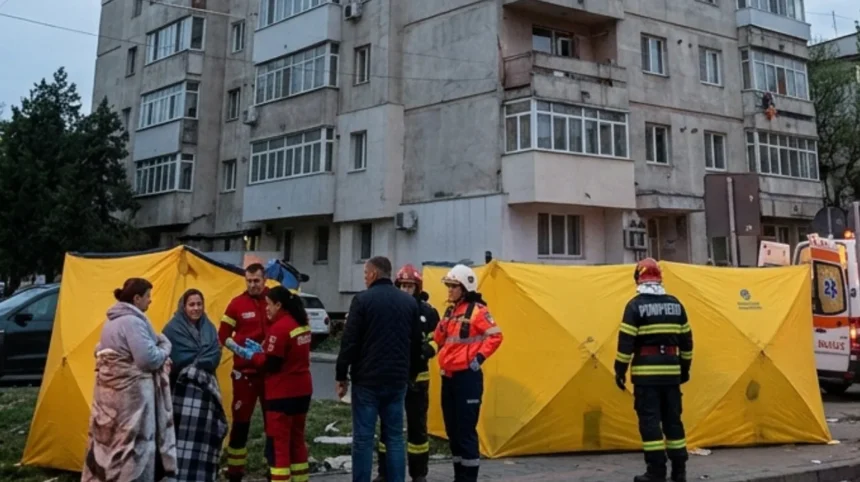
A Russian drone used in an overnight attack on Ukraine crashed into a 10-storey apartment building in Galați, eastern Romania, on May 29, 2026, injuring two people and marking the first time a Russian munition struck a residential structure inside a NATO member state since the full-scale invasion of Ukraine began. Romanian authorities confirmed the drone entered Romanian airspace, was tracked by radar, ignited a fire on the building’s roof, and caused minor injuries to two residents before the building was evacuated as a precaution. South London residents following international news will find this incident especially relevant as it demonstrates how the Ukraine war continues to spread beyond its borders.
- What exactly happened during the Russian drone incident in Romania?
- How did Romanian authorities respond to the drone crash?
- Why did a Russian drone strike occur in Romania territory?
- What is the historical context of Russian drone attacks near Romania?
- Which specific location in Romania was affected by the drone strike?
- How does Galați compare to other Romanian cities near the Ukraine border?
- What are the consequences of a Russian drone strike on NATO territory?
- Does this incident trigger NATO Article 5 collective defence?
- How does this drone strike affect regional security in Eastern Europe?
- What are the implications for Ukraine-Romania relations?
- What types of drones does Russia use in attacks near Romania?
- How effective are air defences against Russian drones near the Romanian border?
- What can civilians in border regions expect going forward?
- How does this incident compare to previous spillover attacks from the Ukraine war?
- What is the future outlook for drone attacks near Romanian territory?
- How might EU sanctions evolve following the drone strike?
What exactly happened during the Russian drone incident in Romania?
On May 29, 2026, a Russian attack drone part of an overnight Ukraine strike entered Romanian airspace, crashed onto a 10-storey apartment block in Galați, started a fire, and injured two people with minor wounds. The Romanian Defence Ministry stated the drone penetrated airspace during resumed Russian drone attacks on civilian and infrastructure targets near the Ukraine-Romania river border.
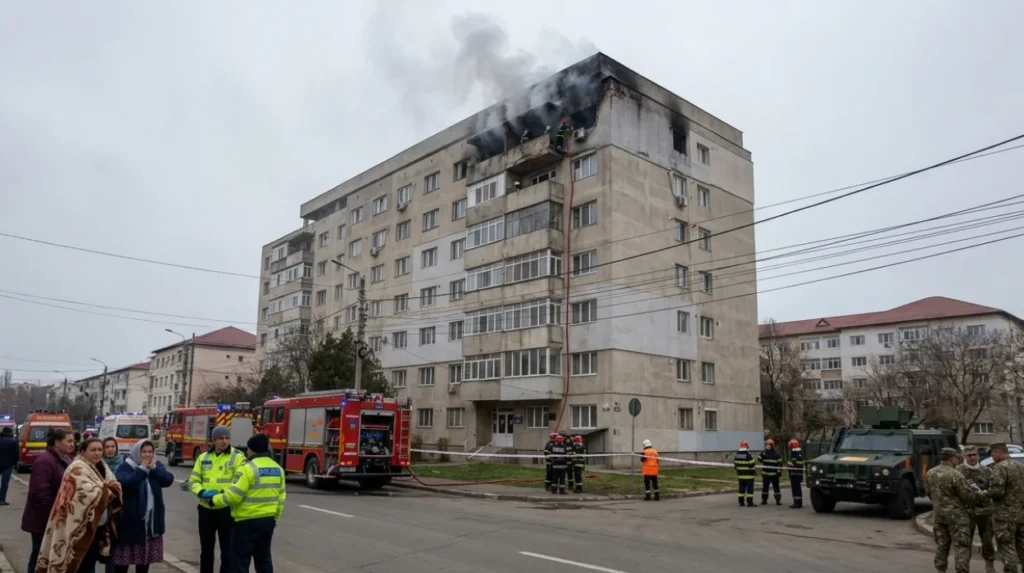
The incident occurred in Galați, a city in southeastern Romania located near Romania’s borders with both Ukraine and Moldova. The drone struck the roof of the residential building, causing a fire that emergency services extinguished. The Romanian General Inspectorate for Emergency Situations confirmed the impact on the 10-storey structure and reported that two individuals sustained minor injuries. Romanian officials evacuated the building as a precautionary measure following the crash.
This event represents a significant escalation because Romania is a member of both the North Atlantic Treaty Organization (NATO) and the European Union. The 650km land border between Romania and Ukraine places Galați in a strategically sensitive location near active conflict zones. Romanian President Niculae Dan called this incident “unprecedented” and convened an emergency defence council meeting. South London communities monitoring global security developments should note this escalation affects NATO’s eastern flank directly.
How did Romanian authorities respond to the drone crash?
Romania summoned the Russian ambassador following the incident, calling it an “extremely serious incident” and a “grave and irresponsible escalation.” President Dan demanded a “firm, coordinated, and appropriate response” to the drone incursion that struck a densely populated area.
The Romanian Defence Ministry issued an official statement detailing how the drone entered airspace during Russian bombardments targeting Ukrainian sites close to the river border. Radar tracking confirmed the drone’s path to the southern area of Galați before impact. The ministry emphasized that Russia had resumed drone attacks on both civilian and infrastructure targets near the border.
NATO expressed solidarity with Romania following the incursion. German Chancellor Friedrich Merz stated that “we need a strong NATO presence on the eastern flank” after learning about the drone strike. The alliance’s response emphasized collective defence principles while avoiding immediate military escalation. South London residents can follow NATO’s official statements for updates on alliance responses to this situation.
Why did a Russian drone strike occur in Romania territory?
The drone was launched during Russia’s overnight attack on Ukrainian infrastructure near the Ukraine-Romania river border, entered Romanian airspace accidentally or deliberately, and crashed into a residential building after failing to reach its intended Ukrainian target. Russia resumed drone attacks on civilian and infrastructure targets close to the border on the night of May 28-29, 2026.
Russian forces have increasingly used drone attacks targeting Ukrainian energy infrastructure, military facilities, and civilian areas. The Galați incident occurred during a resumption of these attacks after a period of reduced drone activity near the Romanian border. The drone had been used to bomb infrastructure in Ukraine before it deviated from its flight path and entered Romanian territory.
The geographic proximity of Galați to the Ukraine border explains why Romanian territory became involved. Galați sits near the Prut River, which forms part of the border between Romania and Ukraine. This location places the city within range of Russian drones launched from occupied Ukrainian territory or Russian bases in southern Ukraine. South London news consumers tracking international conflict should understand this geographic因素 explains why border regions face spillover risk.
What is the historical context of Russian drone attacks near Romania?
Prior to May 2026, Russian drones had entered Romanian airspace multiple times, with the most significant incident occurring on November 25, 2025, when NATO scrambled fighter jets to track two Russian drones during the first daytime breach since the full-scale Ukraine war began. The November 2025 incident marked the deepest incursion into Romanian airspace recorded during the conflict.
The May 29, 2026 drone crash represents an escalation from previous airspace violations because it resulted in physical damage to property and civilian injuries inside a NATO member state. Previous incidents involved drones entering and exiting Romanian airspace without striking targets or causing casualties. The November 2025 drone incursion was tracked by NATO aircraft but did not result in impact on Romanian soil.
Romania’s 650km land border with Ukraine creates continuous exposure to spillover from the conflict. Both Romania and Ukraine share borders with Moldova, adding another layer of regional complexity. The European Union and NATO membership of Romania provides legal protections under collective defence agreements, though Article 5 has not been triggered. South London readers interested in local governance can compare this international crisis response to how South London councils handle emergency situations.
Which specific location in Romania was affected by the drone strike?
Galați, a city in southeastern Romania with approximately 261,000 residents, experienced the drone strike on a 10-storey apartment building in an area near Romania’s borders with both Ukraine and Moldova. Galați is situated in the historical region of Moldavia and serves as an important port city on the Danube River.
The apartment building that was struck stands 10 storeys tall and houses multiple residential units. Emergency services evacuated the entire building as a precaution after the drone impact ignited a fire on the rooftop. The fire was contained to the roof area and did not spread extensively through the residential floors below.
Galați County, where the city is located, borders Ukraine to the east and shares proximity with Moldova to the southeast. This geographic positioning makes Galați one of the Romanian locations most vulnerable to spillover from the Ukraine conflict. The city’s distance from the actual border is approximately 30-40 kilometres, within range of short-to-medium range attack drones. For South London residents comparing urban vulnerabilities, Galați’s population density mirrors challenges faced by South London boroughs during emergencies.
How does Galați compare to other Romanian cities near the Ukraine border?
Galați is not the only Romanian city near the Ukraine border, but it is among the closest major urban centres. Other border cities include Siret in the north and Giurgiu in the south, though Galați’s position near both Ukraine and Moldova creates unique strategic vulnerability. The 650km land border spans multiple Romanian counties, with Galați County representing one of the most exposed segments.
The population density in Galați distinguishes it from smaller border villages. With approximately 261,000 residents, the city represents a significantly larger civilian population at risk compared to rural border communities. The drone striking a densely populated residential area rather than an isolated location increases the incident’s severity and potential for casualties. South London communities with similar population densities face comparable challenges in emergency evacuation planning.
What are the consequences of a Russian drone strike on NATO territory?
The drone strike constitutes a grave escalation because it represents the first confirmed Russian munition impact causing civilian injuries inside a NATO member state, triggering diplomatic protests, emergency defence council meetings, and calls for strengthened NATO presence on the eastern flank. Romania is a full NATO member since 2004 and EU member since 2007, providing legal protections under collective defence frameworks.
The incident has immediate diplomatic consequences including Romania’s summoning of the Russian ambassador and formal complaints through NATO channels. President Dan’s characterization of the event as “unprecedented” signals that Romania views this as crossing a threshold from previous airspace violations. The EU is preparing fresh sanctions against Moscow in response to the incident.
NATO’s response has focused on expressing solidarity with Romania while avoiding language that would automatically trigger Article 5 collective defence obligations. The alliance emphasized monitoring and deterrence rather than immediate military retaliation. German Chancellor Merz’s call for “strong NATO presence on the eastern flank” reflects the alliance’s strategy of defensive reinforcement without offensive escalation. South London residents following UK foreign policy can track how the British government responds within NATO frameworks.
Does this incident trigger NATO Article 5 collective defence?
No, the drone strike does not automatically trigger NATO Article 5 because the incident appears to result from a drone targeting Ukraine that deviated into Romanian airspace rather than a deliberate armed attack against Romania itself. Article 5 requires an armed attack against one member to be considered an attack against all members, but the determination rests with the North Atlantic Council.
The distinction between deliberate attack and accidental incursion matters significantly for Article 5 activation. Previous drone airspace violations in November 2025 did not trigger collective defence measures, and NATO appears to be maintaining similar caution following the May 2026 crash. The alliance is treating this as a serious incident requiring diplomatic response and enhanced monitoring rather than military retaliation.
Romanian officials have not formally requested Article 5 activation, instead focusing on diplomatic channels and EU sanctions. President Dan’s call for a “firm, coordinated, and appropriate response” suggests a multi-lateral approach involving NATO, the EU, and individual member states rather than immediate collective military action. South London communities interested in international law can study how Article 5 thresholds are interpreted in practice.
How does this drone strike affect regional security in Eastern Europe?
The incident significantly increases regional tensions by demonstrating that Russian drone attacks can reach NATO territory with physical consequences, prompting calls for enhanced air defences, strengthened NATO presence on the eastern flank, and fresh EU sanctions against Russia. The strike proves that Romania’s NATO membership has not prevented Russian munitions from impacting civilian infrastructure.
Eastern European NATO members including Romania, Bulgaria, Poland, and the Baltic states face increased vulnerability as Russia continues drone attacks on Ukrainian targets near their borders. The Galați incident demonstrates that airspace violations can escalate to physical damage and civilian casualties. This reality forces NATO to reconsider defensive posture and air defence capabilities along the entire eastern flank.
The EU’s preparation of fresh sanctions against Moscow reflects the broader international response to the escalation. Sanctions will likely target Russia’s defence industry, drone production capabilities, and financial systems supporting military operations. The incident strengthens arguments within the EU for increased military support to Ukraine and enhanced border security for member states sharing borders with conflict zones. South London residents following European politics can monitor how EU sanctions evolve from this incident.
What are the implications for Ukraine-Romania relations?
The incident strengthens Ukraine-Romania cooperation as both countries face shared threats from Russian attacks, with Romania providing increased support for Ukraine while managing spillover effects on its own territory. The border region between Ukraine and Romania has become increasingly militarized as both countries coordinate defence efforts.
Romania has been a significant supporter of Ukraine since the full-scale invasion began in February 2022, providing humanitarian aid, military equipment, and serving as a transit route for Western weapons. The drone strike has not diminished Romania’s support for Ukraine but has added urgency to calls for increased international protection for border regions. Ukrainian officials have expressed solidarity with Romanian civilians affected by the strike.
The shared border creates interdependence between Ukrainian and Romanian security. Russian attacks targeting Ukrainian territory near the border inherently risk Romanian casualties and infrastructure damage. This reality encourages closer military coordination and intelligence sharing between the two countries, even as Romania manages domestic political pressure to protect its own citizens from spillover violence. South London communities can draw parallels to how local neighbourhoods cooperate during shared crises.
What types of drones does Russia use in attacks near Romania?
Russia primarily uses Shahed-136/138 loitering munitions (Iranian-designed Geran-2 drones) and smaller tactical drones for attacks on Ukrainian infrastructure near the Romanian border. These drones have ranges of 1,000-2,000 kilometres and can carry warheads weighing 20-50 kilograms, sufficient to cause significant damage when striking residential buildings.
The Shahed-136 is a propeller-driven, jet-fuel powered drone with a wingspan of approximately 2.5 metres. Its relatively slow speed (180-200 km/h) and low-altitude flight profile make it difficult for radar detection but also vulnerable to interception. The drone’s small radar cross-section enables it to penetrate airspace without immediate detection, as demonstrated in both the November 2025 and May 2026 Romanian incidents.
Russia has produced thousands of these drones through domestic manufacturing and imports from Iran. The mass production allows Russia to deploy drones in large waves against Ukrainian targets, increasing the probability that some will evade air defences. The Galați incident likely involved a drone from such a wave attack targeting Ukrainian infrastructure near the Prut River border. South London technology enthusiasts tracking military innovation should note these drones represent accessible asymmetric warfare tools.
How effective are air defences against Russian drones near the Romanian border?
Air defences have limited effectiveness against Russian drone swarms due to the drones’ low altitude, small radar signature, and large numbers, allowing some drones to penetrate airspace and reach targets or deviate into neighbouring countries. NATO aircraft scrambled during the November 2025 incident successfully tracked the drones but did not intercept them, indicating interception challenges.
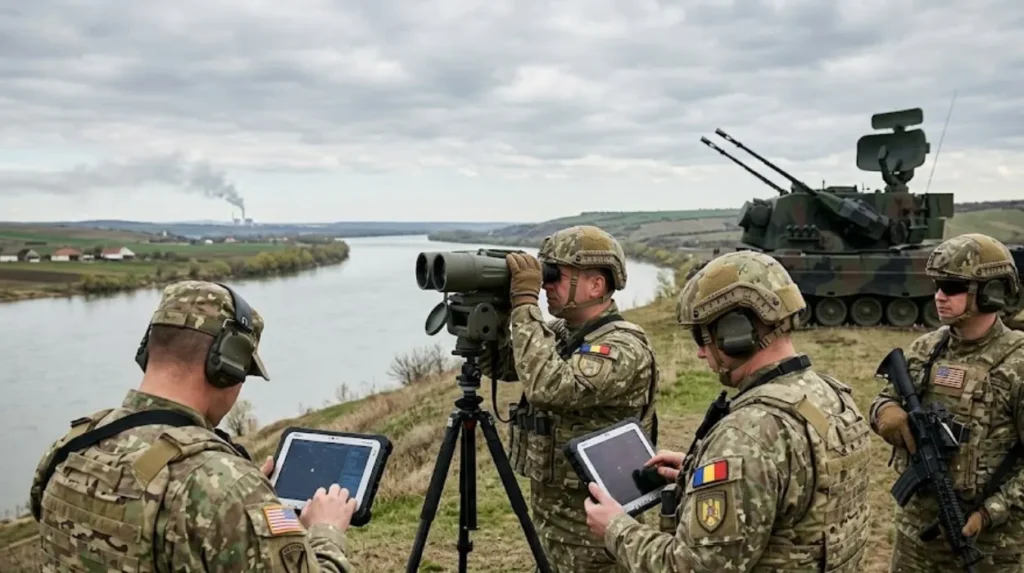
Romania and other NATO members along the eastern flank have deployed additional air defence systems since the full-scale Ukraine invasion began, including Patriot batteries, IRIS-T systems, and shorter-range MANPADS (man-portable air defence systems). Despite these deployments, the sheer number of Russian drone attacks overwhelms available interception capacity. The May 2026 incident demonstrates that drone penetrations continue despite enhanced defences.
The cost asymmetry between Russian drones and Western air defence interceptors creates strategic challenges. A Shahed-136 costs approximately $20,000-50,000, while a single air defence missile can cost $100,000-400,000. This economic reality makes sustained drone defence expensive and complicates decisions about when to commit limited interceptor resources. South London residents interested in defence spending debates can compare these costs to UK military budget allocations.
What can civilians in border regions expect going forward?
Civilians in Romanian border regions near Ukraine should expect continued drone incursions, potential property damage, emergency evacuations, and ongoing air defence activity as Russian attacks on Ukrainian targets near the border continue. The May 2026 incident establishes that residential areas face real risk from drone strikes.
Emergency preparedness measures for border region residents include maintaining awareness of emergency alert systems, identifying safe rooms or basement areas in buildings, and having evacuation routes planned. The Romanian General Inspectorate for Emergency Situations has updated protocols following the Galați incident to improve response times and evacuation procedures for future drone incidents.
Insurance coverage for war-related damage and drone strikes varies by policy and country. Romanian residents may face challenges obtaining compensation for damage from spillover attacks, as many standard insurance policies exclude war-related incidents. The Romanian government may need to establish special compensation mechanisms for civilians affected by the conflict’s spillover effects. South London residents can compare emergency preparedness guidance to conseils issued by South London borough councils during local emergencies.
How does this incident compare to previous spillover attacks from the Ukraine war?
The Galați drone strike ranks as the most serious spillover incident from the Ukraine war in terms of physical damage to residential property and civilian injuries inside a NATO member state, surpassing previous airspace violations and the 2022 Polish missile incident that killed two people. The November 25, 2025 drone incursion into Romanian airspace caused no damage or injuries.
The November 2022 missile strike in Przewodów, Poland, killed two civilians and initially raised concerns about Article 5 activation. Investigation later determined the missile was likely a Ukrainian air defence interceptor defending against Russian attacks rather than a deliberate Russian strike. The May 2026 Galați incident differs because it involved a confirmed Russian drone deliberately targeting Ukrainian territory that struck Romanian property.
Other spillover incidents include Russian shelling of Ukrainian border towns near Belarus and occasional drone incursions into Slovakian and Hungarian airspace. None of these incidents resulted in confirmed civilian injuries inside NATO territory until the Galați drone strike. The incident represents an escalation in the conflict’s geographic spread. South London news readers tracking conflict escalation patterns can monitor how similar incidents develop in other border regions.
What is the future outlook for drone attacks near Romanian territory?
Drone attacks near Romanian territory will likely continue and potentially increase as Russia maintains its campaign against Ukrainian infrastructure, with NATO enhancing air defences and monitoring along the eastern flank to prevent further incursions and civilian casualties. The May 2026 incident demonstrates that current defensive measures are insufficient to prevent all drone penetrations.
Russia’s drone production capacity remains substantial, with thousands of Shahed-series drones available for deployment. The Kremlin shows no indication of reducing drone attacks on Ukrainian targets near the Romanian border. Continued attacks will maintain pressure on Romania and other border NATO members to enhance defensive capabilities and prepare for potential escalation.
NATO’s response will likely include additional air defence deployments, enhanced surveillance and reconnaissance capabilities, and increased fighter jet patrols along the eastern flank. The alliance may also strengthen coordination with Romania on early warning systems and emergency response protocols. Enhanced NATO presence aims to deter further Russian incursions while avoiding direct confrontation. South London residents following UK defence policy can track how British military assets contribute to NATO’s eastern flank operations.
How might EU sanctions evolve following the drone strike?
The EU is preparing fresh sanctions against Moscow targeting Russia’s defence industry, drone production facilities, financial institutions supporting military operations, and individuals responsible for authorizing attacks near NATO territory. These sanctions will build upon existing EU sanction packages that have targeted Russia’s energy, financial, and technology sectors since 2022.
The new sanctions package will likely focus specifically on Russia’s unmanned aerial vehicle (UAV) programme, including entities involved in Shahed drone production, import, and deployment. The EU may also target Iranian entities supporting Russia’s drone programme, given Iran’s role as the original designer and supplier of the Shahed platform. Individual sanctions against Russian military leaders overseeing drone operations are also possible.
EU member states face varying levels of economic dependence on Russian energy and trade, which can complicate sanctions unity. However, the direct attack on Romanian territory has strengthened arguments for maximum pressure on Russia. The European Commission is coordinating with member states to ensure sanctions are comprehensive and enforceable while minimizing economic disruption to EU economies. South London businesses and residents affected by EU sanctions can monitor updates from the UK government’s sanctions implementation guidance.
The Russian drone strike in Romania represents a critical moment in the Ukraine war’s geographic expansion, demonstrating that NATO territory is no longer immune from physical damage and civilian casualties. The incident demands careful diplomatic management to prevent uncontrolled escalation while maintaining firm pressure on Russia to halt attacks threatening alliance members. South London communities staying informed about global security developments should continue monitoring NATO, EU, and UK government statements for updates on this evolving situation. This evergreen article provides foundational context for understanding how the Ukraine conflict continues to impact NATO member states and regional security across Eastern Europe.
What happened in the Russian drone incident in Romania?
A Russian drone involved in an overnight attack on Ukraine entered Romanian airspace on 29 May 2026 and crashed into a 10-storey apartment building in Galați, Romania. The impact caused a roof fire and left two residents with minor injuries.