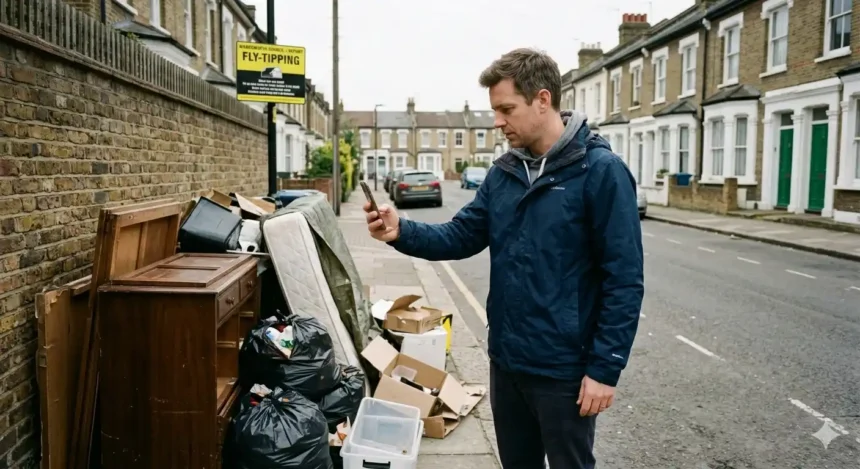
If you spot fly-tipping in Wandsworth, you should report it directly to Wandsworth Council using their online fly-tipping form and provide clear details of the location, what has been dumped, and any photos you can safely take. The council aims to remove most fly-tips on public land within 24–48 hours, although larger incidents may take longer if enforcement officers need to investigate.
- Why reporting fly-tipping matters
- Step-by-step: how to report fly-tipping in Wandsworth quickly
- 1. Stay safe and keep your distance
- 2. Note the exact location
- 3. Record what has been dumped
- 4. Take photos if it is safe
- 5. Report it online to Wandsworth Council
- 6. If you witnessed the incident, provide extra details
- Which council service handles fly-tipping
- Information and documents you will need
- Expected response time
- What to do if follow-up is required
- Rights and responsibilities under UK rules
- Practical tips to avoid fly-tipping in future
Why reporting fly-tipping matters
Fly-tipping harms local streets, parks, and estates across South London, making areas feel less safe and welcoming for local residents. Dumped rubbish can attract pests, block pavements, and create health risks, especially where food waste, hazardous materials, or sharp objects are involved.
Cleaning up illegally dumped waste also costs South London council services significant time and money that could be spent on other community priorities. By reporting fly-tipping quickly, residents in Wandsworth, Bexley, Bromley, Lewisham, Southwark, Greenwich, and Croydon help their councils act faster, gather evidence, and deter repeat offenders.
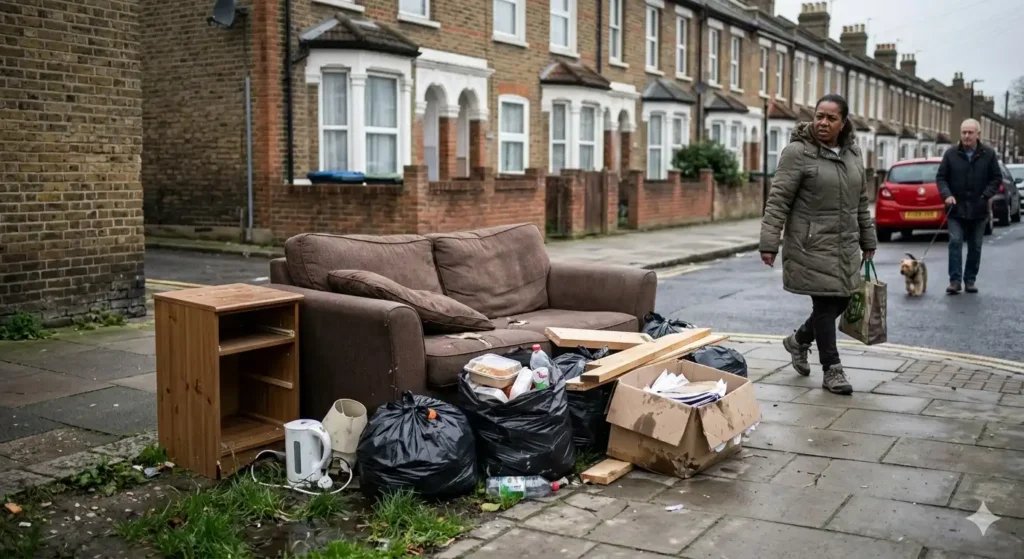
Step-by-step: how to report fly-tipping in Wandsworth quickly
Follow these steps to get a fly-tip dealt with as quickly and safely as possible under local council procedures.
1. Stay safe and keep your distance
Do not touch the waste, as it could contain hazardous materials such as chemicals, asbestos, broken glass, or clinical waste. If you see someone in the act of fly-tipping, do not confront them, because illegal dumping is a criminal offence and may be linked to other criminal activity.
2. Note the exact location
Make a clear note of where the fly-tip is so Wandsworth Council can find it quickly.
Useful details include:
- Street name and nearest house number or building
- Nearby landmarks (for example, a junction, bus stop, or park entrance)
- Whether it is on the pavement, road, alleyway, estate, or park
The more precise the description, the faster the crew can locate and remove the waste.
3. Record what has been dumped
Make a brief description of the rubbish so the council can send the right team and equipment.
For example, note:
- Type of waste (e.g. black bags, furniture, fridge, builders’ rubble, tyres)
- Approximate amount (e.g. a few bags, a pile covering a parking space)
This helps Wandsworth and other South London councils plan the clearance and any investigation.
4. Take photos if it is safe
If you can, take clear photos from a safe distance showing:
- The waste itself
- Its position in the street or space
- Any useful details such as vehicle details or labels on items
Wandsworth’s online reporting forms allow you to upload photos, which can speed up both clearance and enforcement action.
5. Report it online to Wandsworth Council
For fly-tipping on council-managed land in Wandsworth (public highways, council parks, and housing estates), you should use Wandsworth Council’s online fly-tipping reporting form. This form is specifically for fly-tipping and is the quickest way to reach the correct team.
You will be guided to:
- Confirm you are reporting fly-tipping rather than a missed collection
- Pinpoint the location
- Describe the waste
- Upload any photos
Online forms are designed to be mobile-friendly, so you can submit a report while you are still near the incident, which is particularly useful for busy local residents.
6. If you witnessed the incident, provide extra details
If you saw someone fly-tipping, Wandsworth Council’s enforcement team can use your information to investigate and may issue a Fixed Penalty Notice or prosecute.
They will find it helpful if you can safely provide:
- Date and time of the incident
- Description of the people involved
- Vehicle registration number and description, if relevant
- Any photos or video footage
Witness statements are treated confidentially, and residents are advised not to put themselves or others at risk to obtain evidence.
Which council service handles fly-tipping
In Wandsworth, fly-tipping on council-managed land is dealt with by the council’s street care and cleaning or environmental services teams, working with enforcement officers where appropriate. These teams are responsible for removing waste from:
- Public highways and pavements
- Council-managed parks and open spaces
- Council housing estates
If the fly-tipping is on private land (such as a private driveway, business yard, or housing association land), the responsibility for clearing it normally rests with the landowner, although the council may still investigate to look for evidence of who dumped the waste. Across South London, similar arrangements apply: bexley council, Lewisham Council, Southwark and other authorities each operate their own environmental services teams for public land, and expect landowners to manage private sites in line with local rules.
Information and documents you will need
When you report fly-tipping to Wandsworth or any South London council, you will typically be asked for:
- Exact location (street name, nearby address, landmark, or map pin)
- Description of the waste (type and quantity)
- Date and time you noticed it or saw it being dumped
- Any details about people involved (appearance, clothing) if you witnessed the incident
- Vehicle details if seen (registration number, make, model, colour, signage)
- Photos or video, if available and safely obtained
You do not usually need formal documents, but accurate information greatly improves the chance of a quick response and successful enforcement.
Expected response time
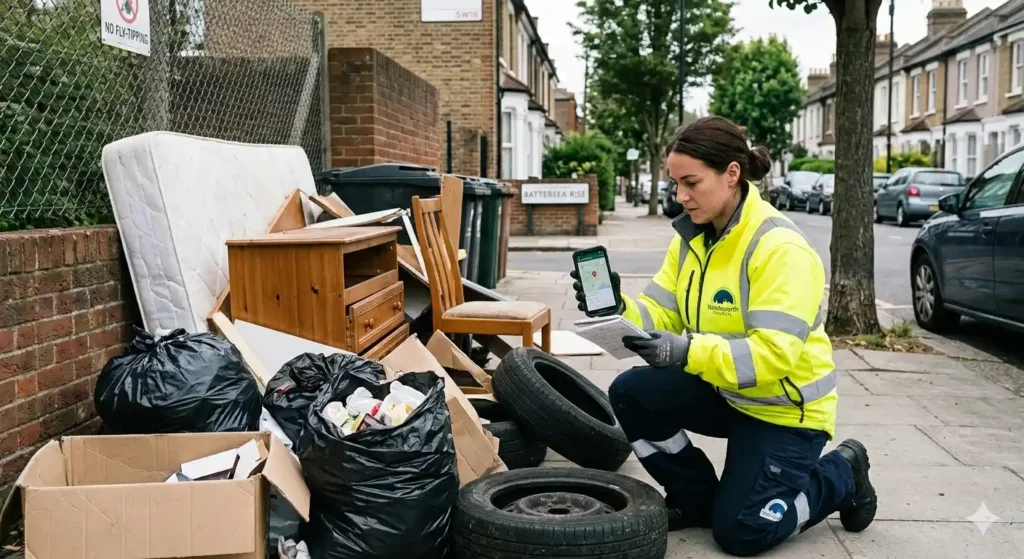
Wandsworth Council publishes target times for clearing fly-tips on the public highway.
They aim to remove:
- Small-scale fly-tips (less than two cubic metres) within 24 hours of reporting
- Large-scale fly-tips within 48 hours of reporting
These timescales apply to highway land and may be extended if enforcement officers need to inspect the waste for evidence before removal. Other South London councils, such as Harrow and similar London boroughs, often work to a one–two working day target for fly-tipping on public land, though exact times vary between authorities.
What to do if follow-up is required
When you submit a report using Wandsworth’s online form, you will usually receive confirmation that the issue has been logged. If the waste has not been removed within the expected timeframe, you can:
- Check whether the report reference confirms an investigation is in progress (for large or complex fly-tips)
- Submit an updated report if the problem has grown or changed
- Contact the council again quoting your original details
If the fly-tipping is on private land and remains uncleared, you may wish to contact the landowner or managing agent, as they are normally responsible for removal, while the council may take separate enforcement action where evidence allows.
Local residents in Bexley, Bromley, Lewisham, Southwark, Greenwich and Croydon can take a similar approach with their own South London council, using online forms, keeping reference numbers, and following up if clearance does not happen within the published timescales.
Rights and responsibilities under UK rules
Under UK law, fly-tipping is a criminal offence under the Environmental Protection Act 1990, and offenders can face prosecution and substantial fines. Wandsworth and other councils can issue on-the-spot Fixed Penalty Notices (FPNs) for smaller fly-tipping offences where they have sufficient evidence.
Local residents have the right to expect that:
- Fly-tipping on public land will be investigated and cleared within reasonable timescales
- Any information they provide will be treated confidentially
- Councils will use evidence to take enforcement action where possible
Residents also have responsibilities, including:
- Disposing of their own rubbish and bulky items using lawful routes (household collections, recycling centres, bulky waste services, or licensed waste carriers)
- Keeping a “duty of care” over their waste, meaning they must ensure anyone they pay to remove rubbish is properly licensed and disposes of it legally
- Not leaving items on the pavement or in alleyways in the hope someone will collect them, as this can be treated as fly-tipping in many boroughs
Practical tips to avoid fly-tipping in future
There are several practical steps residents in Wandsworth and across South London can take to reduce the risk of fly-tipping in their area.
- Use council services for bulky waste
Most South London councils provide bulky waste collection services for items like sofas, mattresses, and white goods, sometimes for a small fee. Using these services means items are collected legally and safely. - Visit local reuse and recycling options
Where suitable, donate unwanted items to charity shops or reuse schemes, or sell or give them away online, so they are kept in use rather than dumped. Some councils highlight local reuse initiatives to help residents pass items on responsibly. - Check waste carriers are licensed
If you pay someone to take waste away, always check they are registered as a waste carrier, and ask where the rubbish will go. If they dump it illegally and it can be traced back to you, you could be held responsible. - Store waste securely until collection
Put bags and bins out only on the correct collection day and secure them where possible, particularly in shared spaces, to reduce the chance of scavenging or mess that can lead to further dumping. - Report problems early
The sooner fly-tipping is reported in Wandsworth, Bexley, Bromley, Lewisham, Southwark, Greenwich, and Croydon, the faster councils can respond and prevent sites becoming regular dumping grounds.
By using the correct South London council channels, providing clear information and acting quickly, local residents can help keep Wandsworth and neighbouring boroughs cleaner, safer, and more pleasant places to live.
How do I report fly-tipping in Wandsworth?
You can report fly-tipping online through the Wandsworth Council website by submitting a quick report with details of the dumped waste.
Is there an app to report fly-tipping in Wandsworth?
Yes. You can use the Love Clean Streets app to report fly-tipping directly from your phone.
What information do I need to provide?
You’ll need the location of the fly-tipping, a brief description of the waste, and photos if possible.