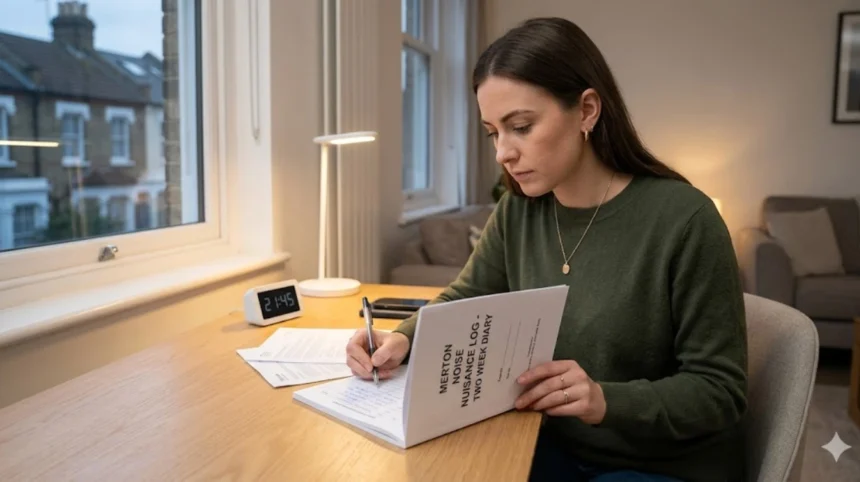
If you are dealing with persistent noise in Merton, the council’s diary process is often the most important first step because it helps Environmental Health assess whether the disturbance may amount to a statutory noise nuisance. In practice, the diary asks you to record incidents over roughly two weeks so the council can see patterns, frequency, timing, and impact rather than relying on a single complaint alone. The process is designed for ongoing problems such as loud music, parties, barking dogs, shouting, machinery, or other repetitive disturbances, and it can lead to further investigation if the evidence is strong enough.
What the 2-week diary is for
The 2-week diary is an evidence-gathering tool used by councils when a noise complaint is not a one-off emergency. It helps officers judge whether the problem is serious, regular, and capable of amounting to a legal nuisance, which under UK law means noise that unreasonably interferes with the use or enjoyment of a home or is prejudicial to health. Councils commonly ask residents to complete diary sheets first because those notes help decide whether the case should move to a warning letter, neighbour contact, monitoring equipment, or direct enforcement action.
For Merton residents, the diary is especially useful because many noise complaints depend on time, frequency, and what exactly was heard. A detailed log gives officers more to work with than a simple statement that “the noise was bad.” It also creates a clearer record if the case later needs follow-up or formal action.
When to use it
You should use the diary when the noise is recurring rather than an isolated event. Typical examples include late-night music, repeated barking, ongoing building noise, constant shouting, alarms, or regular mechanical noise from a nearby property or business. If the noise is happening right now and feels urgent, the online reporting route is usually the first step; the diary is then used to build the evidence over time.
The diary is not mainly for brief annoyances that stop quickly and never return. Councils generally use it where they need a clearer pattern before deciding whether the issue reaches the legal threshold for action. That is why the 2-week period matters: it gives a short but meaningful snapshot of the problem.
How to start the complaint
The usual process begins by making an initial report to the council through the noise or nuisance reporting route. Merton’s Regulatory Services Partnership routes nuisance reports through council systems used by partner boroughs, and the standard council process is to gather basic details first before asking for diary evidence where appropriate. After that, officers may issue or request diary sheets so you can record each disturbance consistently.
When you open the complaint, be ready with the location, type of noise, dates, times, and whether it is happening at the moment. It helps to be precise from the beginning because the quality of the first report often affects how quickly the case moves forward. In many cases, the council will not treat the diary as a separate formality but as part of the same investigation file.
How to complete the diary
The diary works best when you record each incident as soon as possible after it happens. Write the date, start and end time, the exact type of noise, where it seemed to come from, and how it affected you. A useful entry might say that loud bass music started at 11:20 pm, continued until 1:05 am, and made it impossible to sleep in the front bedroom; that level of detail is far more helpful than “music was loud”.
You should keep the notes factual and avoid guesses or emotional wording. Councils use the diary to assess evidence, so accuracy matters more than drama. If you can, note whether windows were closed, whether you moved rooms, whether the noise could be heard throughout the property, and whether anyone else heard it too. That kind of information can help an officer understand severity and frequency.
What officers look for
Environmental health officers are usually looking for patterns that show the noise is recurring, unreasonable, and linked to a specific source. They want to see whether it happens at anti-social times, how long it lasts, and whether it affects sleep, concentration, or day-to-day use of your home. A diary that shows repeated incidents over a short period is often more persuasive than a very long log with only vague notes.

If the diary suggests a genuine nuisance, the council may contact the person responsible, warn them that complaints have been made, or ask for a further diary after initial contact to see whether matters improve. If the problem continues, councils may use monitoring equipment or ask officers to witness the noise themselves before considering stronger action. This staged approach is common because it balances enforcement with evidence gathering.
Why the 2-week period matters
The 2-week period is not arbitrary. It gives enough time to capture repeated incidents while keeping the evidence recent and relevant. Many councils prefer short, structured diaries because they show a current pattern of behaviour rather than an outdated history of complaints. That can matter if the noise changes from week to week or happens mainly on certain nights.
It also encourages complainants to log events consistently instead of relying on memory. From an enforcement perspective, a well-kept two-week diary is often more reliable than a casual written summary after the fact. The clearer the diary, the easier it is for officers to decide whether further investigation is justified.
What happens after you submit it
Once you return the diary, an officer will review it and decide the next step. If the evidence is strong, the council may contact the source of the noise, issue a warning, or begin a more formal investigation. If the diary does not show enough detail or does not indicate a likely nuisance, the council may decide that no further action is possible at that stage.
If the matter continues after initial contact, the council may ask for another diary or move to monitoring equipment to confirm the problem. In some cases, an officer may try to witness the noise directly, and if a statutory nuisance is established, the council can serve an abatement notice. That is why it is worth filling out the diary carefully the first time: it can shape the whole direction of the case.
Confidentiality and evidence
Residents often worry that a complaint will be shared with the neighbour or business causing the noise. In general, complainant details are kept confidential and are not passed on when the council investigates. However, if a case proceeds to court and an abatement notice is relied upon, diary sheets may be used as evidence.
That means the diary should be written with the understanding that it may later be read by an officer, lawyer, or tribunal. Keep it objective, legible, and consistent. Avoid exaggeration, because credibility matters when the council is deciding whether the noise is likely to be a legal nuisance.
Common mistakes to avoid
One common mistake is writing too little detail. A note like “loud again” does not tell the council much about duration, timing, or impact. Another mistake is filling the diary in days later from memory, which can make times and descriptions less reliable.
It is also important not to mix different problems together without clarity. Noise from a neighbour, a pub, a business, or roadworks may all be relevant, but each needs clear identification if possible. The council’s job is to assess evidence, so neat, consistent records are much more useful than long emotional descriptions.

A practical example
Imagine a resident in Merton hears loud amplified music from a nearby flat over several evenings. On Monday, the noise starts at 9:45 pm and continues until 12:10 am; on Wednesday, it returns at 10:15 pm and lasts until 1:00 am; on Friday, the bass is strong enough to be heard in the bedroom with windows closed. That sort of repeated pattern over two weeks gives the council a basis to consider whether the disturbance is persistent and unreasonable.
Now compare that with a vague note saying “noise most nights.” The first example gives dates, times, duration, and impact. The second does not, which makes it much harder for an officer to act confidently.
Why this matters for South London readers
For South London residents, local noise complaints often sit between everyday annoyance and formal enforcement. A good diary helps bridge that gap because it turns a frustrating experience into structured evidence that an environmental health officer can assess. In areas like Merton, where housing is close together and mixed residential-commercial streets are common, that evidence can make the difference between a stalled complaint and a meaningful investigation.
It also helps residents understand what the council can and cannot do. Councils do not usually act on every irritation, but they do investigate possible statutory nuisance using evidence-based procedures. The diary is central to that process because it shows whether the disturbance is sustained, unreasonable, and serious enough to justify formal steps.