Key Points
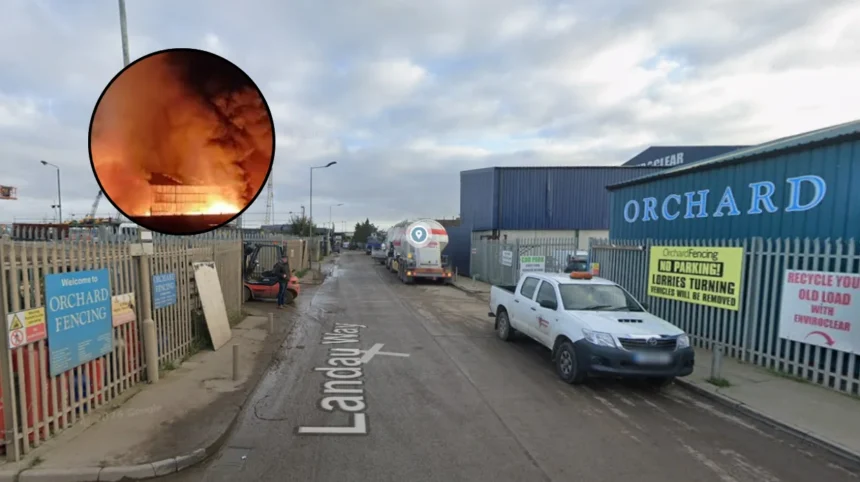
- Incident Location and Scale: A major industrial fire erupted at a scrap yard on Landau Way in Erith, South East London, involving approximately 100 tonnes of scrap metal.
- Emergency Response Forces: Ten fire engines and around 70 firefighters were dispatched to the scene, with emergency crews arriving from London, Kent, and Essex.
- Widespread Visual Impact: The blaze produced massive plumes of thick black smoke that were visible across the River Thames, reaching parts of South Essex and the Dartford Crossing in Kent.
- Specialist Equipment Deployed: Fire services utilised advanced firefighting tools, including a 32-metre turntable ladder, two water bowsers, a high-volume pump, a water relay system, and an aerial drone team.
- Casualties and Status: No injuries or casualties were reported during the incident, and emergency responders successfully brought the fire under control by Wednesday evening.
- Current Investigation: The official cause of the industrial blaze remains unknown and is currently under investigation by the London Fire Brigade’s Fire Investigation Unit.
Erith (South London News) June 18, 2026 – A major industrial fire broke out at a commercial scrap yard in South East London yesterday afternoon, sending dark plumes of smoke billowing across the River Thames and drawing an emergency response from multiple county fire services. Ten fire engines and approximately 70 firefighters were mobilised to suppress the inferno, which compromised around 100 tonnes of scrap metal at an industrial estate located on Landau Way, Erith. Emergency emergency services worked for several hours to contain the incident, which caused significant visual disruption visible from Kent and Essex but resulted in no reported injuries.
As detailed in official incident logs released by the London Fire Brigade (LFB), emergency control officers received the initial emergency call at 10:50 am on Wednesday, June 17, 2026. Crews from Erith, Bexley, Plumstead, and surrounding municipal fire stations were immediately dispatched to the scene along the banks of the River Thames.
Due to the scale of the fire and the volume of combustible material involved, mutual aid was requested, bringing in additional assets and personnel from the Kent Fire and Rescue Service and the Essex County Fire and Rescue Service.
The physical footprint of the blaze generated substantial amounts of thick, dark smoke that drifted across the regional waterways. As reported by Jessica Day-Parker, Deputy Live Lead for the Colchester Gazette, the massive smoke plumes were dense enough to be clearly seen by motorists on the Dartford Crossing in Kent and by residents living in parts of South Essex.
In response to the worsening atmospheric conditions, a spokesperson for the London Fire Brigade issued an immediate public safety directive, stating:
“People in the area are advised to keep their windows and doors closed at this time.”
To overcome the challenges of a dense metal fire, operational commanders deployed an array of specialist tactical assets. According to an official public notice published by the London Fire Brigade media team, crews utilised a 32-metre turntable ladder configured as an elevated water tower to pour water onto the heart of the flames from height. Additionally, two water bowsers and a high-volume pump were brought to Landau Way to establish a high and continuous supply of water.
Firefighters implemented a strategic water relay system to combat the logistical strain of the industrial estate’s layout.
As recorded in the London Fire Brigade’s incident summary, appliances were positioned in a chain formation between the primary fire site and the nearest functioning water hydrant.
By connecting these vehicles sequentially via high-pressure hoses, crews were able to maintain a constant, uninterrupted flow of water directly to the burning scrap heaps.
Advanced technological tools were also used to manage the emergency operations from a command level. The London Fire Brigade’s specialized drone team was deployed directly to the scene on Landau Way.
As noted in the LFB operational update, these aerial drones provided the Incident Commander with enhanced situational awareness of the fire’s boundaries, tracking hot spots and monitoring smoke propagation in real time.
Operational coordination extended beyond emergency service personnel, involving the active participation of local industrial workers. As stated in the official report from the London Fire Brigade,
“The Brigade has also been liaising with on-site staff and their machinery was used to safely remove waste from the scene to reduce fire spread and turn over scrap metal to extinguish deep-seated pockets of fire.”
The utilization of on-site heavy excavators allowed crews to break apart the compressed metal piles, exposing deeply buried embers to the water streams.
Through these combined efforts, the multi-agency response successfully mitigated the emergency within several hours. The London Fire Brigade officially declared the blaze under control at 5:13 pm on Wednesday evening, roughly six and a half hours after the first emergency call was logged.
While the primary open flames were extinguished by early evening, select crews remained on-site on Landau Way well into the night to continue damping down the remaining hot spots and preventing re-ignition.
The financial and environmental damage to the local industrial area is still being calculated, but the lack of casualties provided relief to local authorities. A formal statement issued via the London Fire Brigade incident registry confirmed that “there were no reports of any injuries” among the scrap yard workers, local residents, or the dozens of emergency responders on the scene.
The exact origin of the ignition and the precise materials that fueled the 100-ton metal fire remain unverified, and the incident has been passed to the Brigade’s specialized Fire Investigation Unit for a thorough forensic examination.
Background of Scrap Yard Fires in Erith
The industrial corridors of Erith and the wider Borough of Bexley have a documented history of major recycling and scrap metal fires, owing to the high concentration of industrial estates operating near the Thames riverbanks. In March 2026, a separate incident occurred on nearby Manor Road in Erith, where a scrap metal recycling yard caught fire, compromising approximately 400 tonnes of scrap metal.
That previous incident required 12 fire engines, 80 firefighters, and the deployment of a specialized LFB fire boat to pump water directly from the River Thames.
Industrial metal recycling sites present distinct operational hazards for fire services due to the varied composition of scrap piles. These piles often contain mixed materials, residual petroleum products, industrial plastics, and lithium-ion batteries, which can ignite under pressure or friction.
Because metal retains heat intensely, these fires routinely become “deep-seated,” meaning the fire burns deep within the center of a pile where water cannot easily penetrate without the use of heavy machinery to pull the debris apart. Consequently, municipal authorities and environmental agencies have maintained ongoing scrutiny over storage thresholds and safety protocols within South East London’s industrial zones.
Predictions and Future Impact on Local Stakeholders
This latest industrial fire on Landau Way is expected to have a direct impact on several key audiences, most notably local residents, regional commuters, and the industrial businesses operating within the Erith commercial zones. For residents living in Erith, Bexley, and across the river in South Essex, this incident will likely trigger heightened demands for stricter environmental oversight.
The recurring nature of thick, potentially toxic smoke plumes over residential areas will intensify local campaigns focused on air quality monitoring and the enforcement of stricter buffer zones between heavy recycling yards and residential neighborhoods.
For the business community and operators of scrap recycling facilities, this development is highly likely to result in tighter regulatory pressure from the Environment Agency and the London Fire Brigade. Facilities may face mandatory safety audits, lower maximum tonnage limits for stored materials, and stricter requirements regarding the separation of scrap piles to prevent lateral fire spread.
Furthermore, local commuters utilizing major arteries like the Dartford Crossing could experience future preventative traffic diversions or speed restrictions if municipal authorities implement stricter protocols for smoke-induced visibility drops across the River Thames.