Key Points
- Elmers End is a suburban district in south-east London, now within the London Borough of Bromley.
- One longstanding theory claims the name comes from a highwayman named Elmer who was hanged at the crossroads, so that he met his “End”.
- An alternative and more historically grounded explanation links the name to the medieval Aylmer (or Elmer) family, wealthy landowners in the area during the reign of Henry III.
- Wikishire suggests the name may derive from an Anglo-Saxon term associated with criminals and public punishment, and that Elmers End Green may once have been used for executions.
- Today, Elmers End Green is essentially a traffic roundabout with a small public space, around 11 miles from Charing Cross.
- The area is bordered by Beckenham, Anerley, Eden Park, and Monks Orchard, and forms part of outer south-east London’s suburban belt.
Bromley (South London News) July 4, 2026 –The Bromley area where executions may have taken place on a village green is now at the centre of a renewed discussion about place-name origins and local history. Elmers End, a suburban district in south-east London whose name may originate from a place of execution, has long been associated with two competing theories: one romantic, involving a highwayman called Elmer, and one more severe, suggesting that the name reflects a site where criminals were publicly punished.
As reported by local historians referenced on Wikishire, one longstanding theory claims a highwayman named Elmer was hanged at the crossroads, where Elmer met his “End”, according to Foxtons.
This narrative has been repeated in area guides and online summaries, often presented as a “more romantic” origin story for the name.
However, according to Wikishire, the name may instead derive from an Anglo-Saxon term associated with criminals and public punishment, and that Elmers End Green, now a traffic roundabout and small public space, may once have been used for executions. Local theories, as summarised on community sites and property portals, say that criminals were publicly executed on Elmers End Green.
How Do Historians Explain the Name Elmers End?
The most historically grounded explanation for the name links it to the medieval Aylmer family, wealthy landowners who held estates in the area during the reign of King Henry III.
According to Wikipedia, in old English place-name conventions, “End” referred to the edge or boundary of an estate, making Elmers End effectively “the boundary of the Aylmer lands”.
Bromley Council’s own local history material states that “Elmers End – 1226” refers to
“the end or part of the parish (of Beckenham) owned by the Elmer or Aylmer family”.
This official account supports the Aylmer-boundary theory and places the name’s origin in the 13th century, well before the Victorian railway era.
As reported by the Beckenham Residents Association in a 2022 article on the history of Elmers End Green, Elmers End, as a district, was first recorded in the reign of Henry III (1216–1272) as land owned by Ralph Aylmer.
This aligns with Wikipedia’s description of the Aylmer family as local landowners in the 13th century.
Why Does the Execution Theory Persist Despite Weaker Evidence?
The execution theory persists partly because it fits a familiar pattern in English place-name lore, where greens, fairs, and crossroads are sometimes linked to public punishment.
Wikishire suggests that the name may derive from an Anglo-Saxon term associated with criminals and public punishment, and that Elmers End Green may once have been used for executions.
Yet, as noted by property agent Foxtons, while the highwayman story is romantic, the explanation that the name comes from elm trees or from the Aylmer family is “possibly more historically accurate”.
Foxtons also points out that the name Elmers End clearly predates the coming of the railway by at least ten years, which undermines some later folklore.
The Beckenham Residents Association does not explicitly mention executions in its 2022 history of Elmers End Green, focusing instead on the Aylmer ownership and the development of the green as a public space. This suggests that, while the execution story is widely circulated online, it is not emphasised in more formal local-history accounts.
Where Is Elmers End Today and What Does Elmers End Green Look Like Now?
Today, the area sits within the London Borough of Bromley, bordered by Beckenham, Anerley, Eden Park, and Monks Orchard.
It lies around 11 miles from Charing Cross and forms part of outer south-east London’s suburban belt.
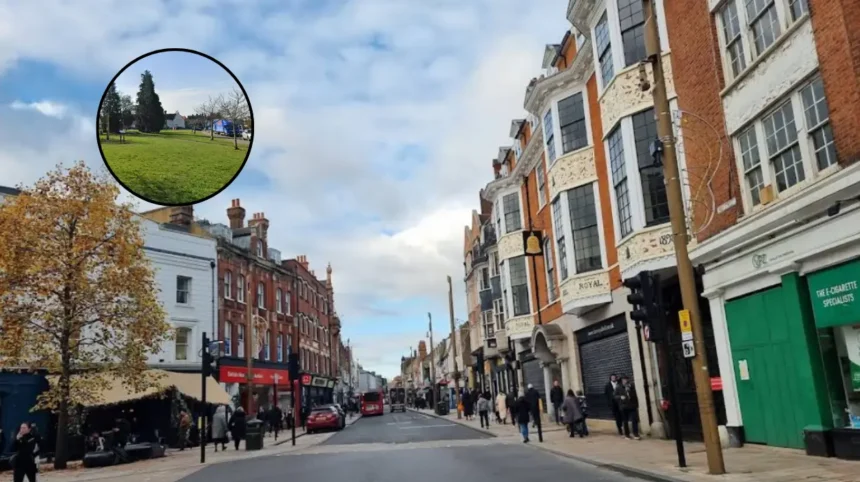
Elmers End Green, formerly a village green, is now described as a traffic roundabout and small public space. Local theories say that criminals were publicly executed on Elmers End Green, but the site today is primarily a junction with limited open space, rather than a traditional green.
The area remains a residential suburb with local shops, transport links, and community facilities, and the name continues to be used for the station, roads, and neighbourhood identity.
Background of the Development
The discussion about Elmers End’s name origins is not a new discovery but a reiteration of long-standing local folklore and place-name analysis.
The two competing theories – the highwayman Elmer and the Aylmer boundary – have both circulated for many years in property guides, local-history websites, and community forums.
Wikishire’s suggestion that the name may derive from an Anglo-Saxon term associated with criminals and public punishment, and that Elmers End Green may once have been used for executions, adds a sharper dimension to the folklore.
However, official sources such as Bromley Council and the Beckenham Residents Association emphasise the Aylmer family connection and the 13th-century recording of the name, without confirming executions on the green.
The persistence of the execution story illustrates how local legends can survive alongside more documented historical explanations, particularly when they are repeated on popular websites and property portals.
There is no current archaeological or documentary evidence cited in these sources that definitively proves executions took place on Elmers End Green; the claim remains part of local theory rather than established fact.
Explore More Bromley News
Galliard Gains Approval for 222 Flats in Bromley 2026
Emergency Services Incident Closes Bromley High Street, 2026
What Could This Development Mean for Local Residents and History Enthusiasts?
If the execution theory gains more attention, it could affect how Elmers End is presented in local history materials, area guides, and community storytelling.
Residents and history enthusiasts might see increased interest in the site’s past, potentially leading to discussions about commemoration, signage, or educational content about the area’s medieval and early modern history.
For people using the area for leisure or commuting, the story could become part of the local identity, adding a layer of historical intrigue to everyday use of Elmers End Green and the surrounding neighbourhood. However, without stronger evidentiary support, the execution claim will likely remain a piece of local folklore rather than a confirmed historical fact, meaning its impact will be mostly cultural and narrative rather than practical.