Key Points
- Croydon’s streets celebrated the news of the Armistice on 11 November 1918 with joy, gaiety, and spontaneous festivities.
- Flags and bunting in red, white, and blue sold rapidly; shops closed early after selling out.
- The day featured symbolic sounds: munitionettes used factory tools to make noise, church bells that had been silenced since 1914 were rung, and maroons (flares) exploded in celebration.
- Aerial celebrations included planes flying low over Croydon, dropping victory leaflets and displaying coloured lights.
- A large service was held at Croydon Parish Church attended by local dignitaries, with a hopeful sermon calling for change and brotherhood.
- Despite general joyful celebrations, a knife incident at Café Royal led to arrests and fines; alcohol was blamed as a contributing factor.
- Newspapers also conveyed mixed emotions including grief, sorrow, and loss alongside pride and thankfulness.
- The Armistice ended the First World War fighting at 11am on 11 November 1918 after over four years of conflict, marking a moment still solemnly commemorated today.
What happened in Croydon when the Armistice was announced?
On Monday 11 November 1918, as the Armistice came into effect bringing an end to more than four years of war, Croydon erupted in spontaneous celebrations. Local newspapers of the time captured the atmosphere vividly: the streets were packed with throngs of people waving flags and wearing symbolic colours of red, white and blue, regardless of nationality. David Morgan, sifting through the cuttings in the Minster archives, described the borough’s chief industry that day as flag selling, with shops and sales assistants fervently distributing flags to a grateful public.
- Key Points
- What happened in Croydon when the Armistice was announced?
- How did Croydon’s people express their joy and relief?
- Why were the church bells in Croydon significant that day?
- How did aerial displays contribute to the celebrations?
- What was the significance of the evening service at Croydon Parish Church on Armistice Day?
- Were there any incidents during the celebrations?
- What mixed emotions were reflected in the newspapers after the Armistice?
- Why is the Armistice Day still commemorated in Croydon and worldwide?
According to the reports, the crowds were lively, with many adults and children sporting paper hats in tri-colours, while prams pushed down the High Street were decked with flag decorations. Commercial activity paused early in the day, as once flags and bunting were exhausted, many shops closed their shutters or finished business at lunchtime.
How did Croydon’s people express their joy and relief?
Not only was the day a visual spectacle, but it also involved exuberant noise-making. As one reporter noted,
“300 munitionettes set Noth End agog,”
highlighting the young women who took circular saws and metal tools from their wartime factory work into the streets to create an “exceptional band” of celebratory noise. This was particularly symbolic because these tools had recently been used in munitions production for the war effort.
In West Croydon, a gathering of wounded soldiers surrounded a bus departing for Merstham—the crowd boarding with joyful abandon. Elsewhere, a group of women with white flowers in their hair played “ring-a-ring of roses” and other children’s games near the tram terminus, exemplifying the carefree spirit after years of hardship.
Why were the church bells in Croydon significant that day?
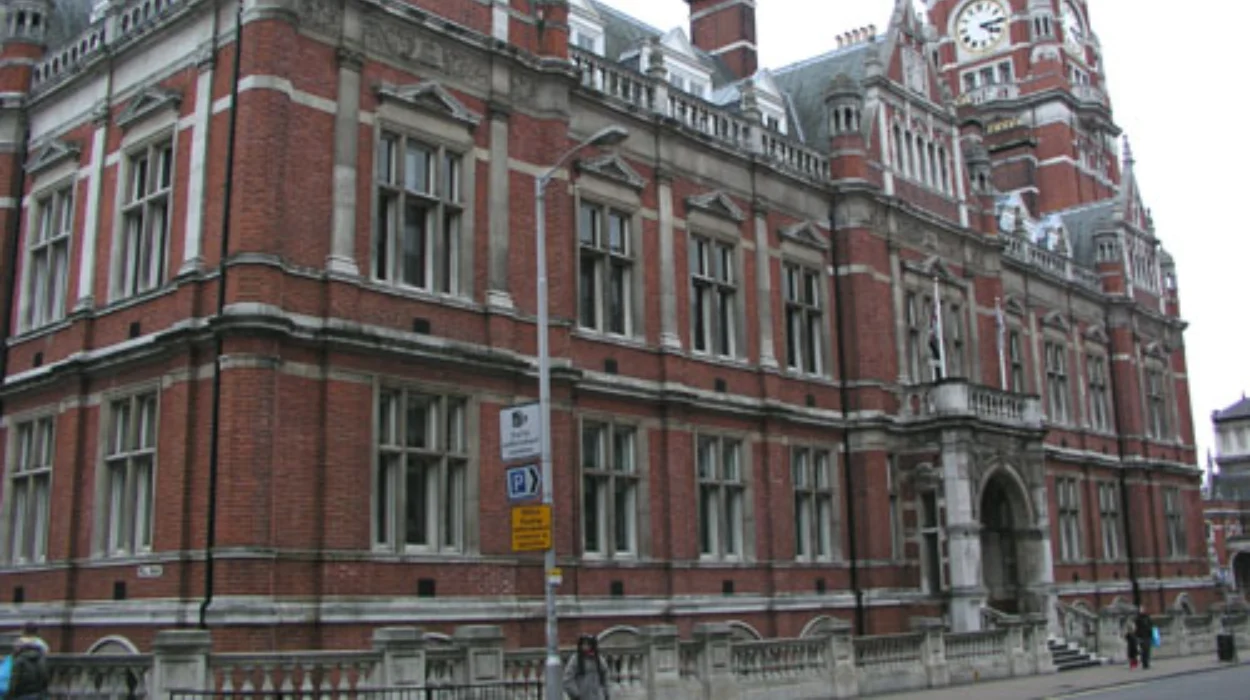
One woman, standing on the steps of the Town Hall, was one of the first to hear church bells ringing after a long silence since 1914. The Defence of the Realm Act had silenced the bells during the war to prevent false alarms. Their ringing was thus a powerful symbol of peace and freedom restored.
Maroon flares were also fired off, adding their distinctive explosive sounds to the celebrations. Bunting adorned many buildings, displaying flags of “all the civilised nations,” showing solidarity with the Allied Forces. The entire borough was “ablaze with the colours of the Allied Nations”.
How did aerial displays contribute to the celebrations?
Ausrusting the skies, a “mammoth batleplane” flew toward the Town Hall. Smaller planes flew daringly low over the town, discharging colourful red and green lights and scattering hundreds of victory leaflets over cheering crowds. One pilot’s low flyover on Katharine Street was met with enthusiasm, and his wave from the cockpit symbolised a new dawn for the community.
What was the significance of the evening service at Croydon Parish Church on Armistice Day?
Despite wet weather marks in the evening, enthusiasm remained undimmed as musical instruments such as mouth organs, buzzers, and concertinas combined with the crackle of Chinese crackers, creating a special atmosphere. A well-attended service at Croydon Parish Church included the Mayor Alderman Howard Houlder and other notable Croydon Corporation representatives.
Rev Leonard White-Thompson offered a sermon expressing thanks to God who sustained the borough through the “darkest days” of war. Importantly, he called for societal transformation, advocating the removal of prejudices and the spirit of self-seeking, and urged the development of brotherhood. He emphasised responsibility on both elected representatives and citizens for positive change.
“The hymn ‘Now thank we all our God’ was sung most fervently,”
Were there any incidents during the celebrations?
Despite the overwhelmingly joyous mood, there was a serious incident reported involving a couple at the Café Royal in North End on the Sunday evening prior to the Armistice. The police were called after a woman was spotted running with knives in both hands, threatening violence following a dispute with staff over service availability as the restaurant closed.
The woman and her soldier companion appeared in court the following day, each fined 20 shillings (about £1 then, equivalent to £70 today), with the woman paying an additional small fine. The soldier’s officer covered his fine, providing testimony of good conduct. Excess alcohol consumption was cited as the cause of the altercation. However, drunkenness was not widespread; only one other intoxicated individual faced magistrates on 12 November, fined one shilling for being found slumped in Church Street.
What mixed emotions were reflected in the newspapers after the Armistice?
While the public rejoiced, newspapers also gave voice to the complex emotions experienced by many. There were reflections of grief for the lost, pride in service, thankfulness for peace, and sorrow for those still absent or forever changed by war.
A young lady was quoted saying,
“I must be happy with you today and forget my own sadness,”
encapsulating the bittersweet mood of the day. Some found solace in faith, others questioned it, shaped by the horrors they had endured.
Why is the Armistice Day still commemorated in Croydon and worldwide?
The Armistice that silenced guns on 11 November 1918 was the beginning of peace, not its final conclusion. Ceasefire began at the eleventh hour of the eleventh day of the eleventh month, marking the official end to fighting on the Western Front and symbolising the hope for a lasting peace after the devastating First World War.
Memorial services such as those at Croydon Town Hall, the RAF memorial by Purley Way, Kenley aerodrome, Coulsdon, and Croydon Minster continue to honour those who died and reflect on peace. The poppy remains the potent symbol of remembrance, alongside solemn rituals such as the two-minute silence, the playing of buglers or pipers, and the lowering of standards.
These traditions, observed every Remembrance Sunday (this year on 9 November) and Armistice Day itself (11 November), connect generations in remembering sacrifice, reflecting on conflict, and renewing hopes for peace.