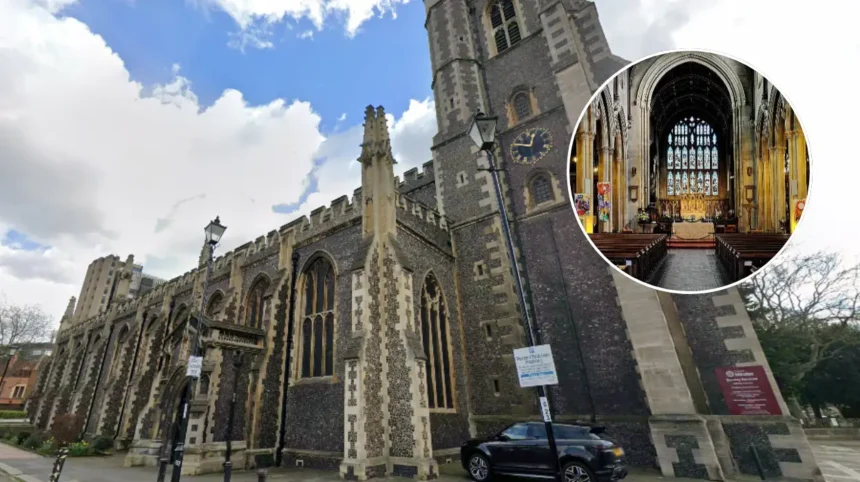
Key Points
- St John the Evangelist church in Upper Norwood, Croydon, South London, has been sinking and expanding since the 1990s due to soft ground exacerbated by climate change.
- The church, a 19th-century structure on Sylvan Road atop a hill, has suffered significant structural damage, particularly on the south side.
- By 2014, it was shifting by 25mm in multiple directions, with cracks inside and out, and a visibly sunk and fractured floor.
- Historic England placed St John’s on its At Risk Register in 2014, highlighting the urgent need for intervention to prevent permanent loss.
- In 2017, £750,000 in major restoration work was undertaken, including internal and external piling up to 20 metres deep, reinforced concrete beams, and reinstatement of historic tiled and woodblock floors.
- Ongoing issues require millions more in funding to stabilise the building fully and halt further subsidence.
- Over 40 per cent of London homes are likely to face subsidence by 2030 due to extreme weather, as per the London Climate Resilience Review commissioned by Mayor Sadiq Khan.
- Subsidence poses a “considerable climate risk” across the capital, linked to climate change impacts on soft ground.
Croydon (South London News) February 8, 2026 – St John the Evangelist church in Upper Norwood, a prominent 19th-century landmark, has been sinking and expanding for over three decades due to climate change-induced subsidence on soft ground, requiring millions in further funding to prevent collapse.
- Key Points
- Why Is St John the Evangelist Church Sinking?
- What Restoration Efforts Have Been Made?
- How Does Climate Change Contribute to This Subsidence?
- What Is the Current Condition of the Church?
- Who Is Responsible for Saving the Church?
- When Did the Problems First Emerge?
- Where Exactly Is the Church Located?
- Why Does the Hilltop Location Worsen the Issue?
- How Much Will Full Repairs Cost?
- What Broader Lessons Can London Learn?
- How Can the Public Help?
Church officials warn that without substantial investment, the historic structure on Sylvan Road faces irreversible damage, following previous costly repairs that have only temporarily stemmed the problem. The issue, first noted in the 1990s, has worsened with structural shifts, cracks, and floor failures, mirroring broader subsidence risks across London where more than 40 per cent of homes could be affected by 2030.
The London Climate Resilience Review, commissioned by Mayor Sadiq Khan, identifies subsidence as a “considerable climate risk” tied to extreme weather patterns softening the capital’s clay-heavy soils.
Why Is St John the Evangelist Church Sinking?
St John the Evangelist stands tall above Upper Norwood, yet its elevated position on unstable hill ground has proven problematic. Since the 1990s, the south side has endured serious structural damage, prompting repeated interventions to restore stability.
As reported in the MyLondon article, the church’s foundations on soft ground have led to ongoing subsidence, accelerated by climate change effects like heavier rainfall and temperature shifts. By 2014, measurements showed the building shifting by 25mm in multiple directions, with visible cracks forming both internally and externally, and the floor sinking and fracturing.
This deterioration compelled Historic England to list St John’s on its At Risk Register that same year, signalling an urgent threat of permanent loss without action.
What Restoration Efforts Have Been Made?
Major works in 2017 addressed the crisis with a £750,000 investment to halt subsidence and reinforce the structure. These efforts, as detailed in coverage from MyLondon, included installing internal and external piles driven up to 20 metres deep into the ground.
Reinforced concrete beams were added to bear the building’s load, while crews removed and reinstated the historic tiled and woodblock flooring to preserve its heritage value. Despite these measures, church representatives note that the problems persist, demanding further millions to secure long-term viability.
The 2017 project bought time but underscored the relentless nature of the subsidence, with soft ground continuing to expand and contract under climatic pressures.
How Does Climate Change Contribute to This Subsidence?
Climate change lies at the heart of the church’s plight, with wetter winters and drier summers causing the clay-rich soils beneath Croydon to swell and shrink unpredictably. MyLondon reporting links this directly to broader patterns, noting that extreme weather has intensified such ground movement across South London.
The London Climate Resilience Review warns that subsidence will impact over 40 per cent of London homes by 2030, branding it a key climate vulnerability for the capital. For St John the Evangelist, this means the hilltop location—once an asset—now amplifies risks as the soft ground reacts to changing moisture levels.
Mayor Sadiq Khan’s commissioned review emphasises that without adaptation strategies, historic sites like this church face heightened threats from these environmental shifts.
What Is the Current Condition of the Church?
Today, St John the Evangelist remains at risk, with south-side damage ongoing despite past repairs. Cracks persist inside and out, floors show fractures, and subtle shifts continue, as observed in post-2017 assessments referenced in MyLondon.
The At Risk Register status from Historic England in 2014 has not been lifted, indicating unresolved structural woes. Church leaders appeal for millions, stressing that full stabilisation demands comprehensive underpinning and modern engineering beyond the 2017 scope.
Visitors to Upper Norwood can still see the towering spire, but insiders warn of creeping instability that could escalate without funding.
Who Is Responsible for Saving the Church?
Local church authorities, alongside heritage bodies like Historic England, lead the charge, but funding gaps loom large. The 2017 restoration relied on grants and donations, yet sustaining the site requires public and governmental support amid competing priorities.
MyLondon highlights pleas from church officials for intervention, positioning the story as a call to action for South London communities invested in their landmarks. Mayor Sadiq Khan’s climate review indirectly bolsters such cases by framing subsidence as a city-wide crisis warranting investment.
No single entity bears full responsibility; collaboration between faith groups, councils, and national heritage protectors is essential.
When Did the Problems First Emerge?
Structural issues surfaced prominently since the 1990s, with south-side damage marking the onset. By 2014, the crisis peaked visibly, prompting the At Risk listing and urgent monitoring.
The 2017 repairs followed swiftly, but as MyLondon notes, the timeline reveals a 30-year battle against subsidence that predates widespread climate awareness. Ongoing needs trace back to this era, with climate change amplifying ground instability over decades.
Where Exactly Is the Church Located?
St John the Evangelist resides on Sylvan Road in Upper Norwood, Croydon, South London, perched on a hill overlooking the area. This vantage point offers stunning views but exposes it to unique subsidence risks from the soft, clay-based terrain.
MyLondon coverage situates it as a local icon amid Upper Norwood’s residential landscape, easily accessible yet vulnerable due to its topography.
Why Does the Hilltop Location Worsen the Issue?
The elevated site on soft ground creates a perfect storm: gravity pulls the heavy stone structure downward while climatic moisture fluctuations cause expansion and contraction. Unlike flatter terrains, the hill accelerates shifts, as explained in reports on the 25mm multi-directional movements by 2014.
Climate change intensifies this by altering rainfall patterns, making the ground beneath even less predictable.
How Much Will Full Repairs Cost?
Church estimates point to millions required for comprehensive work, far exceeding the £750,000 of 2017. This includes deeper piling, advanced monitoring, and climate-resilient reinforcements to counter future subsidence.
MyLondon frames the appeal as urgent, with no specific figure yet pledged, leaving the campaign in early stages.
What Broader Lessons Can London Learn?
The St John the Evangelist case exemplifies London’s subsidence crisis, with the Khan review projecting widespread home impacts by 2030. It calls for proactive measures like soil stabilisation grants and climate-adaptive building codes.
Historic sites must prioritise resilience, blending heritage preservation with modern engineering.
How Can the Public Help?
Donations, awareness campaigns, and advocacy to local authorities and Historic England are key, as urged by church voices in MyLondon. Community support could unlock matching funds from heritage lotteries or council budgets.
Engaging with Sadiq Khan’s climate initiatives might amplify resources for such at-risk treasures.