Key Points
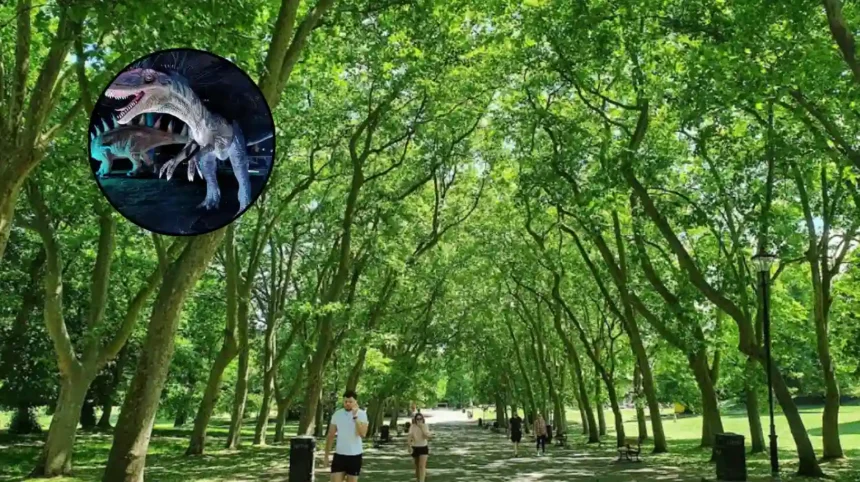
- South London’s Crystal Palace Park will undergo a major conservation project to restore its 30 Victorian-era concrete dinosaur and prehistoric animal sculptures.
- The London Borough of Bromley, which owns the park, has committed approximately £27 million to the work, according to recent council and media reporting.
- The sculptures, created between 1853 and 1855 by Benjamin Waterhouse Hawkins under the scientific guidance of Sir Richard Owen, are Grade I listed monuments of international importance.
- The models have received very little maintenance since their construction, with only a limited conservation round in 2002 followed by further deterioration.
- Nine sculptures have already been repaired; the remaining 21 are scheduled for detailed restoration as part of the wider programme.
- The project has allowed the dinosaurs to be removed from Historic England’s Heritage at Risk register.
- The park is owned by the London Borough of Bromley but sits close to the boundary with Southwark and is a key local attraction for residents of South London, including neighbourhoods such as Crystal Palace, Penge and Beckenham.
- The work is expected to be carried out over multiple phases, with ongoing public access maintained where feasible.
Crystal Palace (South London News) July 16, 2026 –As reported by the council’s communications team and confirmed by regional media, the London Borough of Bromley has approved a £27 million conservation package for the 30 prehistoric animal models in Crystal Palace Park. The investment is described as a “long-awaited makeover” intended to address decades of neglect and secure the site’s future as a heritage and public attraction.
- Key Points
- Which Models Are Being Restored?
- What Work Has Already Been Done?
- What Is the Historical Significance of the Crystal Palace Dinosaurs?
- How Are The Models Classified in Heritage Terms?
- How Was the Conservation Arrangement Reached?
- What Technical Challenges Are Involved?
- How Have Scientists and Historians Responded?
- What Do Local Media Say About the Investment?
- Background of the Development
- Prediction: How This Development Can Affect Local Residents and Visitors
- How Might This Affect Tourism and Local Economy?
The sculptures have had
“barely any maintenance since they were first built, almost 200 years ago,”
according to local reporting on the Metro website, which highlighted their deteriorating condition and the need for urgent intervention.
The council states that the project is necessary to prevent further damage from weather, vegetation and time, and to ensure the statues remain safe and accessible for visitors.
Which Models Are Being Restored?
The phrase “dinosaurs” in Crystal Palace Park refers not only to actual dinosaurs but to approximately 30 palaeontological statues, including marine reptiles, amphibians, early mammals and other extinct creatures. Only four of the sculptures represent true dinosaurs in the strict zoological sense: two Iguanodon, one Hylaeosaurus and one Megalosaurus.
The remaining models include plesiosaurs, ichthyosaurs, pterodactyls, crocodilians and mammals such as the South American Megatherium (giant ground sloth) once brought to Britain by Charles Darwin. All of these are part of the same Grade I listed ensemble and are included in the conservation work.
What Work Has Already Been Done?
According to information from the Crystal Palace Dinosaurs project and heritage reporting, nine sculptures have already undergone repair work as part of earlier conservation efforts, with the remaining 21 scheduled for attention under the new programme.
The current £27 million package is intended to complete the full restoration of all 30 models, as well as associated landscaping and safety measures.
The project has also enabled the removal of the dinosaurs from Historic England’s Heritage at Risk register, indicating that the site is no longer considered to be in immediate danger of irreversible loss.
What Is the Historical Significance of the Crystal Palace Dinosaurs?
The Crystal Palace Dinosaurs are widely regarded as the world’s first large-scale public attempt to model extinct animals as full-size, three-dimensional, active creatures based on fossil remains.
They were constructed between 1853 and 1855, predating Charles Darwin’s On the Origin of Species by five years, and were unveiled as part of the reopening of the Crystal Palace in its new South London location.
The sculptures were designed by Benjamin Waterhouse Hawkins, a natural history artist and sculptor, under the scientific direction of Sir Richard Owen, the anatomist who later founded the Natural History Museum.
Queen Victoria and Prince Albert visited the site several times, underscoring the national importance of the project at the time.
How Are The Models Classified in Heritage Terms?
The statues are listed on Historic England’s National Heritage List for England as Grade I monuments, the highest level of protection and reserved for sites of international importance. This classification reflects their unique role in the history of science and public engagement with palaeontology.
Their Grade I status means that any conservation work must be carefully managed to preserve their historical and scientific character, including their original materials, forms and placement within Joseph Paxton’s landscape design.
How Was the Conservation Arrangement Reached?
The London Borough of Bromley, as owner of Crystal Palace Park, has been central to securing funding and approving the conservation programme.
Local reporting indicates that the council is investing the £27 million directly, with oversight from heritage specialists and conservation experts.
Historic England’s removal of the dinosaurs from its Heritage at Risk register signals that the project has met the necessary criteria for long-term protection and that the site is now under a credible conservation plan. This step is typically taken when a clear maintenance and restoration strategy is in place and funded.
What Technical Challenges Are Involved?
The models are made from mixed materials, including early concrete and mortar, which have proved vulnerable to weathering, cracking and biological growth over nearly two centuries.
Conservation work must therefore address both structural stability and surface preservation, while retaining the original character of the sculptures.
As noted by the Crystal Palace Dinosaurs project, the statues were created in situ and set within a landscape designed by Joseph Paxton that included geological illustrations and terraces.
This means that restoration is not only about the individual models but also about their integration with the wider park environment.
How Have Scientists and Historians Responded?
Researchers involved in the Crystal Palace Dinosaurs project, including work supported by King’s College London, have emphasised the importance of preserving the site as a record of how scientific ideas evolved in the 19th century.
Dr Chris Manias and other historians have highlighted that the statues’ “wild inaccuracies” compared with modern interpretations are themselves valuable, showing how interpretations changed as new evidence emerged.
Smithsonian Magazine has described the site as a “time capsule of early palaeontology,” noting that the restoration is “breathing life into the Crystal Palace Dinosaurs” and helping to re-engage the public with the history of science. The project is seen not only as conservation but also as an educational opportunity.
What Do Local Media Say About the Investment?
Regional media have described the £27 million spend as a major investment in South London’s cultural infrastructure, with emphasis on the uniqueness of the dinosaurs as a local and national attraction.
The coverage has focused on the long interval since the last significant maintenance and the need to act now to prevent further deterioration.
Reporting has also noted the broader context of Crystal Palace Park as a green space for recreation, family outings and community events, with the dinosaurs at its core as a distinctive landmark.
Background of the Development
The Crystal Palace Dinosaurs were commissioned in 1852 as the world’s first large-scale public outreach project on science, designed to explain geologic time and the history of life through life-sized reconstructions set in palaeo landscapes.
They were built on the grounds of the former Penge Place mansion, on Penge Common, which were transformed into Crystal Palace Park following the relocation of the Crystal Palace from Hyde Park after the 1851 Great Exhibition.
The models were unveiled in 1854 as part of the reopening of the Crystal Palace in its new South London site, with Queen Victoria and Prince Albert as patrons.
The original plan included 42 models, but funding ran out before 12 additional sculptures, including a mammoth and a moa, could be completed. Only the current 30 statues and associated geological displays were realised.
Over the years, the sculptures have suffered from weathering and lack of maintenance. A major conservation round was completed in 2002, but no further systematic maintenance was carried out, leading to renewed deterioration.
The site was subsequently placed on Historic England’s Heritage at Risk register, prompting the recent council-led conservation programme.
The park is now owned by the London Borough of Bromley and remains a free-to-visit public space, attracting families, school groups and visitors interested in local history and science.
Prediction: How This Development Can Affect Local Residents and Visitors
For residents of Crystal Palace, Penge, Beckenham and neighbouring South London areas, the £27 million restoration is likely to strengthen the park’s role as a central community space.
The project is expected to improve the visual quality and safety of the dinosaurs, making them more inviting for families and local users who already rely on the park for recreation and leisure.
A well-maintained, historically significant attraction can also support local pride and identity, particularly in areas where green space and cultural landmarks are important.
The removal of the site from the Heritage at Risk register signals long-term stability, which may encourage further investment in surrounding facilities and events.
How Might This Affect Tourism and Local Economy?
The Crystal Palace Dinosaurs are already a unique draw for visitors interested in heritage, science and unusual outdoor attractions.
A fully restored ensemble is likely to increase visitor numbers, both from London and from outside the city, potentially benefiting nearby businesses such as cafes, shops and transport services.
Schools and educational groups may also use the site more frequently for science and history lessons, given its status as a time capsule of early palaeontology.
This could lead to more structured visits, guided tours and associated activities, further supporting the local economy.
However, the scale of investment and the length of the project may also bring temporary disruptions, such as access restrictions around specific models or areas of the park.
Local authorities will need to manage these carefully to maintain public access and ensure that the benefits of the restoration are felt as soon as possible.