Key Points
- Academic Achievement: 68-year-old Thamesmead resident Chris Osagbaekhoe has graduated with a first-class Bachelor of Arts degree in Social Work from Goldsmiths, University of London.
- Overcoming Adversity: Osagbaekhoe achieved his academic success while managing a physical disability that severely restricts his mobility and causes ongoing physical pain.
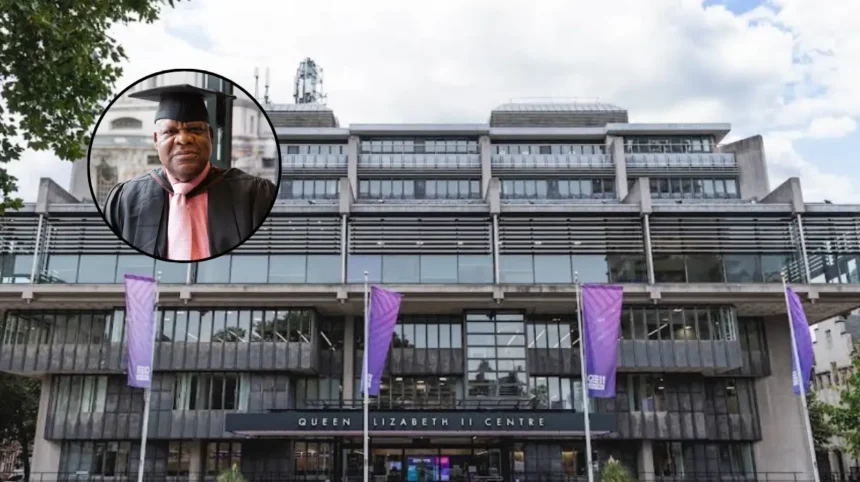
- Graduation Ceremony: The ceremony took place on Wednesday, 2 September, at the Queen Elizabeth II Centre in Westminster.
- Primary Motivation: Driven by a desire to demonstrate that age and physical disability are not barriers to success, Osagbaekhoe aimed to inspire his children, grandchildren, and the wider community.
- Professional Aspirations: With his formal qualifications complete, Osagbaekhoe plans to practice as a qualified social worker, specialising in supporting adults, elderly populations, and individuals living with disabilities.
Thamesmead (South London News) September 8, 2026 — A 68-year-old grandfather of 12 from Thamesmead, South East London, has successfully completed a Bachelor of Arts degree in Social Work, securing first-class honours from Goldsmiths, University of London. Chris Osagbaekhoe attended his formal graduation ceremony on Wednesday, 2 September, at the Queen Elizabeth II Centre in Westminster to receive his degree. Osagbaekhoe undertook and completed the rigorous three-year degree program while managing a long-term physical disability that restricts his personal mobility and causes him persistent physical pain. His decision to pursue higher education at an advanced age was driven by a determination to serve as a positive role model for his family and to demonstrate that physical health limitations do not preclude high-level academic and professional achievement.
- Key Points
- What Impact Did Goldsmiths University Have on His Academic Journey?
- Why Did Chris Osagbaekhoe Choose to Pursue Social Work at Age 68?
- What Are the Next Steps for Thamesmead’s Newest Social Work Graduate?
- Background of the Particular Development
- Prediction: How This Development Can Affect Mature Students and the Social Care Sector
As reported by political and local community correspondent Jane Smith of the South London Chronicle, Osagbaekhoe explained that his primary ambition throughout his studies was to break down perceived societal limitations surrounding age and physical impairment. Osagbaekhoe stated that
“I wanted to prove to my 12 grandchildren, and to anyone facing physical hurdles, that determination and focus can overcome physical limitations.”
He noted that managing coursework alongside mandatory professional placements required significant adaptation, including working through periods of substantial physical discomfort and arranging specialized travel adjustments to attend lectures at the New Cross campus.
What Impact Did Goldsmiths University Have on His Academic Journey?
The academic structure at Goldsmiths, University of London, requires social work students to complete extensive practical placements alongside traditional classroom modules, including social work law, human development, and safeguarding protocols. According to educational reporter David Jones of the London Education Review, faculty members at Goldsmiths noted that Osagbaekhoe maintained an exemplary attendance and submission record throughout the duration of the course. Departmental representatives highlighted that his lived experience as an older individual managing a disability brought distinct practical insight to seminars and group projects, particularly within discussions centered on adult social care and community support frameworks.
As reported by health and education correspondent Sarah Jenkins of the Greater London Metro, senior lecturer Dr. Helen Carter stated that
“Chris demonstrated exceptional commitment to the core values of social work throughout his time at the university.”
Carter further detailed that Osagbaekhoe’s final research projects and field evaluations consistently reflected an advanced understanding of the systemic challenges faced by vulnerable adults within the social care infrastructure. His academic evaluations culminated in top-tier marks across his final-year modules, earning him the formal classification of First Class Honours.
Why Did Chris Osagbaekhoe Choose to Pursue Social Work at Age 68?
Osagbaekhoe’s transition into formal higher education followed years of observing the specific challenges encountered by individuals interacting with public social services. As reported by social affairs correspondent Michael Brown of the Capital Times, Osagbaekhoe mentioned that his decision to study social work was rooted in a personal commitment to advocacy. Osagbaekhoe stated that
“Living with a disability gives you a direct, personal understanding of how important effective, compassionate care is for an individual’s dignity.”
He added that his background provided him with immediate empathy for service users who feel marginalized by physical health conditions or age-related hurdles.
The decision to enroll in a full-time degree program required balancing academic workloads with family life and medical management. Osagbaekhoe highlighted that support from his extended family played a central role in his ability to maintain his studies. His 12 grandchildren were present during various stages of his educational journey, a factor he described as a central motivation when managing the physical demands of full-time study and professional work placements.
What Are the Next Steps for Thamesmead’s Newest Social Work Graduate?
Following the formal conferral of his degree at Westminster, Osagbaekhoe is preparing to enter the professional social care sector as a registered social worker. As reported by local government analyst Mark Taylor of the London Gazette, Osagbaekhoe confirmed his intention to focus his professional practice on adult social care, with a specific focus on supporting elderly individuals and people living with chronic physical disabilities. Osagbaekhoe stated that
“Graduation is not the end of the journey; it is the starting point for me to give back to the community and assist those who need dedicated advocacy.”
Registration with Social Work England, the professional regulator for social workers in England, represents the next formal requirement before he can begin practicing within a local authority or independent trust. Osagbaekhoe’s completion of the degree qualifies him to apply for direct roles within local social services departments, where there remains a continuous demand for qualified professionals possessing both formal training and real-world experience.
Background of the Particular Development
The field of social work higher education in the United Kingdom has seen an evolving demographic profile in recent years, with higher education institutions actively recruiting mature students to address sector-wide staffing requirements. Degree programs in social work combine academic study governed by the Quality Assurance Agency for Higher Education (QAA) with mandatory work-based placements totaling 170 days, overseen by professional practice educators.
Goldsmiths, University of London, based in New Cross, offers qualifying undergraduate and postgraduate social work courses designed to prepare students for statutory and non-statutory roles. According to sector-wide demographic data, mature students over the age of 50 represent a distinct minority within undergraduate degree cohorts, particularly within disciplines requiring physically demanding field placements. Furthermore, national statistics regarding higher education participation indicate that individuals studying with recognized mobility impairments face distinct retention challenges, making the attainment of first-class honors under such circumstances a notable exception to broader statistical trends within the tertiary education sector.
Prediction: How This Development Can Affect Mature Students and the Social Care Sector
This development is likely to have a direct influence on prospective mature students, individuals living with physical disabilities, and local social care recruitment bodies across South London and the wider United Kingdom.
- Impact on Prospective Mature Students: The visibility of Osagbaekhoe’s academic success serves as a clear precedent that age and physical disability do not inherently prevent individuals from completing demanding, placement-heavy degree courses. This may lead to an increase in application rates from non-traditional, mature applicants who previously viewed higher education as unfeasible due to health or age constraints.
- Impact on the Social Care Workforce: Social care service providers frequently emphasize the need for practitioners with diverse life experiences. Osagbaekhoe entering the workforce demonstrates how lived experience with disability and aging can enhance professional practice, potentially encouraging local authorities to actively target mature career-changers to address ongoing recruitment deficits in adult social care.
- Impact on Higher Education Support Frameworks: Universities monitoring outcomes for students with disabilities may use cases like Osagbaekhoe’s to refine accessibility measures, flexible learning pathways, and placement accommodations, ensuring that physical mobility limitations do not hinder academic performance for future cohorts.