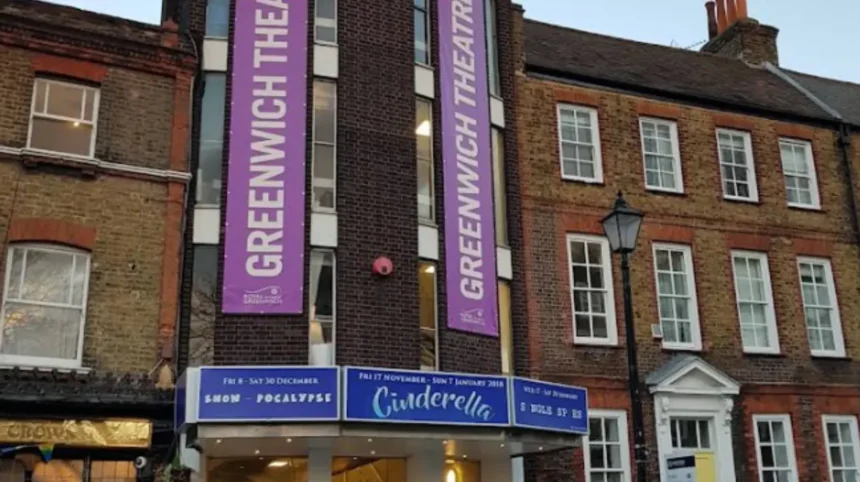
Peter Bleksley’s ‘The making of a murderer: the undercover detective’ arrived at Greenwich Theatre on 28th September. A founding member of Scotland Yard’s undercover unit and former star of Channel 4’s Hunted, Bleksley uncovered a harsh glimpse to the behind-the-scenes of murder investigations.
Bleksley expressed his intention to entertain and inform audiences on law enforcement. The first act vividly describes his journey from uniformed police to detective to spy. Throughout this time, Bleksley details going undercover as everything from a drug lord to a contract killer, and the one operation that forced him into retirement.
The second act dives into the complex and personal: the unsolved murder case of Alistair Wilson. A case he has followed and investigated in his retirement. Bleksley does so in the hope to reach someone “sat on the 20-year secret” of what happened to Wilson.
Bleksley expressed that “I hope I got the audience on board” for the “gear change” in act 2. He claims the prolific cases of household names don’t interest him as much as the smaller ones he can “raise public awareness” for.
After the push from his mother, Bleksley joined the Metropolitan police in 1978. From here he served as a detective before becoming a founding member of Scotland Yard’s uncover unit. Where adapted to a range of characters to suit the current case. Drug dens. Contract killers. Investigating for a range of high-stakes criminal operations.
Whilst most would prefer contact from such worlds on their tv screens, Bleksley summarised the type of person drawn to this line of work as “young, fit, foolish. Call it what you will.”
The key to his success, he described as having a “a talent for telling lies”, which allowed him to become “a very convincing criminal, albeit a pretend one.” From this, he found a talent that had never materialised at school, developing his drive to push forwards and work hard. Bleksley enjoyed a 20-year career in law enforcement, be it answering patrol radios or entering ‘the lion’s den’ of the criminal underworld.
Until the FBI uncovered an assassination plot against him following an operational report leak that would disrupt his professional and personal life.
For two years, Bleksley entered a witness protection programme that introduced his toughest task yet: being Peter Bleksley under a new identity whilst juggling active undercover work. Bleksley described the system as “inadequate, not well thought through” and with “no long-term view”. From here transpired a mental breakdown where everything “came crashing down” and he spent time at a lock-in psychiatric unit.
In his retirement, Bleksley’s skills were put to work in many ways. He wrote a variety of successful books on his experiences in law enforcement, such as ‘The Gangbuster’. As a story consultant for a BBC drama, scriptwriter, and radio investigator, Bleksley recognised public fascination with murder investigations. This led to his public investigations of unsolved cases.
Bleksley described his investigation approach as an “old school-shoe leather” type, meaning he “knocks on doors and sticks fliers through letterboxes”. He suggested the importance of always carrying “a spare pack of biscuits” to integrate himself into communities and build trust in sit-down interviews.
The Alistair Wilson case also known as the ‘the doorstep killing’ is one of Scotland’s largest unsolved murder cases.
On 28th November 2004, Wilson was fatally shot on his home doorstep, with his wife and children upstairs. The murder weapon (a 1930’s pocket pistol) was later recovered in a drain and no arrests have been made.
Prior to Wilson’s shooting, the killer had knocked on the door and handed Alistair’s wife an “unique and bizarre” empty blue envelope. Police later revealed the name ‘Paul’ was written on it. What has remained a shocking case, has become an obsession for Bleksley.
Police have expressed new lines of inquiry with the Havelock Hotel opposite the Wilson residence, over Alistair’s interference with the pub’s decking planning request. Bleksley’s show touched on this with an eye roll and dry remark about his investigations having led him to this belief many years before.
Scotland’s Lord Advocate ordered a cold-case re-investigation conducted by a new team in 16th September 2024. Bleksley cited the “abysmal detective work” to the police being “under resourced, overworked, and more about perception” than solving crime.
Hence, Bleksley’s interest in vocalising this case across the nation. He believes that “police respond to media pressure”, and this has become an underlying motivation for his show because “it could and should be solved”.
When considering why this was the case he chose to platform, Bleksley has two points.
His time in witness protection drilled into him an ongoing fear of being shot on his doorstep. This PTSD manifested to a point where he struggled to even answer his door, adding “I still hate it.”
His sons being a similar age to Alistair Wilson’s have also had an effect. Bleksley lingers on the “joy, love, and happiness” he’s enjoyed being a father and watching his children grow. He recognises Alistair was denied this, and his family were denied the experience of having a father and husband.
“The person who pulled that trigger needs to stand in court,” Bleksley states.
Bleksley is grounded in his belief that truth will out and vows to continue to investigate until he “gulps his last breath.” As he continues his tour and investigations, armed with his of arsenal of credentials, he aims to get closer to the truth: “You have to have hope.”
Whilst many left Greenwich Theatre feeling enthralled by the entertaining ride they’d embarked upon, the question of Alistair Wilson and what happened that night remains burning. Perhaps enough media pressure and public awareness can finally bring a shocking crime to justice.