Key Points
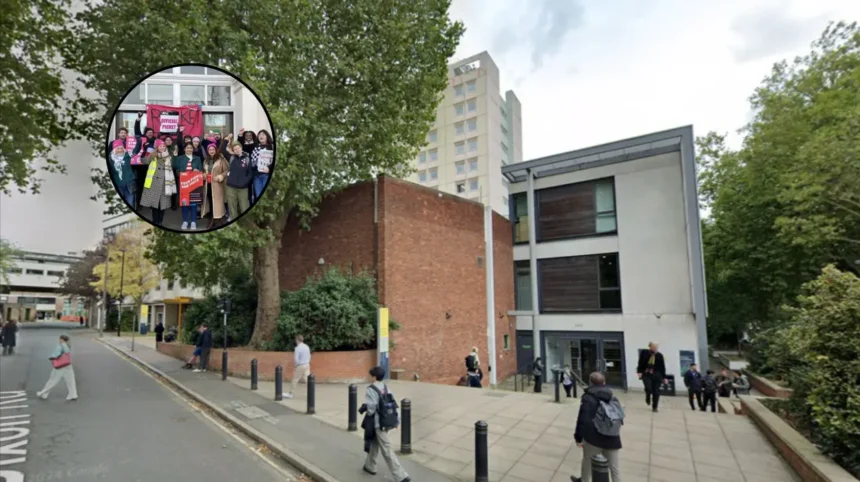
- One-Month Milestone: Activists from the “Free Goldsmiths” campaign have marked a full 24-hour, month-long occupation of the university library in New Lewisham.
- Redundancies Looming: The demonstration stands in direct resistance to a massive cost-cutting programme putting up to 269 staff members—and potentially over 300 by union counts—at immediate risk of losing their livelihoods.
- Sweeping Departmental Impact: The proposed redundancy list targets an expansive cross-section of the campus workforce, ranging from high-profile creative arts academics to critical support personnel including cleaners, security, and maintenance workers.
- Severe Revenue Shortfalls: Senior management reveals the emergency restructuring is mandated by an urgent directive to carve out £22 million in savings by the final close of the 2026/27 academic term, driven by a 25 percent plummet in domestic and global student enrolment over five years.
- Escalating Academic Boycott: In lockstep with student resistance, Goldsmiths University and College Union (GUCU) officially launched a comprehensive marking and assessment boycott (MAB) on May 27, threatening to block student graduations and program progressions until a settlement is reached.
Lewisham (South London News) May 23, 2026 – Student activists inside the library of Goldsmiths, University of London, have officially crossed the one-month milestone of an uninterrupted, round-the-clock structural occupation. Launching their overnight encampment on April 19, the direct-action coalition known as ‘Free Goldsmiths’ has transformed the traditional quiet study zones of the Lewisham facility into a fully operational hub of continuous resistance. Student groups are maintaining rigorous, rotating 24-hour shifts, sleeping between bookshelves and staging community actions in explicit solidarity with hundreds of institutional employees currently facing sudden mass redundancy. The prolonged physical occupation serves as an urgent front line against a sweeping university recovery mandate designed to fundamentally downsize one of the United Kingdom’s most historically prominent, culturally renowned creative institutions.
- Key Points
- How Did a Financial Deficit Bring a Top Creative University to a Breaking Point?
- Why Is Goldsmiths Forcing Through a £22 Million Savings Plan?
- How Does the Executive Plan to Salvage the Budget?
- How Are Workers and Students Coordinating Their Campus Counter-Offensive?
- Background of the Particular Development
- Prediction
How Did a Financial Deficit Bring a Top Creative University to a Breaking Point?
According to public statements issued by the Free Goldsmiths collective and closely catalogued by Camilla Royle of Socialist Worker, university executives have indicated that structural redundancies are a certainty. The administrative target seeks to rapidly cut loose 269 distinct staff lines, though localized trade union assessments fear the final consolidation could see more than 300 active contracts dissolved.
The strategy systematically divides the reductions across the university’s operational framework. As reported by Dorothy Stein of Salamander News, the University and College Union (UCU) branch discovered that management plans to extract £20 million directly from personnel expenditure, split evenly with a £10 million deduction from professional support services and an identical £10 million slice from academic faculties.
This scale represents roughly 25 percent of the remaining total staffing footprint, a number that union leaders argue will inevitably cripple the remaining day-to-day functions of the Lewisham campus.
The targeted layoffs do not solely focus on high-earning management or abstract operational brackets; instead, they cut directly into the foundational human infrastructure of the campus.
The potential redundancy listings encompass prominent creative academics, researchers, and course tutors alongside the frontline estate staff—cleaners, dedicated night security teams, and local maintenance workers—whose daily labour is mandatory to keep the physical university safe, sanitary, and functional.
Protesting students have emphasized that losing these interconnected worker brackets will trigger an immediate decline in campus safety and basic structural viability, directly degrading the working-class community that surrounds the university footprint.
Why Is Goldsmiths Forcing Through a £22 Million Savings Plan?
As documented by Georgia Luckhurst of Arts Professional, Goldsmiths is operating under an increasingly volatile domestic and international higher education framework.
The institution is grappling with severe, long-term recruitment shortfalls, noting that total student enrolment figures have dropped by more than a quarter over the preceding five-year timeline.
In an explanatory dispatch to staff, Acting Vice-Chancellor Professor David Oswell stated that the university requires a complete, “purposeful redesign” to withstand global competition, escalating operational expenses, international geopolitical instability, and fast-moving technological shifts.
Additionally, university briefers have pointed to systemic reductions in the Office for Students strategic priorities grant alongside rising employer National Insurance contributions as severe external financial pressures that left the executive board with limited traditional avenues for balancing the ledger.
How Does the Executive Plan to Salvage the Budget?
To stave off the imminent threat of structural insolvency, the Senior Management Team (SMT) has launched the “Future Goldsmiths” initiative. This fiscal blueprint dictates an unyielding timeline to achieve £22 million in absolute spending cuts by the conclusion of the 2026/27 academic year, followed by an aggressive, top-down institutional transformation strategy scheduled to run through 2027/28.
A spokesperson for Goldsmiths corporate communications defended the intervention to independent journalists, stating:
“We’re taking action to secure our place as one of the world’s leading creative universities, at a time when many in higher education are facing uncertain futures and are having to make difficult decisions. In an increasingly disrupted world we simply cannot afford to stand still, and our plan will ensure that we are able to continue delivering unique critical education and research while supporting our students to achieve their ambitions.”
How Are Workers and Students Coordinating Their Campus Counter-Offensive?
The student-led “Free Goldsmiths” campaign group—consisting of a core contingent fluctuating between 40 and 50 dedicated organizers filtering through the space—has entirely repurposed the library architecture. Activists are utilizing the space to run alternative communal infrastructure, establishing open political workshops, collaborative study groups, and mutual-aid style community kitchens.
As reported by local student press, the occupiers view their actions as an absolute defense of the arts, arguing that humanities and creative sectors are systematically treated as disposable assets whenever economic strains hit British higher education.
Protesting representatives released a unified statement warning of the broader social consequences of the university’s fiscal trajectory:
“These cuts will push our society further into decline, removing possibilities of education from marginalised people and closing down any possibility to imagine any positive future for anyone who is not a part of the ultra-wealthy.”
How Will the Marking and Assessment Boycott Disrupt the Term?
The industrial friction on campus significantly intensified following an official postal ballot conducted by the Goldsmiths branch of the UCU between March 16 and April 10.
The ballot yielded a high 63 percent turnout, satisfying the stringent participation legal thresholds mandated by United Kingdom trade union legislation. An overwhelming 81 percent of voting union members backed full strike actions, while 92 percent endorsed Action Short of a Strike (ASOS).
Consequently, the union leadership officially authorized the commencement of a comprehensive Marking and Assessment Boycott (MAB) set to activate at midnight on May 27. UCU General Secretary Jo Grady publicly supported the local workforce escalation, declaring:
“Cuts of this scale would leave Goldsmiths a shell of its current self and would cause irreparable damage to current and future students as well as the local community.”
This coordinated assessment freeze means that academic staff will systematically decline to grade final exams, process course essays, or log year-end marks, effectively halting student degree progression and preventing upcoming summer graduations until the “Future Goldsmiths” redundancy program is permanently discarded.
Background of the Particular Development
The current structural crisis unfolding across the Lewisham campus is not an isolated financial emergency, but rather the latest chapter in a highly contentious, five-year cycle of aggressive structural downsizing at Goldsmiths.
The university has undergone multiple sweeping restructurings in recent memory, most notably the highly controversial “Transformation Programme” and its predecessor, the 2021/22 “Recovery Programme.”
Under the previous leadership of former Vice-Chancellor Frances Corner, the administration partnered with global management consultancy firm KPMG to design a severe cost-reduction strategy. That earlier intervention forced the removal of over 100 staff positions, striking deep into world-renowned creative departments including sociology, music, theatre, creative writing, and visual cultures.
Notably, pioneering academic figure Professor Deirdre Osborne, the co-founder of the UK’s first Master’s degree in Black British Literature, was initially given redundancy notices before widespread public backlash preserved the course track.
Furthermore, the administrative strategy to streamline operations by dismantling decentralized departmental secretariats and shifting to a centralized administrative hub resulted in severe logistical challenges.
According to documented staff and student testimonies compiled by Salamander News, the corporate restructuring proved highly dysfunctional.
The centralized hub frequently struggled to manage basic module enrollments, provide accurate timetable assessments, or resolve baseline student inquiries.
The resulting instability forced the university executive to subsequently spend millions of pounds in emergency consultancies and legal fees to re-inject administrative capacity back into the systems they had just defunded.
Following these widespread organizational disruptions, Frances Corner made an abrupt departure from the institution, leaving Professor David Oswell to take the reins as Acting Vice-Chancellor amidst an active £24 million structural deficit.
The current student-worker alignment is built directly upon years of accumulated frustration regarding these repetitive rounds of restructuring, which critics maintain have consistently siphoned student fees into corporate consultation pools without ever achieving the promised long-term financial stability.
Prediction
The compounding impact of the “Free Goldsmiths” library occupation and the impending UCU marking and assessment boycott is poised to trigger severe, immediate disruptions for the primary audience: the current student body and the incoming 2026/27 academic cohorts. In the immediate short term, the marking freeze starting May 27 will trap hundreds of final-year undergraduate and postgraduate students in an institutional limbo.
Without formal marks logged into the university registry, a significant portion of the graduating class will be unable to receive finalized degrees this summer. This delay will directly impair their ability to secure immediate postgraduate employment, clear corporate background checks, or fulfill conditional offers at other global higher education institutions.
For international students, who comprise a vital component of Goldsmiths’ community, the lack of a finalized graduation status could complicate visa extensions, potentially threatening their legal residency status in the United Kingdom during a crucial transitional period.
For incoming and continuing students, the long-term reality of a successful £22 million budget reduction will radically reshape the quality of their educational experience.
If the administration pushes through the 25 percent staff reduction, students will return to a campus with significantly higher staff-to-student ratios, larger seminar sizes, and reduced contact hours with specialized lecturers. Highly niche, internationally regarded module pathways within the arts and social sciences are highly likely to be consolidated or phased out entirely as departments merge to save costs.
Additionally, the reduction of frontline estate personnel means that physical campus upkeep, library opening hours, clean study environments, and night-time security provisions will be significantly diminished. This drop in baseline student support services risks accelerating the existing downward spiral in student recruitment.
As word of mouth regarding disrupted classes and administrative delays spreads across social networks, the university’s world-class reputation for creative and cultural excellence faces a critical threat, potentially depressing future enrollment numbers and locking the institution into a self-fulfilling cycle of financial austerity.