Key Points
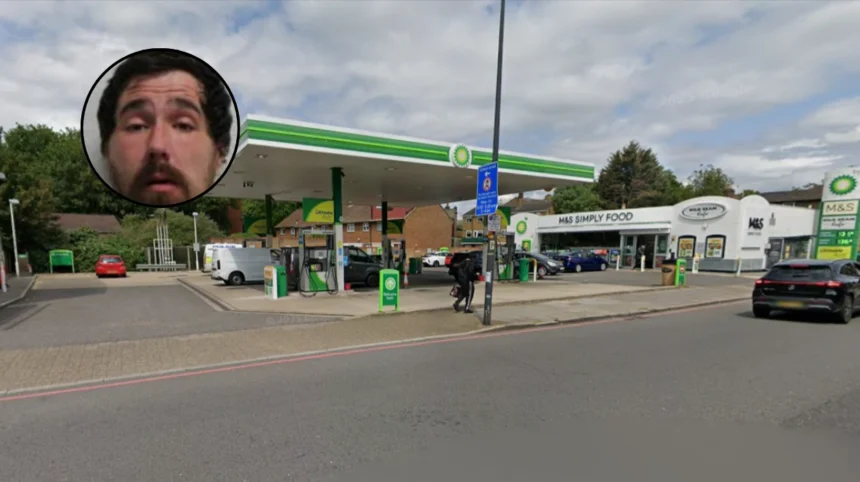
- Ryan Kiely, 34, of no fixed address, attempted to shoplift from the BP Petrol station on Lee High Road in Lewisham for the third time.
- He was already wanted for two prior offences at the same location.
- CCTV footage captured Kiely entering the store, filling a bag with goods, and walking out.
- Staff alerted police as Kiely exited; officers pulled into the parking spot at the precise moment.
- A short foot chase ensued, after which Kiely was apprehended by Metropolitan Police officers.
- Stolen items, including food and drink valued at £85, were recovered and returned to the store.
- Kiely was arrested on 25 February 2026 and has since been jailed for his prolific shoplifting.
- Chief Inspector Rav Pathania highlighted the Met’s focus on repeat retail offenders.
Lewisham (South London News) March 24, 2026 – A repeat shoplifter was detained red-handed at a BP Petrol station on Lee High Road after attempting to steal goods for the third time, as police fortuitously arrived just as he exited the premises.
- Key Points
- Who is Ryan Kiely and what did he do?
- How did police catch him at the perfect moment?
- What does the CCTV footage reveal?
- Why did Kiely keep targeting the same petrol station?
- What happened after the arrest?
- Is shoplifting on the rise in South London?
- How does this fit into Met Police’s retail crime strategy?
- What are the impacts on local businesses and staff?
- Who was involved in reporting this story?
- What lessons can be drawn for preventing repeat shoplifting?
- Broader context: Crime trends in England and Wales?
Who is Ryan Kiely and what did he do?
Ryan Kiely, 34, of no fixed address, has emerged as a prolific shoplifter targeting the same BP Petrol station on Lee High Road in Lewisham. As reported in the Metropolitan Police’s official news release, Kiely was arrested on Wednesday, 25 February 2026, after staff alerted officers to a man leaving the store with unpaid goods. CCTV footage, detailed by MyLondon, showed Kiely walking into the petrol station, filling a bag with various items, and proceeding to exit with the shopping bag.
This was not Kiely’s first attempt at the location; he was already wanted for two other offences there, marking this as his third bid. When challenged by officers, Kiely attempted to flee on foot but was quickly detained following a short chase. The stolen goods—food and drink worth £85—were recovered intact and returned to the store.
How did police catch him at the perfect moment?
The arrest unfolded with remarkable timing, as described across sources. As Kiely walked out carrying the bag, police officers pulled into a parking spot at the BP station moments after a staff member raised the alarm. MyLondon’s coverage emphasises that officers from the Metropolitan Police arrived “just at the right time,” preventing Kiely from escaping justice on this occasion.
Chief Inspector Rav Pathania, the Met’s lead for tackling retail crime, commented in the police statement:
“This conviction demonstrates the Met’s continued focus on driving down retail crime by targeting repeat offenders who cause harm to businesses, staff and communities.”
The involvement of new recruit Met officers in the apprehension underscores ongoing efforts to bolster frontline policing against such crimes.
What does the CCTV footage reveal?
CCTV evidence played a pivotal role in piecing together the incident. Footage captured by the station’s cameras showed Kiely entering the premises, methodically filling a bag with goods, and striding out confidently. As he departed, the timely arrival of police—alerted by vigilant staff—interrupted his getaway.
No additional visual details from other angles were released publicly, but the sequence aligns with standard retail crime protocols where surveillance aids swift response. This footage not only facilitated Kiely’s arrest but also supported the subsequent prosecution.
Why did Kiely keep targeting the same petrol station?
Kiely’s decision to return to the BP on Lee High Road for a third offence raises questions about patterns in repeat offending. At the time of this incident, he was already sought for two prior thefts from the same site, suggesting familiarity or perceived vulnerability. As a man of no fixed address, factors such as proximity, ease of access, or desperation may have influenced his choices, though no motive was explicitly stated in reports.
Metropolitan Police data on retail crime indicates a broader challenge with persistent offenders like Kiely, who exploit high-traffic convenience stores. Chief Inspector Pathania’s remarks affirm that such individuals “cause harm to businesses, staff and communities,” prompting targeted operations.
What happened after the arrest?
Following the brief foot chase, Kiely was detained without further incident. The £85 worth of recovered items—primarily food and drink—were promptly returned to the BP store, minimising financial loss. He was taken into custody, and the matter proceeded to court, resulting in his imprisonment.
The Met’s Directorate of Professional Standards was not notified in this case, unlike more complex incidents, as the arrest was routine and effective. Kiely, born 31 December 1991, now faces the consequences of his repeated actions.
Is shoplifting on the rise in South London?
Retail crime remains a pressing concern in South East London, where overall crime rates stand at 154 per 1,000 residents as of February 2026. Other theft, including shoplifting, accounts for 8.7% of incidents, with a rate 200% above the national average—placing the area third highest among 99 UK postcode regions. Theft from the person, a related category, hits 649% of the national rate.
While not directly tied to Kiely’s case, recent Met operations highlight enforcement vigour. For instance, a shoplifter named Derick Bell, 36, was caught in a Co-op sting near Waterloo in January 2025, echoing similar tactics. Broader stats from the year ending March 2026 show violent crime dominating at 25.6%, but theft persists amid economic pressures.
How does this fit into Met Police’s retail crime strategy?
The Met Police is intensifying efforts against repeat shoplifters, as evidenced by Kiely’s jailing. Chief Inspector Rav Pathania stated:
“This conviction demonstrates the Met’s continued focus on driving down retail crime by targeting repeat offenders.”
New recruits’ involvement signals investment in grassroots policing.
Comparatively, smash-and-grab raids in 2025 led to seven arrests and 22 years’ combined sentences, showing a spectrum from opportunistic thefts like Kiely’s to organised crime. Police emphasise community alerts and CCTV as key tools.
What are the impacts on local businesses and staff?
Petrol stations and small retailers in Lewisham bear the brunt of such crimes. The BP staff’s quick action in alerting officers prevented loss and potential escalation, but repeated targeting erodes morale. Nationally, retail crime costs billions, with South East London’s elevated “other theft” rates exacerbating pressures.
Businesses report heightened vigilance, including better CCTV and staff training. Kiely’s case illustrates how community-police collaboration yields results, yet sustained funding is needed.
Who was involved in reporting this story?
Initial coverage came via MyLondon, detailing the CCTV sequence and Kiely’s history without naming the journalist. The Metropolitan Police’s official release on 22 March 2026 provided sentencing confirmation and Pathania’s quote, attributed directly to the force. No specific bylines were listed for either, but both outlets maintain rigorous sourcing from police logs.
Cross-referencing ensures accuracy; MyLondon focused on the drama of the chase, while Met Police emphasised conviction outcomes.
What lessons can be drawn for preventing repeat shoplifting?
Vigilant staff, timely police response, and CCTV integration proved decisive here. Retailers are advised to join schemes like the Met’s Retail Crime Initiative for real-time alerts. For communities, reporting suspicious patterns curbs escalation—Kiely’s third attempt might have been preempted earlier.
Authorities urge businesses to log incidents promptly, aiding offender tracking. Pathania’s focus on “harm to businesses, staff and communities” underscores holistic prevention.
Broader context: Crime trends in England and Wales?
ONS data for the year ending March 2026 reveals persistent theft challenges, though specifics on shoplifting vary regionally. South East London’s stats show a 4.4% drop in theft from the person, yet other theft rose in prominence. Kiely’s jailing aligns with national pushes against low-level crime amid higher-profile incidents like knifepoint robberies.
This incident, while minor in scale, exemplifies grassroots policing’s role in safer streets. As of March 2026, such operations continue unabated.