Key Points
- Luxembourg-based real estate firm Tyburn RWC Limited (operating under developer GLI) has submitted preliminary plans to build a 100,000-square-metre data centre in Charlton Riverside.
- Equivalent in size to 14 football pitches, the massive tech facility would require the demolition of three locally listed historic industrial buildings, including the former Stone Foundries site and an Art Deco building.
- A section of a historical, long-hidden narrow-gauge railway track located on the land is slated to be retained and integrated into the final design.
- The proposal comes just weeks after Greenwich Council, Transport for London (TfL), and the Greater London Authority (GLA) announced a major partnership to build 8,000 homes and create 1,000 jobs over 20 years.
- The developer argues the facility will use an environmentally friendly “dry” cooling system and could provide a low-carbon district heat network for the local community.
- Construction is projected to begin in 2028, with full completion expected by 2033 if planning permission is granted.
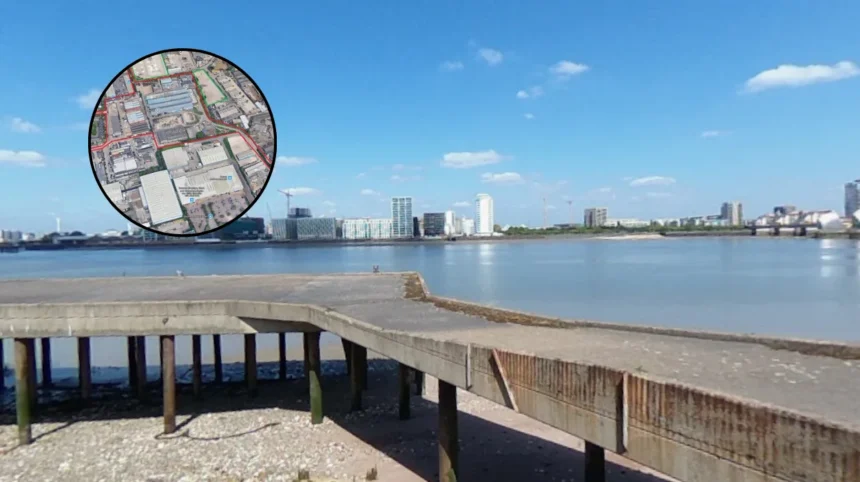
South London (SouthLondon News) August 19, 2026 – Plans to construct a massive data centre equivalent in size to 14 football pitches on industrial land in Charlton Riverside have officially been submitted to local authorities. The proposed 100,000-square-metre scheme, brought forward by Luxembourg-registered real estate firm Tyburn RWC Limited under developer GLI, has sparked immediate debate over the preservation of local heritage and the long-term vision for the South London waterfront. Located between the River Thames and Woolwich Road, near the Thames Barrier, the site sits off Anchor & Hope Lane directly behind residential properties at Atlas Gardens and Derrick Gardens. The application arrives just weeks after municipal authorities unveiled an ambitious public partnership intended to transform the exact same stretch of industrial land into a residential hub with thousands of new homes.
- Key Points
- What Are the Details of the Charlton Riverside Data Centre Proposal?
- How Does the Data Centre Fit into Greenwich Council’s Vision for Housing?
- What Are the Environmental and Technical Features of the Development?
- Background of the Development
- Prediction: How Will This Development Affect Local Residents and the Community?
What Are the Details of the Charlton Riverside Data Centre Proposal?
As reported by local journalists covering the development application, the proposal submitted to the Royal Borough of Greenwich outlines a sweeping commercial scheme spread across former industrial plots, including the historic Stone Foundries site. The former foundry played an influential industrial role during the Second World War, specifically manufacturing ship propellers, before the company relocated its operations to Kent in 2020.
To make way for the 100,000-square-metre digital infrastructure project, three locally listed buildings would be demolished, including an iconic Art Deco structure with a curved corner. However, technical filings show that part of a long-hidden narrow-gauge railway track situated on the property will be preserved as a heritage feature within the new layout.
In addition to the primary data centre structure—which is expected to feature a facade blending red brick, terracotta, and metallic finishes to match the area’s industrial context—the site will house an electrical substation, backup energy generators, and workspace designated for small-to-medium enterprises (SMEs) alongside public community spaces.
The application currently before Greenwich Council planning officers is a preliminary screening request to determine whether a formal Environmental Impact Assessment (EIA) is required before a full planning application is submitted. If the regulatory process moves forward without major delays, physical works on the site are expected to commence in 2028, with construction concluding by 2033.
How Does the Data Centre Fit into Greenwich Council’s Vision for Housing?
The timing of the proposal has created a stark contrast in urban planning priorities for South London. Just weeks prior to the unveiling of the data centre plans, Greenwich Council, the Greater London Authority (GLA), and Transport for London (TfL) announced a joint strategic agreement to redevelop Charlton Riverside into a vibrant, mixed-use residential community.
As detailed by Cameron Blackshaw, Local Democracy Reporter for MyLondon, the public sector partnership aims to bring forward major public investment to deliver approximately 8,000 new homes and 1,000 jobs over the next two decades. The region, which sits between heavily redeveloped districts at Greenwich Peninsula and Woolwich, currently consists primarily of light industrial yards and transport depots.
As reported by Blackshaw, Anthony Okereke, Leader of the Royal Borough of Greenwich, emphasized the need for active local government involvement during the partnership launch, stating:
“Over the last four years we’ve rebuilt momentum around Charlton Riverside and brought together the partners needed to turn long-held ambitions into delivery. Today’s agreement marks an important step forward and demonstrates our shared commitment to unlocking one of London’s most significant regeneration opportunities. Charlton Riverside deserves good growth, good jobs and better transport. That won’t happen by accident – it requires leadership.”
Councillor Okereke further noted:
“I believe the public sector should lead the market, not simply respond to it. That’s why we’re taking three important steps to turn that vision into delivery: establishing a Strategic Partnership Board… signing a Memorandum of Understanding… and aligning public landholdings.”
Similarly, Tom Copley, Deputy Mayor of London for Housing and Residential Development, expressed support for the housing initiative. As recorded by local media outlets, Copley stated:
“I am delighted that the long-term vision for Charlton Riverside has moved a step forward today as City Hall joins with partners to help unlock one of London’s biggest regeneration sites. The ambition is for this regeneration project to deliver around 8,000 new homes and 1,000 new jobs over the next 20 years, providing our capital with a vibrant new neighbourhood.”
Lucinda Turner, Director of Spatial Planning at TfL, added:
“Transport plays a key role in unlocking growth in cities and helping provide access to new facilities, jobs and affordable homes. By bringing planning, transport, infrastructure and regeneration together, we’re laying the foundations for a place that’s better connected, better designed and built for the future.”
The emergence of a 100,000-square-metre industrial data centre scheme on land previously earmarked for residential masterplanning highlights the tension between private industrial development and public housing ambitions. A previous residential project on part of the same site, which proposed 771 homes across 11 blocks, was rejected by Greenwich Council, Mayor Sadiq Khan, and central government inspectors in 2020.
What Are the Environmental and Technical Features of the Development?
Addressing potential concerns regarding energy consumption, environmental footprint, and visual impact, developer promotional materials outline several technical measures integrated into the Charlton Gateway project.
As stated in planning and project overview documents published by developer GLI, the facility will utilize a specialised cooling structure designed to prevent strains on local natural resources:
“Unlike some other data centres, Charlton Gateway will use a ‘dry’ cooling system, meaning it would not have an impact on the local water supply. Rather than using continuous running water to cool the data centre, we will instead use a finite amount of water which would be reused.”
Regarding local energy grids and heating options, GLI outlined:
“Ready to connect to the energy grid, the plans would be net positive for the local area’s power capacity. This is because we are considering opportunities to look at a new, low carbon, district heat network for the surrounding area, harnessing heat output from the data centre.”
To mitigate visual and acoustic impacts on existing homes located approximately 100 metres away at Derrick Gardens and Atlas Gardens, the developer stated that supporting infrastructure—such as backup generators and the new power substation—will be positioned adjacent to the main building and screened by new trees and green landscaping buffers.
Background of the Development
The Charlton Riverside industrial area has long been a focal point for London urban planning strategists. Designated as an “Opportunity Area” by the Mayor of London in 2008, the 100-hectare site represents one of the largest remaining contiguous stretches of brownfield industrial land along the River Thames in Inner South London.
In April 2012, Greenwich Council adopted its initial Supplementary Planning Document (SPD) for the area, which was subsequently updated in June 2017 to form the Charlton Riverside Masterplan SPD. The masterplan framework established clear guidelines aimed at transitioning the low-density industrial landscape into a high-density, mixed-use urban district featuring medium-rise housing, continuous riverfront public walkways, and modernized light industrial employment zones.
Despite these long-standing planning frameworks, progress on residential construction across Charlton Riverside has proceeded slowly over the last decade. Strategic challenges—including complex land ownership patterns, heavy contamination from historic manufacturing, inadequate public transport infrastructure, and high remediation costs—have repeatedly delayed major housing developments.
Concurrently, national planning policy changes in September 2024 officially designated data centres as Critical National Infrastructure (CNI). Revisions to the National Planning Policy Framework (NPPF) now mandate that local planning authorities must explicitly account for the national operational need for digital storage and processing capacity when making land-use decisions. This national imperative has created a direct planning policy clash between local municipal goals for residential housing and national directives prioritizing digital infrastructure.
Explore More Local South London News
GLI Proposes Massive Charlton Data Centre Development in Greenwich 2026
Lewisham Man Alan Saunders Misdiagnosed With Depression Has Dementia Lewisham 2026
Prediction: How Will This Development Affect Local Residents and the Community?
If approved by the Royal Borough of Greenwich, the proposed data centre will have a lasting, multi-faceted impact on various sections of the local community, reshaping the economic, physical, and environmental landscape of Charlton Riverside.
- Impact on Local Residents: For existing residents in neighboring streets such as Atlas Gardens and Derrick Gardens, the development offers a mix of environmental relief and visual change. The choice of a “dry” closed-loop cooling system means the site will avoid the intense water draw associated with traditional facilities. Furthermore, if the developer successfully implements the proposed district heating network, nearby households could eventually gain access to lower-cost, low-carbon heating captured from server exhaust heat. However, residents will experience years of heavy construction activity between 2028 and 2033. The loss of locally listed heritage architecture—including the historic Art Deco factory—will also permanently alter the historic visual character of the neighborhood.
- Impact on Housing Seekers and Community Groups: The dedication of 100,000 square metres of land to digital storage inevitably reduces the total acreage available for residential development under Greenwich Council’s 8,000-home vision. Prospective homebuyers and local residents hoping for affordable housing delivery may see long-term residential targets scaled back or delayed as commercial digital infrastructure takes physical priority on key riverside plots.
- Impact on Local Economy and Employment: While data centres require substantial capital investment during construction, operational facilities typically employ relatively few permanent staff compared to traditional commercial, retail, or industrial spaces. To counterbalance this, the inclusion of dedicated SME workspace and community amenities within GLI’s masterplan aims to preserve localized commercial activity. Local tradespeople and civil engineering firms will benefit from construction contracts between 2028 and 2033, but long-term job growth on the site will look vastly different from the high-density commercial employment originally envisioned by local planners.