Key Points
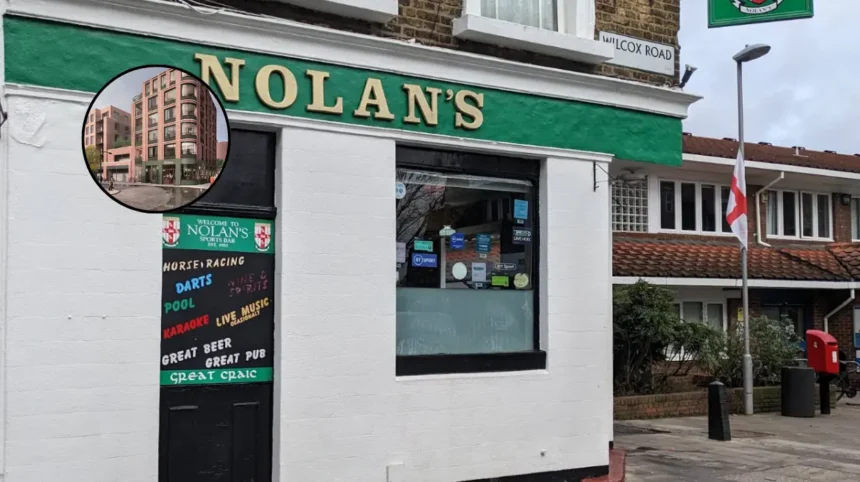
- Nolan’s Public House, a long-standing darts pub in Nine Elms, south London, is being demolished as part of a £12 million development project.
- The current building, which dates back to at least 1867 on historical maps, will be replaced by a new pub structure with residential apartments above it.
- PSA (the developer) has told Lambeth locals that the pub itself is “going nowhere” and will be rebuilt, even though the existing structure will be torn down.
- The site is located near Nine Elms station, where a construction site is now visible where Nolan’s Public House used to stand.
- The development is framed as giving the “legendary darts pub” a “new lease of life” rather than ending its operation.
- Local concerns about the loss of a Victorian boozer and a recognised icon of the London darts scene are being addressed by the developer’s promise of a rebuild.
- The project is valueable at £12 million and includes both hospitality and residential components.
Nolan’s Public House (South London News), July 10, 2026: a Victorian pub long known as a landmark of the London darts scene in Nine Elms, south London, is being demolished and rebuilt as part of a £12 million mixed-use development that will replace the existing building with a new pub and apartments above it.As reported by the author of the original article on the Nolan’s redevelopment, PSA has informed Lambeth locals that if they are near Nine Elms station and see a construction site where Nolan’s Public House used to be, they should “have no fear” because the Victorian boozer is “going nowhere”.
- Key Points
- Why is Nolan’s being demolished instead of simply refurbished?
- How has the local community and darts scene reacted?
- What does the development include and where is it located?
- How does this fit with wider trends in south London pub and regeneration projects?
- What are the implications for the building’s history and character?
- How will the redevelopment be managed and communicated to locals?
The same source explains that, technically, the building itself – which appears on historical maps of the area dating back to 1867 – is being torn down. However, the pub will then be completely rebuilt, this time with apartments above it.
This means the pub’s function and identity as a darts venue are intended to continue, even though the physical structure will be replaced.
Why is Nolan’s being demolished instead of simply refurbished?
The development is described as a £12 million project that will give the “legendary darts pub” a “new lease of life”. The language used – “new lease of life” – indicates that the intention is not to close the pub but to modernise and reconfigure the site as part of a broader regeneration scheme.
Historical mapping shows the building has stood on the site since at least 1867, suggesting it is a long-established Victorian structure.
Older buildings often require substantial structural work, and in many London regeneration projects, demolition and rebuild is chosen when refurbishment is not viable or when the developer wants to add residential space above the pub.
In this case, the decision to demolish and rebuild appears linked to the inclusion of “swanky apartments above it,” which would not be possible without a new build.
How has the local community and darts scene reacted?
The original article notes that Nolan’s is “an icon of the London darts scene,” linking it to a broader narrative that London’s darts culture has “never been bigger”. This suggests the pub holds cultural significance beyond just being a local boozer.
While the article does not quote specific residents or darts players, it frames the demolition as potentially alarming to locals who may fear the loss of a Victorian pub. The developer’s message – “have no fear… the Victorian boozer… is going nowhere” – is directly aimed at addressing those concerns.
The emphasis on the pub’s identity as a darts venue implies that the local darts community is a key audience for this reassurance.
What does the development include and where is it located?
PSA describes the project as a £12 million development that will replace the current pub building with a new structure that includes residential apartments above the pub.
The site is located near Nine Elms station, in south London, in the area where Nolan’s Public House formerly stood. The construction site is now visible to anyone walking past the station, which has led to local speculation about the pub’s fate.
The development is within Lambeth, as the developer’s message is specifically addressed to “Lambeth locals”.
How does this fit with wider trends in south London pub and regeneration projects?
The article links Nolan’s to the broader context of London’s darts scene, noting that it has “never been bigger”.
This suggests that pubs like Nolan’s are seen as important cultural assets in a period when darts is growing in popularity across the city.
At the same time, south London has seen significant regeneration around transport hubs and former industrial sites, with mixed-use schemes combining retail, hospitality, and residential space.
Nolan’s redevelopment fits this pattern: a historic pub kept in use but integrated into a larger housing and commercial project.
Explore More Local South London News
Celebrate the Commonwealth Games with a Weekend of Free Sporting Fun in South London
Lambeth Nets Two Bronzes at London Youth Games 2026; South London 2026
What are the implications for the building’s history and character?
The building at Nolan’s is documented on historical maps from 1867, marking it as a Victorian-era pub with nearly 160 years of local history.
Its demolition means the original architectural fabric will not survive, even if the new building attempts to echo the pub’s identity.
The reassurance that the pub “is going nowhere” focuses on its function and brand rather than the preservation of the original structure.
This is a common approach in urban regeneration: the cultural role of a pub is maintained, but the physical building is replaced to meet modern planning and density requirements.
How will the redevelopment be managed and communicated to locals?
PSA has communicated directly with Lambeth locals through a public statement, telling them not to worry if they see construction where the pub once stood.
This indicates an effort to manage local perception and avoid the impression that the pub is being closed permanently.
The language used – “have no fear” and “new lease of life” – is deliberately reassuring and aims to frame the demolition as a positive step rather than a loss.
Background of the development
Nolan’s Public House is a long-established Victorian pub in the Nine Elms area of south London, within the London Borough of Lambeth.
Historical maps show a pub building on the site dating back to 1867, making it a nearly 160-year-old landmark in the local community.
The pub has become particularly associated with the London darts scene, described in the original article as an “icon of the London darts scene” at a time when darts culture in the city is said to be stronger than ever. This cultural status has heightened local interest in any changes to the building.
The current redevelopment is a £12 million project by PSA, which plans to demolish the existing Victorian structure and replace it with a new pub building with residential apartments above it.
The site is located near Nine Elms station, and construction activity has now made the transformation visible to passers-by.
The development reflects wider trends in south London where historic pubs are being retained in function but reconfigured as part of mixed-use regeneration schemes around transport hubs and former industrial areas.
Prediction: How this development can affect local residents and the darts community
For local residents in Nine Elms and surrounding Lambeth neighbourhoods, the redevelopment will likely bring increased construction activity and, in the longer term, higher-density housing near Nine Elms station.
The addition of “swanky apartments” above the pub may change the streetscape and increase footfall in the area, potentially affecting noise levels, parking, and local traffic patterns.
The pub’s continued operation as a darts venue means that regular customers and the wider darts community will not lose their usual venue, provided the rebuild is completed and the pub reopens as planned.
However, the loss of the original Victorian building means a piece of local architectural history will disappear, which may affect how long-standing patrons perceive the authenticity of the venue.
If the new pub successfully maintains its darts-focused identity, it could strengthen Nine Elms’ reputation as a darts destination in south London, potentially attracting visitors from other areas and supporting local businesses.
Conversely, if the residential component dominates the site’s character or if the new pub fails to capture the same community feel, some locals may feel the area has become more commercialised and less rooted in its traditional identity.
Overall, the development is likely to be seen as a mixed outcome: a practical response to regeneration pressures that preserves the pub’s role while altering its physical form and increasing residential density in a historically low-rise, Victorian part of south London.