Key Points
- Severe Dawn Thunderstorms: Intense thunderstorms and lightning strikes hit South London just after dawn, causing widespread disruption, flash flooding, and property damage.
- Tram Network Disruption: The Croydon tram network was forced to shut down between Addiscombe and Beckenham Junction for several hours due to floodwaters blocking the tracks.
- 400 Emergency Calls: The London Fire Brigade (LFB) responded to approximately 400 incident calls related to lightning strikes and flash flooding across the region.
- Tooting House Fire: A residential property on Wilde Place in Tooting caught fire after suffering a direct lightning strike during the peak of the storm.
- Emergency Protocols Activated: Assistant Commissioner Pat Goulbourne confirmed the activation of both the High-Volume Call procedure and the national emergency call-sharing framework, Operation Willow Beck.
- River Wandle Near Capacity: The River Wandle rose rapidly, coming close to breaking its banks near Beddington.
South London (South London News) June 23, 2026 — A series of severe, intense thunderstorms struck South London just after dawn today, triggering widespread flash flooding, causing a structural house fire via a lightning strike, and forcing the partial closure of the Croydon tram network. The London Fire Brigade (LFB) was placed under immense operational strain, responding to roughly 400 emergency calls as water levels rose rapidly across key residential and transport sectors.
- Key Points
- How Was Public Transport Impacted by the Flash Flooding?
- What Structural Damage Was Caused by Lightning Strikes?
- How Did the London Fire Brigade Manage the Surge in 999 Calls?
- When Was the High-Volume Call Procedure Enacted?
- What Role Did Operation Willow Beck Play in the Crisis?
- Background of the National Mutual Aid Framework and Regional Flood Defences
- Prediction: How This Development Can Affect South London Commuters and Property Owners
- Property Insurance and Local Flood Mitigation
How Was Public Transport Impacted by the Flash Flooding?
The transport infrastructure of South London bore the initial brunt of the flash flooding. Commuters faced severe delays as Croydon’s tram network was officially closed between Addiscombe and Beckenham Junction for several hours this morning.
Heavy accumulation of water physically blocked the lines, rendering tram movement impossible and requiring engineering assessments before service could safely resume.
Concurrently, major roadways across the region were submerged by flash floods, prompting a direct safety warning from emergency officials. In an official statement released by the London Fire Brigade press office, the service issued a stark directive to motorists:
“Drivers are asked not to drive through floodwater… A foot of moving water at just 6mph is enough to float a car. Always try to find an alternative route and make sure to check your journey before travelling.”
What Structural Damage Was Caused by Lightning Strikes?
Beyond the rising water levels, the electrical intensity of the storm posed an immediate threat to local property. In Tooting, an emergency response crew was dispatched to Wilde Place after a residential house was hit by a direct lightning strike.
As reported by responding fire officials, the strike caused the property to catch fire, requiring rapid intervention from local crews to contain the blaze and prevent lateral spread to adjacent properties.
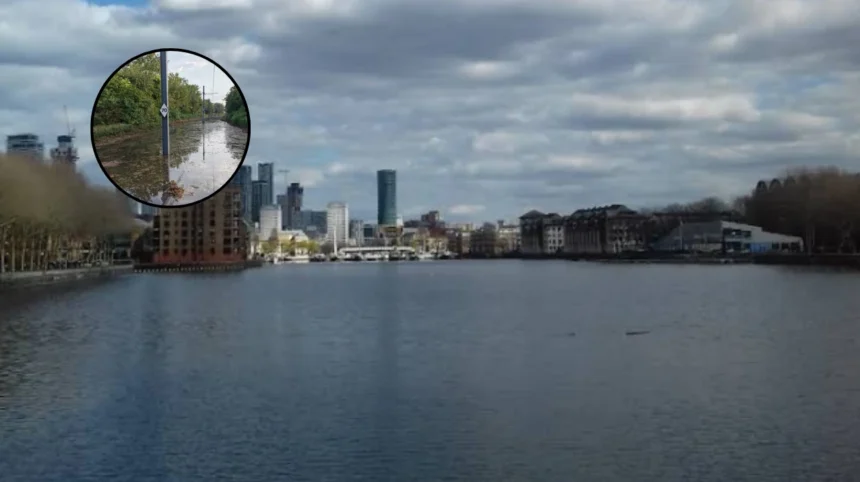
Nearby, environmental monitoring assets noted that the River Wandle was rapidly approaching maximum capacity, coming exceptionally close to breaking its banks near Beddington, which threatened to inundate surrounding low-lying residential zones.
How Did the London Fire Brigade Manage the Surge in 999 Calls?
As the volume of parallel incidents escalated immediately following the dawn downpour, senior command structures within the London Fire Brigade implemented specialized emergency protocols to prevent the local dispatch system from becoming entirely overwhelmed.
When Was the High-Volume Call Procedure Enacted?
The sheer velocity of incoming reports required a fundamental shift in how emergency resources were triaged across the capital. As reported by Assistant Commissioner Pat Goulbourne of the London Fire Brigade, the surge began in the early hours of the morning:
“Shortly after 4am, due to a large number of calls received by the Brigade, we implemented our High-Volume Call procedure which means flooding calls where there is a risk to life are prioritised and crews then attend other calls as non-emergencies when they can.”
Under this directive, standard response time targets for property-only flooding were temporarily suspended, ensuring that available apparatus and personnel were strictly directed toward life-safety rescues and active fires, such as the ongoing incident in Tooting.
What Role Did Operation Willow Beck Play in the Crisis?
To further mitigate the administrative burden on London-based operators, senior command triggered a national mutual aid framework known as Operation Willow Beck. Assistant Commissioner Pat Goulbourne detailed the activation, expressing gratitude for the integrated national system:
“I’d like to thank all of those colleagues in other fire rescue services who assisted us overnight, as well as our own staff for their hard work and professionalism during this busy period. While the worst of the rain now seems to have passed, we continue to work through outstanding calls as well as receive new incidents as Londoners wake to see some of the damage caused by the storms overnight.”
Goulbourne concluded his briefing by emphasizing that despite the residual backlog, operational capacity remained intact:
“We’d like to reassure Londoners that crews are available to respond to emergencies, so please call 999 if you have to.”
Background of the National Mutual Aid Framework and Regional Flood Defences
The deployment of Operation Willow Beck during this morning’s thunderstorm highlights a formalized evolution in how the United Kingdom manages localized environmental crises. Introduced nationally in 2022 by the Home Office in conjunction with the National Fire Chiefs Council (NFCC), Operation Willow Beck is a pre-determined 999 call distribution procedure designed explicitly for periods of extreme, localized demand.
Prior to its implementation, a localized disaster—such as a severe cloudburst over a major metropolitan area—could isolate a single emergency control room, leading to dropped calls or severe delays as a handful of operators attempted to log hundreds of simultaneous reports.
Under the modern framework, when an agency like the LFB experiences a call volume that crosses a specific mathematical threshold, surplus emergency calls are automatically and seamlessly diverted to unaffected fire and rescue service control rooms across the country. These external operators log the details into a shared national system, allowing local dispatchers to focus entirely on positioning assets on the ground.
Locally, the near-breaching of the River Wandle near Beddington brings renewed scrutiny to South London’s catchments.
The Wandle, an urban chalk stream that runs through Croydon, Sutton, Merton, and Wandsworth, has a historical precedent for rapid urban runoff. Because much of the surrounding terrain in Croydon and Beddington is heavily urbanized with impermeable concrete surfaces, heavy rainfall cannot easily permeate the ground. Instead, it converts instantly into surface water runoff, overwhelming localized drainage networks and funneling directly into the Wandle, causing the sharp spikes in river levels observed during this morning’s event.
Explore More Local South London News
Green Candidate Esther Lie Wins Lewisham By-Election 2026; South London 2026
Lambeth Reviews Immigration Enforcement – South London 2026
Prediction: How This Development Can Affect South London Commuters and Property Owners
This severe weather event and the subsequent operational strain on local infrastructure will likely have immediate and mid-term ramifications for South London commuters and property owners.
For the commuting public relying on the Croydon tram network and local arterial roads, this incident demonstrates the vulnerability of the Addiscombe-to-Beckenham Junction corridor to localized flash flooding.
Commuters can expect lingering delays over the coming days as Transport for London (TfL) conducts safety inspections of the ballasts and electrical signaling equipment submerged this morning. Furthermore, the LFB’s explicit warning regarding the floating thresholds of standard passenger vehicles underscores a growing need for motorists to alter their behavior during dawn downpours, likely leading to increased congestion on non-flooded alternative routes as drivers avoid historical flashpoints.
Property Insurance and Local Flood Mitigation
For property owners, particularly those situated near the River Wandle in Beddington or within the flash-flood zones of Tooting, this event will likely influence local risk assessments. Insurance underwriters frequently adjust premiums based on the frequency of high-volume emergency calls and localized flooding markers.
A direct lightning strike causing a structural fire on Wilde Place may also prompt local property owners to reassess residential lightning protection systems and surge protection infrastructure. As climate models indicate a higher frequency of sudden, high-intensity summer storms, property owners in these specific South London boroughs may face escalating pressure to invest in private property resilience measures, such as non-return valves and flood barriers, to safeguard their assets against future drainage failures.