Key Points
- More than 150 residents on Bermondsey’s St James Estate have received Section 21 “no-fault” eviction notices and proposed rent increases of up to £524 a month following BMR Group’s acquisition of the properties.
- At Southwark Council’s full meeting on 18 November, it was revealed that not all affected residents have been able to access legal aid, with some said to be facing homelessness without legal representation.
- Jenny Turner told the council that at least five households had received Section 21 notices but had no legal representation.
- Councillor Reginal Popoola, Executive Member for Council Homes, said Southwark Council is providing £375,979 to Southwark Law Centre for the current financial year.
- Councillor Popoola said the council cannot act as legal representative for residents in individual civil disputes with their landlord.
- Residents affected by Section 13 rent increases have been advised that they may challenge proposed increases through the First-tier Tribunal.
- One resident’s proposed rent increase was reportedly reduced from £400 to £125, but Jenny Turner said that was the only successful outcome among 11 tribunal cases.
- Councillor Popoola said legal aid had been “significantly stifled” by current legislation and called for MPs to seek appropriate funding and an expanded scope for legal aid.
- The 152-home St James Estate was built in the early 1990s on former railway land and was originally owned by Quality Street, a Nationwide-funded landlord intended to provide secure and affordable private rentals.
- Residents fear some family homes could be converted into Houses in Multiple Occupation (HMOs), which they believe would generate higher profits for BMR.
- Southwark Council has received “several” property licensing applications for the estate, according to The i Paper.
- Freshview, the estate’s managing agent, said there were no plans to convert the estate “as a whole” into HMOs, but said a review found a “significant number” of homes were rented substantially below market rates.
- Southwark Council says it cannot prevent a property becoming an HMO where it complies with planning and licensing requirements, but applications requiring permission or a licence will be assessed under relevant policies and regulations.
Bermondsey (South London News) November 20, 2026 — St James Estate residents facing Section 21 eviction notices and rent increases of up to £524 a month following BMR Group’s acquisition of the properties are reportedly struggling to access legal aid, leaving some households without legal representation and at risk of homelessness. The issue was raised at Southwark Council’s full meeting on 18 November, where councillors were asked to consider ring-fenced independent legal funding for tenants on the estate.
- Key Points
- What did residents tell Southwark Council?
- How has Southwark Council responded?
- What support is available to residents?
- What are residents facing?
- What has the council said about HMOs?
- What has been said about the evictions?
- Background of the development
- Prediction: how this could affect residents
What did residents tell Southwark Council?
Jenny Turner, who asked a supplemental question at the start of the meeting, said that, as far as she knew, at least five households on the St James Estate had been served Section 21 “no-fault” eviction notices but had no legal representation.
As reported by MyLondon, Ms Turner said:
“As far as I know, at least five households on the St James Estate currently have been served Section 21 ‘no-fault’ eviction notices, but they have no legal representation, and so they are facing a threat of homelessness.”
She argued that supporting tenants now could avoid costs later if residents became homeless or displaced.
“You could save a lot of money by supporting these tenants now, rather than down the line if they become homeless or displaced,” she said.
Ms Turner added: “Furthermore, and much more importantly, you could save people an awful lot of stress and unhappiness and misery. So will you please reconsider and offer ring-fenced independent legal funding to the St James’ tenants?”
Her intervention came after more than 150 people on the estate were handed Section 21 notices and rent increases of up to £524 per month following BMR Group’s acquisition of the properties.
How has Southwark Council responded?
In a written response, Councillor Reginal Popoola, Southwark Council’s Executive Member for Council Homes, said the council is providing £375,979 in funding to Southwark Law Centre for the current financial year.
However, he said the council itself cannot act as the legal representative for residents in individual civil disputes with their landlord.
Councillor Popoola also said residents affected by Section 13 rent increases have been advised of their right to challenge proposed increases through the First-tier Tribunal.
One resident has reportedly had a proposed rent increase reduced from £400 to £125. But, according to Ms Turner, it was the only case out of a total of 11 that received a successful outcome at the First-tier tribunals.
Addressing Ms Turner’s question at the meeting, Councillor Popoola said:
“I do want to reiterate the fact that work primarily does need to come from the Law Centre.
“It’s been significantly stifled through current legislation at this moment in time, and I do encourage all of our MPs to go back to Parliament to ensure that the legal aid ecosystem is funded appropriately.
“We need to ensure that the scope of legal aid is expanded appropriately to avoid a situation that we currently have right now.”
Councillor Popoola thanked council officers and the Law Centre for their work. He said he would continue to meet residents to see what further help and advice the council could provide to people who are not currently eligible for legal aid.
What support is available to residents?
Southwark Council says it has been working with local organisations, including Southwark Law Centre, which can offer independent advice to residents on their legal rights and, where appropriate, represent them.
In its published guidance on the St James Estate, the council says it has no legal recourse to directly prevent the evictions. It says it has focused instead on ensuring affected tenants understand their rights and are supported by its homelessness prevention team on an individual basis.
The council says it has maintained regular engagement with the St James Tenants Association, residents, local councillors and MPs, Southwark Law Centre, Citizens Advice Southwark and other organisations since July 2026. This has included meetings, outreach activity and coordinated support initiatives designed to help residents understand their rights.
Southwark Council has also established a dedicated St James Estate mailbox for anyone seeking help: StJamesEstateenquiries@southwark.gov.uk.
The council urges residents who have received an eviction notice to contact Southwark Law Centre for legal advice and support. It says anyone worried about losing their home can also contact the council to discuss their circumstances and make a homelessness application if they believe they may become homeless.
Southwark Law Centre says it provides free, independent and confidential legal advice and representation to people who live or work in Southwark, Lewisham and surrounding communities. It has also stated that St James Estate residents do not need to qualify for legal aid to access its eviction advice service.
What are residents facing?
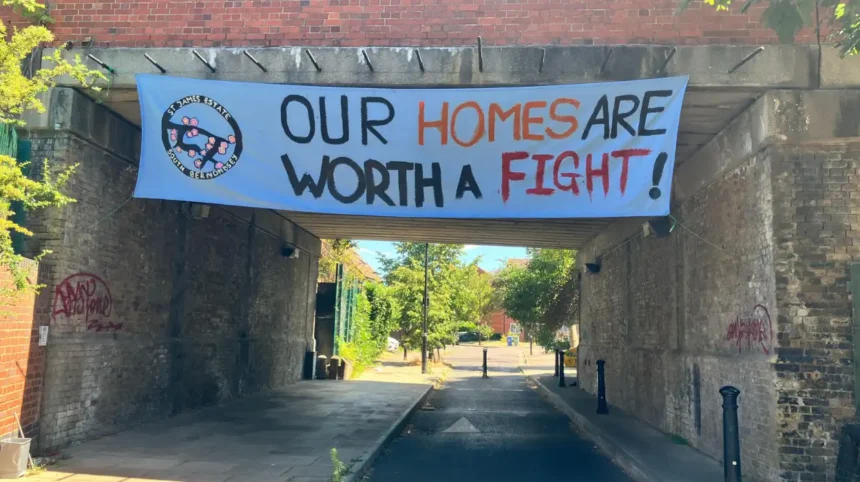
The 152-home St James Estate was built in the early 1990s on old railway land. It was originally owned by Quality Street, a Nationwide-funded landlord that aimed to provide secure and affordable private rentals.
As previously reported by the Local Democracy Reporting Service (LDRS), residents fear their family homes could be converted into Houses in Multiple Occupation (HMOs), which would generate significantly higher profits for BMR.
The council has received “several” property licensing applications for the estate, according to The i Paper. The publication reported that the St James residents’ group believed homes could be converted into larger HMOs, potentially accommodating six or more single individuals paying higher rents.
A spokesperson for the estate’s managing agent, Freshview, previously said there were no plans to “convert the estate as a whole into HMOs”. The spokesperson said a review found a “significant number” of homes were being rented at “substantially below” market rates.
The BBC reported in July that Freshview said individual properties were periodically reviewed, but there was “no proposal to convert the estate as a whole into HMOs”. The spokesperson said recent First-tier Tribunal rulings had confirmed that its proposed increases reflected market rental values and that rent rises were not being enforced while tribunal cases remained ongoing.
Freshview also said renewal agreements had been offered in 20 of the 32 remaining Section 21 cases after discussions with tenants, with rents below current market value. It said the remaining cases mainly involved tenants with significant rent arrears or other individual circumstances.
The company said it intended to continue investing in the estate and work with residents and Southwark Council to secure its long-term future. The BBC said it approached BMR Group on several occasions for comment.
What has the council said about HMOs?
Southwark Council says it does not have the power to prevent a property from becoming an HMO where it complies with planning and licensing requirements.
However, where planning permission or a licence is required, any application would be considered in line with relevant planning policies and licensing regulations.
The council says it can take enforcement action against private landlords where there is evidence that housing standards or legal requirements are not being met. It says it cannot declare a landlord “unfit” based on concerns about business decisions or the use of Section 21 eviction notices.
If evidence is found that a landlord has breached housing, licensing or other relevant legal requirements, the council says it will investigate and take appropriate action using the powers available to it.
What has been said about the evictions?
Southwark Council has said it is “appalled” by the Section 21 no-fault eviction notices and rent increases issued to residents by their landlord.
In its guidance, the council says the landlord, BMR Group, and Freshview, which manages the estate for BMR, imposed the notices the day before the government changed the law to ban no-fault evictions.
The council says it is deeply concerned about the impact on residents and is working with local partners to ensure those affected can access advice and support.
The BBC reported that Southwark Council’s executive member for community safety and engagement, David Watson, confirmed that while the landlord acted legally, the timing was “morally questionable”.
“Unfortunately, the landlord’s actions are legal,” Councillor Watson said.
“They imposed these notices the day before the government changed the law in order to ban no-fault evictions.”
Asha Garway, secretary of the St James’ Tenants Association, accused the landlord of seeking to turn family homes into houses in multiple occupation to boost profits.
“They can turn a three-bedroom property into six to eight-bedroom properties… doubling their profit and kicking families out,” Ms Garway said.
Background of the development
St James Estate is a privately owned and managed estate in Bermondsey. It was built in the early 1990s on former railway land and originally owned by Quality Street, a Nationwide-funded landlord that aimed to provide secure and affordable private rentals.
BMR Group acquired the estate, with Freshview managing it on BMR’s behalf. Residents subsequently received Section 21 “no-fault” eviction notices and proposed rent increases.
Section 21 notices allow landlords in certain circumstances to seek possession without needing to give a reason. Southwark Council says the notices were issued the day before the government changed the law to ban no-fault evictions under the Renters’ Rights Act.
Residents affected by Section 13 rent increases have been advised of their right to challenge proposed increases through the First-tier Tribunal. One reported case resulted in a proposed increase being reduced from £400 to £125.
The estate has also become the focus of concerns over possible HMO conversions. Southwark Council says it has received several property licensing applications, while Freshview has said there is no proposal to convert the estate as a whole into HMOs.
Prediction: how this could affect residents
If legal aid and independent representation remain unavailable to some households, residents could face greater difficulty responding to possession proceedings, challenging rent increases or understanding their housing rights. This may increase the risk of displacement for tenants who cannot secure alternative accommodation or afford the proposed rent levels.
For St James Estate residents, the immediate effect is likely to be continued uncertainty over whether they can remain in their homes, particularly for households already facing eviction proceedings. Those without legal representation may need to rely more heavily on Southwark Law Centre, Citizens Advice Southwark, the council’s homelessness prevention team and the dedicated estate mailbox for advice.
If more tribunal challenges proceed, outcomes could affect the rent levels individual residents are asked to pay. However, the reported experience so far — one successful outcome among 11 tribunal cases, according to Ms Turner — indicates that residents may continue to face financial pressure even where they challenge increases.
For the wider Bermondsey community, the development could affect the estate’s social composition if family homes are converted into HMOs or if households are displaced. Any licensing or planning applications would be assessed by Southwark Council under its relevant policies and regulations, meaning the council’s decisions on individual applications could shape what happens next on the estate.