Key points
- Drivers using the South Circular Road (A205) in south‑east London are facing ongoing disruption this week due to multiple roadworks schemes.
- At Dulwich Common, near the junction with Lordship Lane (SE21/SE22), lane restrictions and temporary traffic signals are in place in both directions to facilitate maintenance works.
- Transport for London (TfL) has flagged that delays are possible at Dulwich Common as part of its ongoing TfL‑led scheme at the Dulwich Common / Lordship Lane junction on the A205.
- The Dulwich‑area works are understood to form part of a longer‑running project to remodel the junction and install new pedestrian crossings, originally scheduled to run from late February to early June 2025.
- No specific end date has been published for the current week’s restrictions at Dulwich Common, though the wider junction‑remodelling project is set to conclude by 6 June 2025.
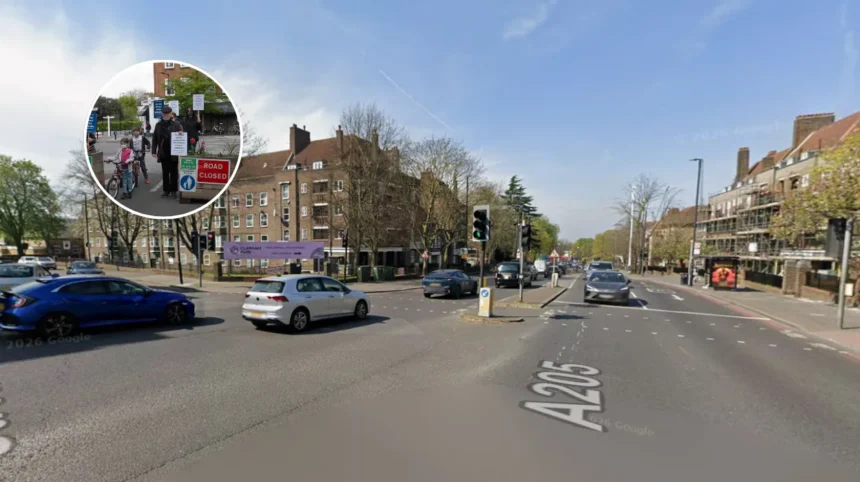
Southwark (South London News) April 9, 2026Southwark, London – Drivers using the South Circular Road (A205) are encountering significant delays this week as multiple sets of roadworks press on along the busy south‑east London artery. In particular, the junction of Dulwich Common and Lordship Lane (SE21/SE22) has narrow lanes and temporary traffic signals in operation in both directions, with Transport for London warning that delays are likely.
- Key points
- Why are there lane restrictions and temporary signals at Dulwich Common?
- How are other parts of the South Circular affected at the same time?
- How long are the current restrictions expected to last?
- How are drivers and local residents being advised to respond?
- Background of the development
- Prediction: How these South Circular works could affect local drivers and residents
As reported by live‑traffic monitoring site London Traffic, the Dulwich Common scheme is listed as
“TfL works” on the A205, with lane‑width reductions and temporary signals in place “to facilitate maintenance works” at the junction of Lordship Lane. The same channel notes that the work is ongoing and that motorists should expect “delays are possible” while the restrictions remain.
Why are there lane restrictions and temporary signals at Dulwich Common?
The lane‑width reductions and temporary signals at Dulwich Common are directly tied to a longer‑running TfL project to remodel the junction of Dulwich Common and Lordship Lane on the A205.
According to Transport for London’s own Q&A to the London Assembly, the authority plans to construct new pedestrian crossings at the junction of Dulwich Common and Lordship Lane, a scheme that was scheduled to follow completion of detailed design in March 2025.
Local forum discussions summarising TfL communications indicate that work at the junction is expected to severely curtail access to the South Circular going west from Lordship Lane, and likely east as well, from late February through to mid‑June 2025.
One resident quoted in an East Dulwich Forum thread said they had received a note from TfL stating that the remodel and new pedestrian‑crossing installation would entail “3 and a half months of disruption” on the A205.
Official traffic‑works listings for the A205 repeated on London Traffic also show that the Dulwich Common section is coded as TfL works with
“restrictions and temporary signals” in both directions, again emphasising that “delays are possible.”
These restrictions are being described by TfL‑linked channels as part of the broader maintenance and safety‑upgrade works at the junction, rather than as isolated, short‑term pothole repairs.
How are other parts of the South Circular affected at the same time?
While the most prominent set of restrictions this week is at Dulwich Common, traffic‑information platforms show that the A205 across south‑east London is concurrently hosting several other utility‑driven works. For example, at Cavendish Road (SW12/SW4), BT‑led utility works have led to an eastbound contraflow system, narrowing the roadway and reducing capacity.
London Traffic’s A205 listing records that the Cavendish Road contraflow is “to facilitate BT works” and notes that while traffic is flowing, “disruption possible” remains the expected impact.
Further along the route, in Westhorne Avenue (SE12), Thames Water utility works have brought lane restrictions between Baring Road and Sidcup Road, again with “delays are possible” as the official advisory.
Utility‑works notices for other A205 sections – including Devonshire Road, Waldram Park Road and London Road – also describe lane‑width reductions, temporary signals and multi‑way temporary lights to allow telecoms and water‑network works. These projects are not all scheduled for completion on the same date as the Dulwich Common scheme, but their combined effect is to depress overall capacity along large stretches of the South Circular during April 2025.
How long are the current restrictions expected to last?
Transport for London has not published a specific end date for the current week’s lane‑restriction and temporary‑signal regime at Dulwich Common, but the broader junction‑remodelling project is known to run until 6 June 2025.
A forum post summarising a TfL‑issued notice states that the works remodelling the junction of Lordship Lane and Dulwich Common will run from “next Monday” in late February up to 6 June 2025, covering the installation of the new pedestrian crossing.
London Traffic’s current A205 works listing likewise does not give a precise end‑time for the Dulwich Common restrictions, only that the scheme is active and that “delays are possible” while the temporary layout remains.
TfL has historically tended to roll out such junction‑remodelling schemes in phases, which may mean that the most disruptive lane‑width reductions and temporary‑signal periods are concentrated into certain weeks within the overall late‑February‑to‑mid‑June window.
How are drivers and local residents being advised to respond?
Third‑party traffic and news outlets advising motorists on the Easter‑2026 weekend, which also saw concurrent South Circular works, have urged drivers to use live‑traffic monitoring tools and to allow extra journey time. A Yahoo News UK article summarising Easter‑weekend disruption on the South Circular warned that
“a series of protracted projects on the A205 are anticipated to lead to delays,”
including the lane‑restriction and temporary‑signal works at Dulwich Common and the contraflow on Cavendish Road.
The same report, citing TfL‑linked traffic‑information channels, notes that while no full closures are expected, the lane‑width reductions and temporary signals will nonetheless “diminish capacity” and increase congestion, particularly during peak hours.
London Traffic’s own A205 notices echo that messaging, advising motorists to “approach with caution” and expect “delays possible” where works are in progress.
Local residents on community forums have also flagged that the South Circular’s role as a key east‑west artery for south‑east London makes the three‑and‑a‑half‑month disruption disproportionately heavy for surrounding neighbourhoods. One East Dulwich Forum contributor wrote that the A205 is
“an artery (a pretty sclerotic one, but the only one we’ve got!) for East‑West connectivity for us South East Londoners,”
and warned that the scale of disruption would “pollute our atmosphere” through prolonged congestion.
Background of the development
The current wave of restrictions on the South Circular is part of a multi‑year programme of utility and infrastructure upgrades along the A205 corridor, driven by both Transport for London and private utility firms. TfL has long treated the Dulwich Common / Lordship Lane junction as a priority for safety improvements, with the planned pedestrian‑crossing scheme following years of local lobbying and council‑level discussions about junction‑safety and access for vulnerable road users.
At the same time, water and telecoms companies have been installing and upgrading underground networks along the A205, which has necessitated repeated lane‑closure and temporary‑signal schemes in sections such as Cavendish Road, Westhorne Avenue, London Road and Waldram Park Road.
These utility works are typically scheduled in multi‑week blocks, often timed to avoid major public‑holiday weekends, but still contributing to the cumulative congestion that residents and commuters now associate with the South Circular.
The broader context is that TfL and the boroughs along the A205 have been under pressure to balance safety‑focused schemes – such as new pedestrian crossings and junction‑remodelling – with the need to maintain traffic flow along a road that already carries high volumes.
The current package of April‑2025 roadworks reflects that tension: physical improvements are being delivered, but only after a protracted period of lane‑width reductions and temporary‑signal phases that are themselves items of public complaint.
Prediction: How these South Circular works could affect local drivers and residents
If the Dulwich Common junction‑remodelling scheme runs through to its scheduled end‑date in June 2025, local drivers and residents can expect three main effects: an extended period of congestion, a lasting change in how the junction is used, and a modest improvement in pedestrian‑crossing safety once works conclude.
For daily commuters, the ongoing lane‑width reductions and temporary signals are likely to keep journey times above pre‑works levels for the duration of the project, particularly at peak hours and during holidays when other A205 utility works coincide. The combined effect of the Dulwich‑junction scheme and parallel utility works on sections like Cavendish Road and Westhorne Avenue may push more traffic onto parallel routes, increasing pressure on local side‑roads and residential streets.