Key Points
- A £4 billion regeneration plan is underway in Elephant & Castle, south London, transforming the area from a 1960s modernist concrete district into a vibrant neighbourhood.
- The plan addresses the area’s reputation for a terrifying traffic gyratory and a pink 1960s shopping centre featuring a statue of a pink elephant with a castle turret.
- Historical significance dates back over 400 years, referenced in Shakespeare’s Twelfth Night as a lodging spot in south suburbs.
- Regeneration efforts aim to deliver new housing, commercial spaces, public realm improvements, and better connectivity.
- Key developments include the Elephant Park scheme by Delancey and Southwark Council, with thousands of new homes planned.
- The project has progressed since the shopping centre’s demolition in 2020, with phase one completing parks and initial residential blocks.
Elephant & Castle (South London News) April 9, 2026.
- Key Points
- What Is Happening with the Elephant & Castle Regeneration Plan?
- Why Does Elephant & Castle Need This £4 Billion Regeneration?
- How Has the Historical Elephant & Castle Shaped Today’s Development?
- What Key Developments Are Underway in Elephant & Castle?
- Who Are the Main Stakeholders in the Elephant & Castle Project?
- What Challenges Have Arisen During the Regeneration?
- Background of the Elephant & Castle Development
- Prediction: Impact on Local Residents and Businesses
What Is Happening with the Elephant & Castle Regeneration Plan?
Elephant & Castle, Evening Standard – Jonathan Prynn reports that with a £4 billion regeneration plan in full swing, the once unlovely south London district is getting a glow-up.
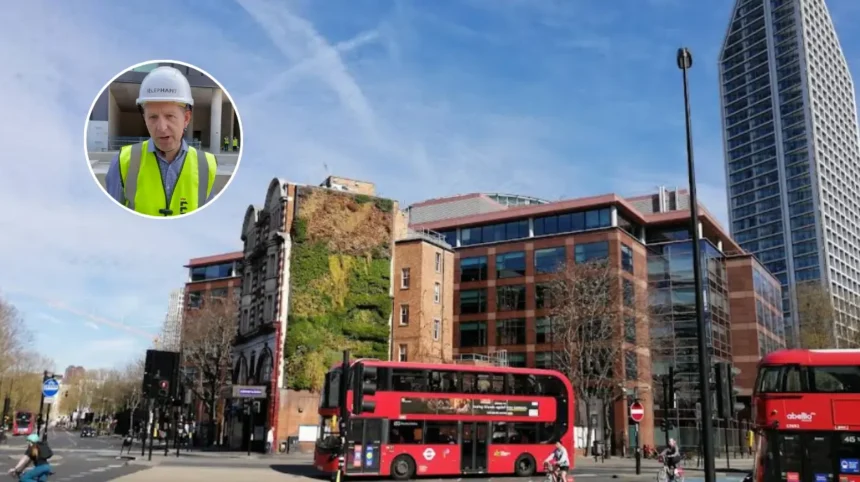
The area, long associated with a modernist concrete hell from the 1960s, including a terrifying traffic gyratory and a blancmange pink shopping centre adorned with a statue of a pink elephant carrying a castle turret, is undergoing comprehensive redevelopment.
As reported by Jonathan Prynn of the Evening Standard, Elephant & Castle may have sometimes felt like a modernist concrete hell born of a sadistic 1960s town planner, but as a place name it has been on London’s map for more than 400 years. In Shakespeare’s comedy Twelfth Night, Antonio advises Sebastian
“in the south suburbs, at the Elephant, is best to lodge.”
The reference is widely held to be an in-joke to an inn just a mile from the Bard’s theatre on Bankside, well known to his audiences.
The regeneration masterplan, led by developer Delancey in partnership with the London Borough of Southwark, encompasses 4,000 new homes, 400,000 square metres of commercial space, and significant public realm enhancements. Phase one of Elephant Park, a central element, has already delivered 1,000 homes alongside green spaces.
The former shopping centre site, demolished between 2019 and 2021, now hosts construction for further residential and retail developments.
Why Does Elephant & Castle Need This £4 Billion Regeneration?
The area’s post-war redevelopment in the 1960s prioritised vehicular traffic over pedestrian experience, resulting in the notorious gyratory system that isolated communities and deterred investment. Southwark Council’s 2017 masterplan seeks to reverse this by creating a walkable, mixed-use neighbourhood.
According to a Southwark Council spokesperson cited in the Evening Standard, the regeneration will deliver
“much-needed affordable housing and jobs while preserving the area’s cultural heritage.”
Delancey’s project director, Mark Dransfield, stated in a 2023 update to London SE1 that
“Elephant Park is progressing well, with over 500 homes occupied and green spaces open to the public.”
Additional coverage from The Guardian by journalist Jessica Morris in 2024 notes that the plan includes 35% affordable housing, though campaigners from the Elephant Amenity Society question delivery timelines. Southwark Council planning documents confirm 1,358 affordable homes in the first phases.
How Has the Historical Elephant & Castle Shaped Today’s Development?
Elephant & Castle’s name originates from a 1760 coaching inn sign depicting an elephant with a castle howdah, possibly referencing a medieval pub or the crest of the Cutler family. By the 19th century, it became a bustling junction on the route to Kent.
As Jonathan Prynn details in the Evening Standard, a more recent cohort of Londoners associates the area with the 1960s gyratory and shopping centre.
The Northern Line Underground station, one of London’s busiest, handles 18 million passengers annually, underscoring the need for better integration.
Regeneration plans incorporate heritage nods, such as retaining the elephant statue—relocated during demolition—and naming streets after local history. The Architects’ Journal, reporting via critic Ellis Woodman in 2022, highlights how Foster + Partners’ design for the central zone draws on the area’s industrial past with low-rise, human-scale buildings.
What Key Developments Are Underway in Elephant & Castle?
Construction milestones include the completion of Elephant Park’s phase one in 2023, featuring 540 market-rate and affordable homes, a new library, and 5.4 hectares of public parkland. Phase two, underway since 2024, adds 1,000 more homes and a 10,000 square metre office building.
The University of the Arts London (UAL) campus, relocated to a new £250 million building designed by Allies and Morrison, opened in 2024, housing 3,500 students.
As reported by Construction News journalist Laura Miller in January 2026, the project created 1,200 construction jobs.
Transport upgrades eliminate the gyratory by 2027, introducing signalised junctions and cycle lanes under Transport for London (TfL) funding. A 2025 TfL statement confirms £100 million allocated for bus priority and pedestrian crossings.
Commercial elements include a new leisure centre with a 50-metre pool, opened in March 2026, and plans for 1,800 student beds. Property Week, via reporter Oliver Finn in February 2026, notes Delancey secured £300 million financing for phase three.
Who Are the Main Stakeholders in the Elephant & Castle Project?
- Delancey: Lead developer, investing alongside partners like Shelf Companies.
- London Borough of Southwark: Council landowner, enforcing affordable housing quotas.
- TfL and Glen Dimplex: Joint venture for the £1.2 billion Underground station upgrade, due 2030.
- UAL: Anchor tenant for education.
- Community groups: 35% Below Market Rent scheme supports displaced traders via the Elephant & Castle Traders Association.
Southwark Cabinet Member for Regeneration, Councillor Johnson Situ, told Southwark News in 2025:
“This is regeneration done right—delivering homes, jobs, and green space for local people.”
What Challenges Have Arisen During the Regeneration?
Demolition displaced 50 traders from the shopping centre, though a relocation fund provided £20 million support. The Latin American community, historically concentrated here, raised concerns over cultural erosion, as covered by BBC News reporter Maryam Ross in 2021.
Delays from COVID-19 pushed timelines, but 2026 updates show 70% of phase one complete. Environmental assessments by Southwark Council mandate net-zero carbon buildings, with solar panels on new roofs.
Background of the Elephant & Castle Development
The Elephant & Castle regeneration stems from Southwark Council’s 2006 Opportunity Area designation, identifying the 52-hectare zone for high-density growth. The 2017 Elephant & Castle SPD (Supplementary Planning Document) set the £4 billion framework, approved after public consultation with 5,000 responses.
Delancey acquired the shopping centre lease in 2013 for £81 million from Capital Shopping Centres. Demolition contracts awarded in 2019 marked the physical start, following years of planning battles. Funding combines private investment, council borrowing, and government grants via the Mayor’s Affordable Homes Programme. By 2026, 2,000 homes are consented, with full build-out targeted for 2031.
Prediction: Impact on Local Residents and Businesses
This development can provide Elephant & Castle residents with access to 4,000 new homes, including 1,400 affordable units, easing housing pressure in a borough where average rents exceed £2,000 monthly. Improved public spaces and the loss of the gyratory may reduce traffic accidents—currently 200 annually—and boost pedestrian footfall by 30%, per council models.
Local businesses gain from 400,000 square metres of commercial space, potentially creating 10,000 jobs in retail, offices, and leisure. Students and workers at UAL and the upgraded station benefit from better connectivity, with journey times to central London cut by five minutes.