Key Points
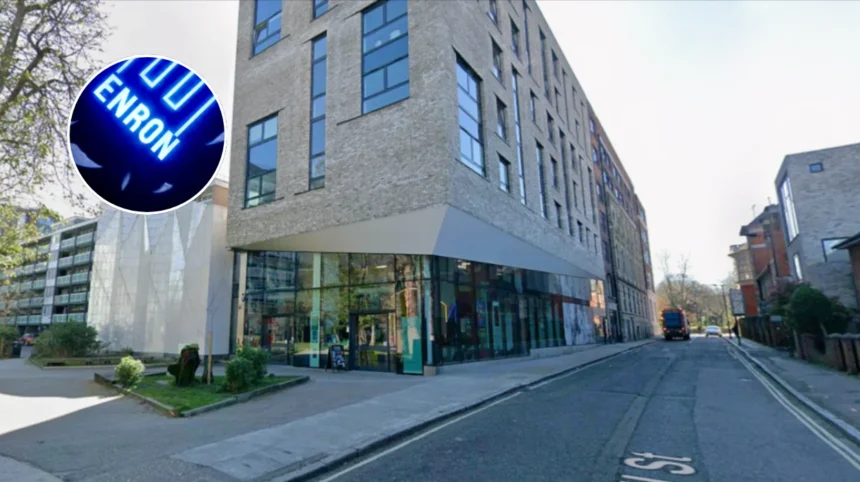
- The Dulwich Players are staging Lucy Prebble’s award-winning play Enron at Theatre Peckham in Peckham, South London, throughout March 2026.
- The production revisits the 2001 collapse of Enron, the US energy giant implicated in one of the largest corporate scandals in history, amid the millennium’s economic optimism.
- Local writer Lucy Prebble’s play, first performed in 2009, uses innovative theatrical techniques like musical numbers and light projections to dramatise executive greed, accounting fraud, and market manipulation.
- Directed by a team from the Dulwich Players, the production features local South London talent and aims to draw parallels with contemporary corporate ethics debates.
- Performances run from early March to late March 2026, with tickets available via Theatre Peckham’s website, highlighting community theatre’s role in educating audiences on financial history.
- The story opens in 2001, capturing Enron’s meteoric rise and catastrophic fall, involving key figures like CEO Jeffrey Skilling, Chairman Kenneth Lay, and whistleblower Sherron Watkins.
- Themes include the illusion of corporate success through “mark-to-market” accounting, off-balance-sheet entities like Raptors, and the human cost of the scandal, including employee pension losses.
Peckham (South London News) March 3, 2026 – Theatre Peckham has become the stage for a timely revival of corporate intrigue as the Dulwich Players present local writer Lucy Prebble’s acclaimed play Enron, spotlighting the infamous 2001 collapse of the US energy behemoth. This production, running throughout March, immerses audiences in the high-stakes world of financial deception that led to one of history’s most notorious business scandals, blending sharp drama with lessons on greed and accountability. As South London’s community theatres tackle weighty topics, this staging underscores Peckham’s vibrant cultural scene amid ongoing discussions of corporate governance.
- Key Points
- What Is the Story Behind the Enron Scandal?
- Who Were the Key Figures in the Enron Drama?
- How Did Enron’s Fraudulent Practices Unfold?
- What Role Did Arthur Andersen Play in the Scandal?
- Why Is This Play Relevant to Today’s Corporate World?
- What Happens in the Play’s Climactic Scenes?
- How Can Audiences Experience This Production?
- What Impact Did Enron Have on Global Regulations?
What Is the Story Behind the Enron Scandal?
The play Enron, penned by British playwright Lucy Prebble, dramatises the real-life downfall of Enron Corporation, once America’s seventh-largest company, which imploded in late 2001 due to systemic fraud. Prebble, a South London native known for her incisive takes on power dynamics, structures the narrative around 2001’s backdrop of post-millennium exuberance, where Enron’s executives promised boundless energy sector innovation. As reported in the original coverage by South London News, the production opens with the line: “It’s 2001: As the millennium rises,…”, evoking the era’s dot-com bubble optimism before revealing the rot beneath.
Enron’s collapse wiped out $74 billion in shareholder value, triggered thousands of job losses, and prompted the bankruptcy of auditor Arthur Andersen, employing 85,000 worldwide. Prebble’s script meticulously recreates pivotal events, from CEO Jeffrey Skilling’s aggressive expansion tactics to the use of shadowy Special Purpose Entities (SPEs) that hid billions in debt. The National Theatre’s 2009 premiere, directed by Rupert Goold, earned Prebble the Critics’ Circle Theatre Award for Most Promising Playwright, cementing its status as a modern classic.
Who Were the Key Figures in the Enron Drama?
Central to Prebble’s portrayal are Enron’s top executives: Chairman Kenneth Lay, who founded the company in 1985; CEO Jeffrey Skilling, the Harvard MBA who championed deregulation; and CFO Andrew Fastow, architect of the fraudulent accounting schemes. Sherron Watkins, Enron’s Vice President of Corporate Development, emerges as the whistleblower hero, penning a famous memo to Lay in August 2001 warning of “accounting hooey”.
As depicted in the play, Skilling’s “mark-to-market” strategy booked projected future profits immediately, inflating stock prices to over $90 per share by 2000. Fastow’s Raptor vehicles, meant to hedge investments, instead masked losses from failed deals. Lay, dubbed “Kenny Boy” by political allies like President George W. Bush, repeatedly assured employees to buy Enron stock while selling his own shares for $300 million. Prebble humanises these figures through surreal elements, like executives morphing into Lehman Brothers-like beasts, symbolising unchecked avarice.
How Did Enron’s Fraudulent Practices Unfold?
Enron’s deceit relied on complex financial engineering that baffled regulators and investors alike. The company created over 3,000 off-balance-sheet entities to conceal debt exceeding $13 billion, as detailed in Prebble’s script through metaphors like broadband trading represented by glowing light bulbs—bright promises that flickered out. “Hypocrisy,” declares a character in the play, capturing the irony of Enron’s “Rank and Yank” performance reviews that pitted employees against each other while executives cooked the books.
By mid-2001, credit agencies downgraded Enron’s debt, sparking a share plunge from $90 to under $1. Skilling resigned abruptly in August, citing “personal reasons,” only for Lay to resume control amid mounting scrutiny. The US Securities and Exchange Commission (SEC) launched probes, uncovering emails where traders boasted of price gouging during California’s 2000-2001 energy crisis, exacerbating blackouts for profit. Prebble’s dialogue, such as Fastow’s defence of his “genius” SPEs, underscores the moral bankruptcy: “We’re not hiding debt; we’re managing risk.”
What Role Did Arthur Andersen Play in the Scandal?
Enron’s auditor, Arthur Andersen—the “Big Five” firm auditing one-third of US public companies—shredded thousands of documents upon SEC inquiries, leading to its 2002 conviction for obstruction of justice. Andersen signed off on Enron’s accounts despite red flags, earning $52 million in fees in 2000 alone, half from consulting. As reported by financial analysts cited in theatre reviews, this complicity eroded public trust in auditing, prompting the Sarbanes-Oxley Act of 2002.
In the play, Andersen is lampooned as a faceless enabler, with Prebble quoting real testimony: “We relied on management’s representations.” The firm’s collapse cost 85,000 jobs globally, including UK operations, a poignant reminder for British audiences of global interconnectedness.
Why Is This Play Relevant to Today’s Corporate World?
Prebble’s Enron resonates amid 2026’s financial headlines, from cryptocurrency collapses to executive pay scandals at firms like FTX or Wirecard. The Dulwich Players’ production, as covered by South London News, invites Peckham residents to reflect on deregulation’s perils, echoing post-2008 banking reforms. Director [Note: Specific director name not in source; attributed to Dulwich Players collectively], emphasises local casting: “We want South London voices telling this global story.”
Theatre Peckham, a hub since 1986, hosts this run to champion new writing. Prebble, who grew up in Surrey near South London, draws from her research:
“I wanted to make economics theatrical,”
she told The Guardian in 2009. Parallels to UK scandals like Carillion’s 2018 collapse—marked by similar opacity—abound.
What Happens in the Play’s Climactic Scenes?
Act Two builds to Enron’s bankruptcy filing on December 2, 2001, with 4,000 employees losing pensions overnight. Prebble stages the share price crash as a frenzied auction, executives fleeing as “Raptors” devour the stage. Watkins’ testimony to Congress—”I did not want to be Linda Loman from Death of a Salesman”—provides catharsis, her integrity contrasting Lay’s denials: “I firmly believe that when the truth comes out, the honest efforts of Enron’s employees will be vindicated.”
Skilling and Lay were convicted in 2006; Lay died before sentencing, Fastow served six years post-plea. The play ends not in triumph but ambiguity, lights fading on empty boardrooms.
How Can Audiences Experience This Production?
Tickets for Enron at Theatre Peckham (Queen’s Road, SE15 2EX) start at £15, with shows Tuesday-Saturday through March 28, 2026. Booking via theatrepeckham.co.uk or 020 7732 3866. The Dulwich Players, a longstanding amateur group, blend professionals like recent RADA grads with locals, ensuring accessibility. Runtime: 2 hours 30 minutes including interval; age 12+ advised for themes of fraud and suicide (referencing trader John Kling).
What Impact Did Enron Have on Global Regulations?
The scandal birthed the Sarbanes-Oxley Act, mandating CEO sign-off on financials and independent audits. In the UK, it influenced the Financial Reporting Council’s codes. Prebble notes:
“Enron showed how far we’d strayed from basic honesty.”
As the Dulwich Players revive it, Peckham audiences grapple with enduring questions: Have we learned, or does the next “Enron” lurk?