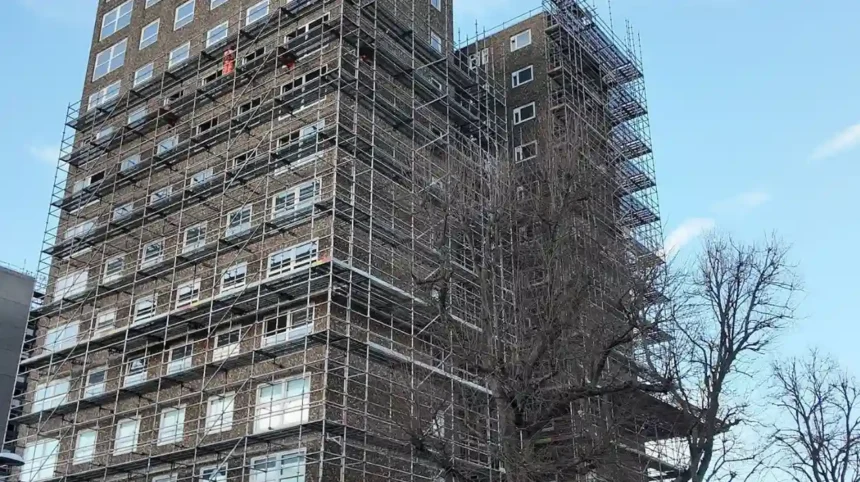
Work on phase two of the Ledbury Estate redevelopment has “progressed more quickly” than anticipated with phase one residents on time to move back in “later this year”.
Southwark Labour Councillor, Helen Dennis, spoke to South London News about the current project’s timeline. Dennis added phase two was moving ahead as planned, with the site currently being cleared in preparation for the towers’ demolition.
The news comes as bidding for the next decade of London’s affordable and social housing fund starts, with Ledbury specifically tying into Southwark Council’s plans for 2030 and the regeneration of Peckham as whole.
To the residents of Ledbury, Dennis said:
“I want to thank them for their patience and for their understanding, because it hasn’t been an easy year or so with all of the news that came forwards and with the relocations, but I am really excited […] Not only will the homes be fire safe, they will be energy efficient, they will be of good quality and the wider estate is really going to benefit as well with a new games court, new landscaping, a new community hall.”
On the project’s progress as a whole, Dennis said:
“It’s hard to give exact timelines because things can slip a bit, but that [phase one completion] is on course to complete this year. And so those residents that were planning to move into phase one will have that opportunity.”

She added that throughout the redevelopment, in 2024 and 2025, further fire risk assessment led to a “risk of building collapse [that] was intolerable.” leading to residents being relocated ahead of schedule.
Reported by Southwark News in August 2024, residents in the phase one tower blocks were relocated earlier than planned due to concerns with lithium ion batteries amidst post Grenfell fire checks.
Dennis said:
“It has progressed more quickly, that was never the intention […] Throughout the process we’ve continued to carry out fire risk assessments of the remaining towers where there were still residents […] We received a further fire risk assessment in 2024, and a further report in 2025, which basically said the deterioration of conditions combined with the risk from Lithium batteries, particularly e-scooters and e-bikes [meant] the risk of building collapse was intolerable.”
Lithium Ion batteries have remained a large fire risk concern, in March, the death of a 16 year old near Old Kent Road, in a suspected battery related fire, sparked renewed energy around the debate.
On the topic of Southwark’s approach to the risk posed by batteries, Dennis said:
“It’s clearly a significant risk which has increased over the last few years. And it’s a big cause of fires across London now.”
Dennis added part of the issue was the materials used in these 1960s developments, which include large panel systems (LPS) that were easily mass produced, but pose a significant fire risk with today’s regulations and hindsight.
Dennis said:
“They were built in the late 1960s, but it’s quite well known now that those, what we call, LPS buildings are at risk of collapse and lots of other local authorities are also now having to look at their LPS buildings and to make decisions on their future”
Dennis added that new government regulations had required local authorities to undertake new, detailed fire risk assessments of all high-rise blocks.
Dennis said:
“[Southwark] Council is also now working through that, ensuring that we deliver on that legislation and that we have done the assessments that are required on all of our high-rise blocks.”
Although she assured that provided residents follow local and regional advice on charging batteries, such as guidance issued by the London Fire Brigade, the risk was well managed with plans for further checks in place.
While some Councils have effectively delivered thousands of new homes compliant with emerging legislation, other boroughs have failed at producing results, often due to developers finding some areas easier to work in than others, according to Labour councillors across the Greater London Authority (GLA).
Liberal Democrat Council Leader and Labour Assembly Member, Gareth Roberts and Bassam Mahfouz had a heated back and forth regarding Richmond’s current delivery of affordable homes after bidding started for the London Social and Affordable Homes Programme 2026-36.
The programme is essentially a pool of £11.7 billion meant to deliver more affordable and social housing through government and institutions, like the homes included in the Ledbury Estate.
What’s the future for social and affordable homes in London as bidding to secure the next decade in funds begin?

With £11.7 billion in funding made available, Bassam Mahfouz told South London News he is hopeful the current government will deliver the social and affordable housing he feels all Londoners need.
Mahfouz said:
“We’ve got the new Renters Rights’ Act which is obviously coming into play next month so young Londoners in particular will have more secure tenancies for the first time ever which is brilliant given how challenging it can be […] in any capital city.”
He added that families, as well as current residents should be just as prioritised, and assured current residents of estates like Ledbury, they would be prioritised in any regeneration both now and in future.
He added:
A press release from London Councils last year showed waiting lists for social housing at a 10 year high in the capital, with some boroughs delivering far more than others.
During Mayor’s Question Time (MQT) on the 26th of March at City Hall, Labour Assembly Member for Ealing and Hillingdon, Bassam Mahfouz raised the issue of the discrepancy of affordable housing delivered by different borough councils to London Mayor, Sadiq Khan.
Sadiq Khan replied:
“It’s been decades in the making, in terms of supply not meeting demand. […] There’s a problem. The problem is caused by some councils not carrying their fair share of the burden, responsibility and joy of building homes for their local residents, it can’t be right that some councils are doing more while others are doing less.”
“Waiting lists continue to rise, those children in temporary accommodation continue to rise, and that’s why we need to address this problem.”
In a back and forth with Richmond’s Council Leader – Gareth Roberts, in which Bassam Mafhouz criticised the Council Leader for the borough’s low delivery of housing.
In response to the Mayor’s criticisms, he referred to the Stag Brewery development which was blocked by Sadiq Khan in 2021 for a failure to deliver on affordable housing quotas.
Roberts added that the development was planned to provide a new secondary school and nearly 1,100 homes, and referred to Mahfouz’s comments as “greasy” and “odious”.
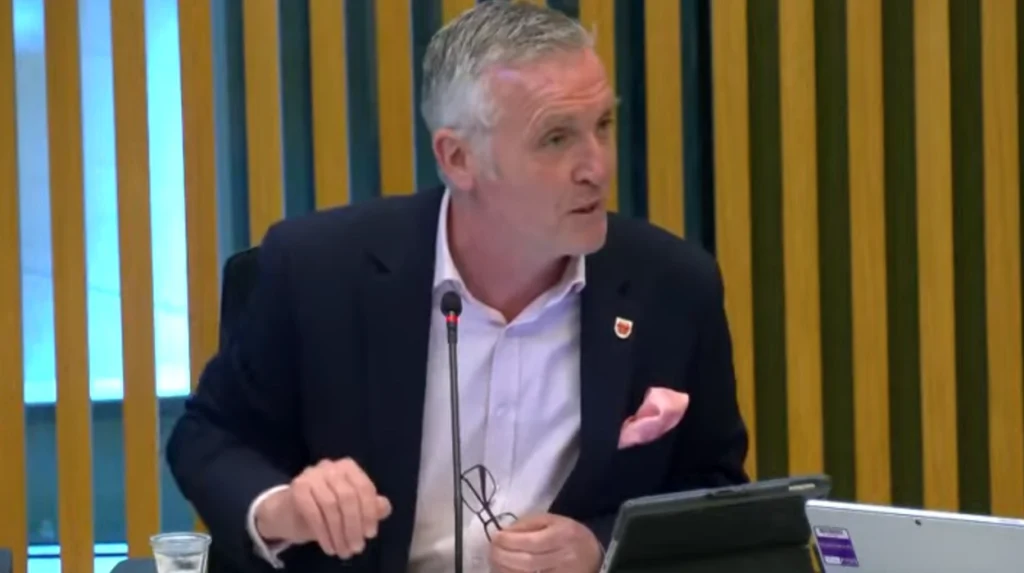
Mafhouz replied:
“I’m sure that entirely explains the gap between 5,000 homes in Ealing and the mere 279 he [Roberts] has delivered in his tenure.”
Speaking to South London News, Mahfouz was clear that housing was one of the biggest issues concerning all Londoners today.
Mahfouz said:
“It’s very much in the hands of local authorities as to how much money they apply for and how ambitious they are in terms of that program […] what you do have is some boroughs apply and deliver thousands of new, genuinely affordable homes whereas in other areas you’ve got well below a thousand in terms of delivery.”
According to data mapped by the Trust for London, while boroughs such as Croydon, Southwark and Greenwich rank above average for housing delivered, others such as Lewisham or Richmond fall short.