Key Points
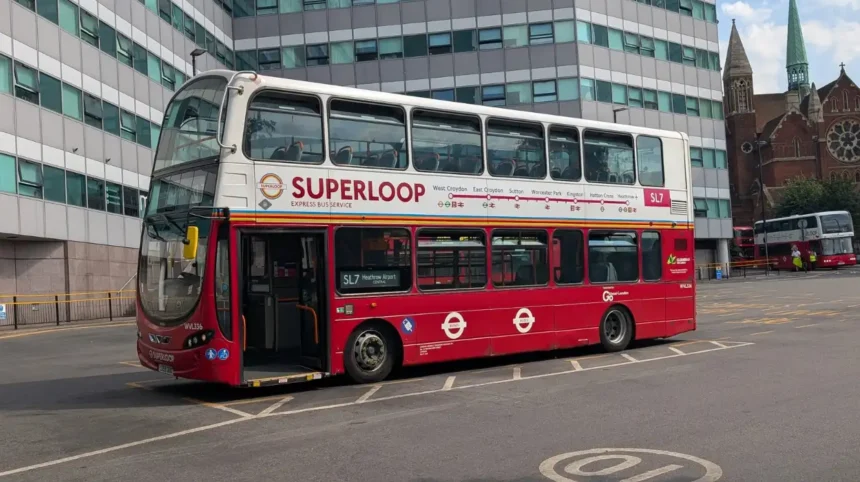
- A rail cancellation at Epsom forced an impromptu maiden journey on Transport for London’s (TfL) express SL7 Superloop route to reach Croydon.
- Despite initial connection delays and timetable disruptions at North Cheam, the SL7 provided a direct, comfortable, and cost-effective alternative to outer London’s traditional rail services.
- The Superloop network was originally championed by London Mayor Sadiq Khan and hailed by TfL as the “jewel in the crown” of outer London public transport to drive sustainable travel.
- Outer south London commuters remain uniquely reliant on express bus routes due to historical gaps in the Underground network across the southern boroughs.
- The success and expansion of express orbital bus routes present both structural opportunities for daily commuters and financial challenges for suburban rail operators.
North Cheam (South London News) August 25, 2026 – An unexpected railway cancellation at Epsom station left a commuter facing a heavily disrupted journey into Croydon, ultimately leading to a first-hand trial of Transport for London’s express SL7 Superloop bus service. The original travel itinerary relied on a standard rail journey using Southern services into either East Croydon or West Croydon station. However, following the sudden cancellation of the train, alternative travel arrangements had to be arranged immediately across the outer south London transit network. Because no direct orbital bus link connects Ewell directly to Croydon, the journey required an initial bus leg to North Cheam to intercept the express corridor, highlighting both the flexibility and the remaining connection gaps within suburban public transport provision.
- Key Points
- What Occurred During the Transition from Rail to the Superloop Service at North Cheam?
- How Has Transport for London Positioned the Superloop Network Since Its Debut?
- Why Does South London Transport Depend So Heavily on Express Bus Corridors?
- What Is the Operational Background of the Superloop Project?
- How Will the Expansion of Express Orbital Buses Affect Outer London Commuters and Rail Operators?
What Occurred During the Transition from Rail to the Superloop Service at North Cheam?
The transition between transport modes in North Cheam was initially marked by notable waiting times and sudden scheduling adjustments. Upon arriving at the bus stop to await the Croydon connection, passengers were met with immediate service delays. At one stage, an incoming bus arrived at the stop only for an official announcement to declare it entirely out of service. Following that withdrawal, digital passenger display boards indicated that the next incoming Superloop bus would not arrive for another 26 minutes, threatening a substantial lengthening of the overall travel time.
Atmospheric conditions during the wait provided minor relief, with the journey taking place during a brief mild interval situated between a recent summer heatwave and an incoming drop in temperature. This temperate interlude spared stranded passengers from enduring prolonged waits in extreme heat. The travel delay subsequently saw a rapid reversal when service timetables adjusted dynamically, reducing the projected 26-minute wait to a six-minute arrival time. The sudden arrival of the vehicle allowed the passenger to board the SL7 for their maiden journey on the outer London express network.
How Has Transport for London Positioned the Superloop Network Since Its Debut?
The Superloop orbital network was launched as a major structural enhancement to public transport across outer London boroughs. When the express strategy was first unveiled by Transport for London, transport officials formally described the orbital network as the “jewel in the crown” of the capital’s bus operations. Transport for London leadership further designated the service design as an absolute “game changer” for outer London travel, a strategic vision strongly backed by London Mayor Sadiq Khan to encourage a modal shift away from private car usage.
Three years on from its initial implementation, the Superloop network has progressively expanded its operational footprint across various outer London transport corridors. Official statements from Transport for London emphasize that the introduction of express, limited-stop bus infrastructure has measurably boosted sustainable travel metrics by filling strategic transit voids across peripheral town centres where rail infrastructure is either fragmented or absent.
| Route Aspect | Traditional Outer Suburban Rail | SL7 Superloop Bus Express |
| Route Geometry | Radial (In/Out of Central Termini) | Orbital (Connecting Outer Town Centres) |
| Vulnerability | Single track/signal faults halt entire line | Dynamic road rerouting capability |
| Fare Structure | Zone-dependent National Rail pricing | Standard TfL flat bus fare with Hopper cap |
| Interchange Need | Frequent central terminal changes | Direct suburban point-to-point links |
Why Does South London Transport Depend So Heavily on Express Bus Corridors?
South London has historically maintained a unique transport geography characterized by a sparse Underground network compared to boroughs north of the River Thames. Because underlying geological conditions historically limited deep-level Tube construction, outer south London grew overwhelmingly dependent on surface suburban rail lines and localized bus routes. Consequently, travel between adjacent southern suburban hubs—such as Epsom, Sutton, Cheam, and Croydon—frequently forced passengers into indirect radial trips into inner London stations before traveling back out.
The implementation of dedicated limited-stop corridors like the SL7 directly targets this structural flaw. By skipping lower-density local stops, the SL7 replicates express rail speeds on arterial surface roads. The experience of stepping onto the route following a localized rail failure demonstrates the structural redundancy the Superloop provides to south Londoners, transforming an unexpected disruption into a seamless, high-frequency orbital transit alternative.
What Is the Operational Background of the Superloop Project?
Background details regarding the emergence of the Superloop trace back to TfL’s strategic effort to mitigate the expansion of the Ultra Low Emission Zone (ULEZ) to outer London. To provide residents in outer London boroughs with viable alternatives to private vehicle ownership, the Mayor of London announced a dedicated investment package for a ring of express bus routes. Formally designated under the Superloop banner, the project integrated existing express services—such as the legacy X26 route, which was subsequently re-branded as the SL7—alongside newly commissioned orbital routes.
The SL7 route specifically services a critical south-western to south-eastern outer axis, linking West Croydon to Heathrow Airport via major interchange nodes including Sutton, Cheam, Kingston, and Teddington. Since the full brand rollout, Transport for London passenger metrics have registered substantial patronage increases along these orbital corridors, outperforming passenger growth trends seen across standard stopping bus lines. The network’s success has anchored the Superloop as a core pillar of outer London transit planning.
How Will the Expansion of Express Orbital Buses Affect Outer London Commuters and Rail Operators?
The ongoing development and refining of express orbital bus routes like the SL7 are projected to significantly re-shape daily travel patterns for outer London commuters while creating clear commercial ripples across the wider transport sector.
For local residents and daily commuters across south London, the continued reliability and expansion of express bus routes provide a much-needed layer of resilience against suburban rail disruptions. The lower cost structure of bus travel under TfL’s Hopper fare scheme—offering unlimited bus transfers within one hour for a single flat rate—presents a compelling financial alternative to escalating National Rail fares. As commuters increasingly recognize that limited-stop buses can match suburban rail travel times without requiring expensive rail passes or central interchanges, modal shift toward bus transit is likely to accelerate, particularly for cross-borough journeys.
Conversely, traditional suburban rail operators face shifting demand patterns along peripheral routes. Frequent rail cancellations or localized signaling faults risk driving discretionary passengers permanently toward orbital bus alternatives. While National Rail services retain an absolute speed advantage for long-distance radial commuting into central London, orbital express buses are capturing an increasing share of local inter-borough travel. Over the long term, this structural shift may pressure rail operators to enhance service reliability and re-evaluate off-peak fare models to remain competitive against TfL’s growing outer London surface network.