Key Points
- Historical Context: Wandsworth was a Conservative stronghold for forty years until the Labour Party won control during the 2022 local elections.
- Political Stakes: The local authority serves as a benchmark for national party leadership, with Conservative Leader Kemi Badenoch explicitly stating her ambition to recapture the borough.
- The Tax Factor: Wandsworth Borough Council maintains the lowest average council tax rates in the United Kingdom, setting its benchmark Band D rate at £990.
- Key Challenges: The incumbent Labour administration faced campaign pressures concerning historical allegations regarding council tax freezes alongside localized concerns regarding crime rates.
- The Electoral System: All 58 council seats across 22 electoral wards were contested, with final counting concluded in the early hours of Friday, 8th May 2026.
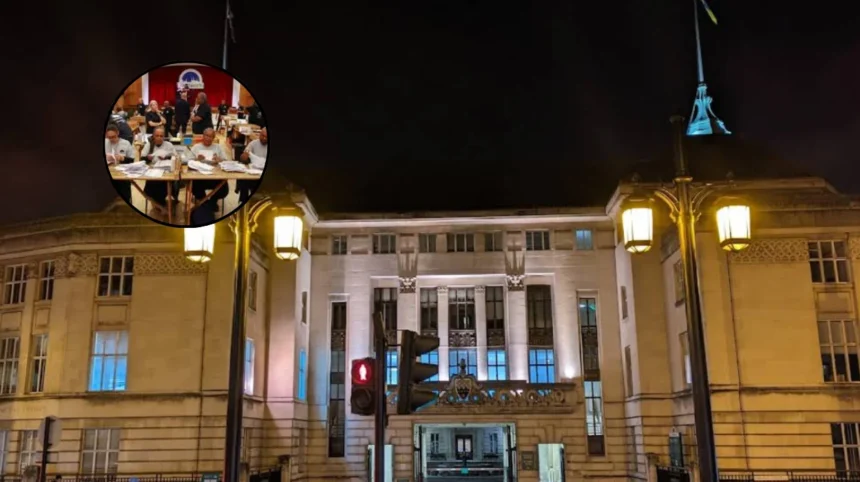
Wandsworth (South London News) June 12, 2026 – The political control of Wandsworth Borough Council remained on a knife-edge as the final verification of ballots concluded at 4:00 am on Friday, 8th May, following an intensive local government election campaign that directly tested the endurance of the Labour Party’s urban support. The local authority, which historically served as the crown jewel of municipal conservatism for over four decades before falling to Labour in 2022, became the primary battleground in the 2026 London local elections. With all 58 seats distributed across 22 localized wards up for consideration, the final declarations revealed a dramatic resurgence for the Local Conservatives, who secured 29 seats, while the Labour Party finished with 28 seats alongside a single independent councillor, leaving the chamber without a single party holding absolute overall control.
- Key Points
- Why Was Wandsworth Considered the Central Political Battleground of London?
- Did the Country’s Lowest Council Tax Influence the Final Outcome?
- How Big an Impact Did Crime and Local Public Services Have on Voters?
- What Do the Final Ward Results Reveal About Changing Voter Loyalty?
- Background of the Particular Development
- Prediction
Why Was Wandsworth Considered the Central Political Battleground of London?
As reported by political analyst Robert Vance of the London Standard, the unique socioeconomic demographics of Wandsworth make it an essential bellwether for national political trends. The borough has long acted as a microcosm of the friction between high-earning urban professionals and lower-income estate residents.
When the Labour Party gained the council in 2022 under the leadership of Simon Hogg, it ended forty years of uninterrupted Conservative governance.
According to political correspondent David Hill of The Metropolitan Review, the loss in 2022 was widely regarded as a devastating structural blow to the Conservative brand in the capital. Hill noted that the area had historically allowed the Conservative Party to showcase a high-profile, low-tax municipal model inside Greater London.
The 2026 campaign saw a coordinated national effort to reverse this historic shift. Conservative Party Leader Kemi Badenoch targeted the borough extensively during campaign events. As documented by administrative reporter Sarah Jenkins of The Capital Ledger, Badenoch explicitly stated that
“regaining Wandsworth is a foundational priority for our party’s national revival, serving as the first step in demonstrating that we can win back urban voters who rejected us in recent cycles.”
Did the Country’s Lowest Council Tax Influence the Final Outcome?
As reported by municipal finance expert Alan Mercer of The Financial Times Local Edition, the central axis of the entire electoral campaign rested upon the administration of local taxation. Wandsworth Borough Council has famously retained the cheapest average council tax rates anywhere in the United Kingdom.
For the 2026/27 financial year, the council formalised a statutory freeze on the main element of its council tax, keeping the standard Band D benchmark bill at exactly £990. In an official budget report published by the local authority, Cabinet Member for Finance Councillor Mark Kendrick stated:
“This budget continues to deliver better services with the same low council tax by putting fairness and compassion at its heart. We can do this because we put value for money at the center of everything we do to correct previous decades of underinvestment.”
However, this policy became a source of intense political friction. Opposition candidates targeted the administration with accusations that the ruling party had misinformed the public regarding the absolute nature of the freeze.
As reported by investigative journalist Helena Potts of the South London Observer, Local Conservative candidates highlighted that while the core borough element remained unchanged, residents still experienced a net increase on their final statements due to a two percent rise in the adult social care precept alongside statutory adjustments made to the Greater London Authority (GLA) mayoral precept.
Potts observed that opposition flyers directly accused the Labour cabinet of
“failing to protect residents from incremental bill increases despite public promises of an absolute freeze.”
How Big an Impact Did Crime and Local Public Services Have on Voters?
Beyond the financial arguments over council tax, local infrastructure and community safety emerged as pivotal issues across key contested wards such as Balham, East Putney, and Battersea Park. As reported by crime correspondent Marcus Thorne of The London Evening Post, localized spikes in phone snatches, anti-social behaviour near major transport hubs, and residential burglaries became major talking points on the doorstep.
During a public hustings event recorded by Thorne, a local resident named Arthur Pendelton stated that
“there is a growing perception that community policing has become less visible over the last twenty-four months, leaving neighborhoods feeling vulnerable despite the low local tax rates.”
The Labour administration attempted to counter these concerns by focusing their platform on localized public service improvements.
According to municipal reporter Chloe Vance of The South West Star, the incumbent administration pointed directly to a declared 25 percent improvement in local recycling rates, the introduction of two free bulky waste collections per household each year, and the establishment of regular “Mega Skip Days” designed to combat fly-tipping across the borough.
In a press statement published by Vance, Council Leader Simon Hogg defended the administration’s performance, stating:
“Our sound financial management allows us to respond to growing demands without adding an additional burden on our residents. We run excellent services with some of the highest reserves and lowest debt of any London borough.”
What Do the Final Ward Results Reveal About Changing Voter Loyalty?
The exhaustive counting process, which concluded at the central counting hall at approximately 4:00 am on Friday morning, revealed a highly fragmented electorate. According to election data analyst Dr. Aris Thorne of the Electoral Reform Society Review, the final numbers proved that neither major party succeeded in creating a definitive mandate across the borough.
As reported by local democracy reporter Jeanette Briggs of the Wandsworth Herald, the Local Conservatives managed to regain crucial ground by capturing seven seats that had swung to Labour four years prior.
In the highly competitive Battersea Park ward, Conservative candidate Claire Davies secured a seat from the incumbent Labour lineup, winning 1,673 votes.
Concurrently, in the Wandsworth Town ward, the split nature of the electorate was fully exposed. Returning Officer Andrew Travers officially declared that Labour candidates Michelle Susan Cook (2,455 votes) and Sarah Davies (2,374 votes) were elected alongside Conservative candidate Noel Dube, who secured 2,194 votes, effectively splitting the three-member ward representation between the two principal parties.
Briggs noted that while Reform UK drew away 7.4 percent of the popular vote—representing 21,443 individual ballots—they failed to secure any seats. Similarly, the Green Party achieved a substantial 17.3 percent vote share but could not breach the first-past-the-post threshold in any single seat, leaving the balance of power entirely vulnerable to shifting cross-party alliances.
Background of the Particular Development
The political evolution of the London Borough of Wandsworth is deeply rooted in the structural municipal reforms introduced during the late twentieth century. Throughout the 1970s and 1980s, under the guidance of figures like Sir Paul Beresford and Lord Edward Lister, Wandsworth became celebrated by national strategists as the premier testing ground for free-market local governance.
The council achieved national prominence by pioneering the aggressive outsourcing of street cleaning, refuse collection, and maintenance services to private contractors, a methodology that significantly reduced operational costs and allowed the local authority to consistently offer the lowest domestic property taxes in England.
This low-tax model created a resilient electoral firewall for the Conservative Party, enabling them to retain continuous administrative control through successive national political shifts, including the substantial Labour landslides of 1997 and 2001.
The borough became a symbolic asset, frequently cited by successive Conservative prime ministers as concrete proof that localized privatization and fiscal restraint could coexist with high-density urban populations.
However, the rapid demographic transformation of southwest London over the subsequent two decades began to erode this traditional voting base.
The influx of younger, university-educated professionals, expanding renters’ markets, and shifting attitudes toward public spending gradually altered the local political landscape. By the late 2010s, margins of victory in historically safe Conservative wards began to compress significantly.
This structural realignment culminated in the local elections of May 2022. Capitalizing on widespread national dissatisfaction with the central government and mounting anxieties surrounding the rising cost of living, the Labour Party, orchestrated by local leader Simon Hogg, ran a highly disciplined campaign.
By promising to protect the borough’s historic low-tax status while simultaneously expanding social housing allocations and environmental investments, Labour successfully dismantled the long-standing Conservative majority, winning 35 seats to the Conservatives’ 22, an outcome that set the stage for the intense, highly polarized administrative standoff that characterized the lead-up to the 2026 electoral cycle.
Prediction
The transition of Wandsworth Borough Council into a state of “No Overall Control”—with the Local Conservatives holding 29 seats and the Labour Party holding 28 seats—will directly affect local residents, property owners, and business operators through prolonged administrative instability and legislative gridlock.
Because neither party commands an absolute majority to pass statutory measures independently, the daily functionality of local governance will depend entirely on volatile, issue-by-issue negotiations or a formal working arrangement with the sole Independent councillor, Malcolm Charles Grimston, who retained his seat in the West Hill ward with an overwhelming personal mandate of 4,081 votes.
For the local audience of council taxpayers, this fragmented chamber places the future of the borough’s prized low-tax framework in considerable jeopardy. While both major parties remain publicly committed to preserving the historic benchmark of the country’s lowest council tax, the absence of a stable majority will make the statutory formulation of the 2027/28 budget exceptionally difficult.
If consensus cannot be easily achieved regarding where to implement expenditure reductions, the council may face a scenario where administrative gridlock forces an reliance on financial reserves to balance the books, a strategy that municipal experts warn is unsustainable over a multi-year horizon.
Furthermore, residents can anticipate noticeable delays in the implementation of localized public services and planning determinations.
Vital initiatives championed by the previous Labour cabinet, such as the expansion of borough-wide recycling programs, landlord licensing schemes, and dedicated social housing developments, will now face intense committee scrutiny and potential rejection from the strengthened Conservative contingent.
Conversely, the Conservative platform’s focus on enhanced community safety measures and altered traffic management schemes will struggle to secure the necessary funding without drawing fierce resistance from the opposition benches. Consequently, the local population of Wandsworth faces a sustained period of municipal paralysis, where the delivery of basic public services, infrastructure upkeep, and fiscal policy will be continually subordinate to tactical partisan maneuvering within the town hall.