Key Points
- Medical Emergencies: Three children residing in temporary accommodation were hospitalised after the building’s air conditioning was deactivated during a UK heatwave.
- Affected Residents: Approximately 60 homeless families living at Britannia Point in Colliers Wood, South London, were reportedly impacted by the shutdown of cooling units.
- Landlord Directives: Residents received communications indicating that air conditioning was not provided as an amenity under their housing contracts and warned against manual tampering.
- Property Management Response: Management company Aura Assets Management stated that systems are fully operational and open for tenant use, contrasting with messages sent to residents.
- Freeholder Stance: Freeholder Criterion Capital acknowledged the situation and urged leaseholders to work with local authorities during unprecedented weather events.
- Parliamentary Action: Local Member of Parliament (MP) Siobhain McDonagh formally raised concerns with management following reports of children suffering severe heat-related symptoms, including fainting and cluster nosebleeds.
UK (South London News) August 1, 2026 – Three children living in temporary accommodation at Britannia Point in Colliers Wood were taken to hospital following the deactivation of air conditioning units in their high-rise tower block during a period of extreme heat in the United Kingdom. As reported by The Independent, approximately 60 homeless families housed within the residential complex allegedly had their cooling systems turned off by their immediate landlord without prior notice as temperatures surged nationwide.
- Key Points
- Why Were Children Hospitalised at Britannia Point During the Heatwave?
- What Directives Did Management Issue Regarding Air Conditioning Usage?
- How Have Aura Assets Management and Criterion Capital Responded to the Allegations?
- Background of the Particular Development
- Prediction: How This Development Can Affect Temporary Housing Residents and Local Councils
Why Were Children Hospitalised at Britannia Point During the Heatwave?
The sudden loss of active cooling within the multi-storey structure created hazardous indoor living conditions for vulnerable residents during record-breaking summer temperatures. Families reported that indoor temperatures rose rapidly, resulting in acute physical symptoms amongst young occupants.
As detailed in the reporting by The Independent, 31-year-old resident Sabrina Walters, a mother of two living in the building, recounted the severe physical impact on her young children following the termination of cooling services. According to The Independent, Ms Walters stated:
“My youngest is one year old, and she was dripping with sweat. I picked her up from her chair after she had fallen asleep, and she was literally soaked. My 12-year-old was having constant cluster nosebleeds – she had between 10 and 20 within two or three days.”
Further health concerns were raised directly with local parliamentary representatives. As noted by The Independent, Mitcham and Morden MP Siobhain McDonagh intervened after receiving urgent distress calls from another mother residing in the block. The parent informed the MP that her young son required immediate emergency treatment at an Accident & Emergency (A&E) department after experiencing severe heat exposure, which caused frequent nosebleeds and episodes of fainting.
What Directives Did Management Issue Regarding Air Conditioning Usage?
Official correspondence sent to building residents indicated an explicit instruction to cease using built-in cooling infrastructure.
As highlighted in documentation reviewed and reported by The Independent, written communications issued from the Britannia Point building reception informed Ms Walters that the air conditioning units had been intentionally “switched off” on the grounds that the cooling system was “not offered as an amenity” under the specific contractual terms of their temporary accommodation placement.
The written message seen by The Independent further detailed that the units “cannot be switched back on as a result”, explicitly warning residents that any attempt to manually restore power to the cooling systems would constitute “interference with equipment that is not yours.” The reception communication confirmed that these instructions were issued directly on behalf of the building freeholder, Criterion Capital, alongside property management firm Aura Assets Management.
How Have Aura Assets Management and Criterion Capital Responded to the Allegations?
In response to direct inquiries regarding the hospitalisations and the deactivation of cooling systems, property managers and freeholders provided differing statements regarding operational policy.
As reported by The Independent, property management firm Aura Assets Management denied that the units were currently unavailable for tenant use. A spokesperson for Aura Assets Management stated that the air conditioning system is “fully operational and tenants have been advised they are welcome to use it.”
Meanwhile, freeholder Criterion Capital distanced itself from direct tenancy operations within the property. As cited by The Independent, a spokesperson for Criterion Capital stated:
“As the freeholder, we engage with our leaseholders and encourage them to work with local authorities to support tenants in these unprecedented circumstances.”
Background of the Particular Development
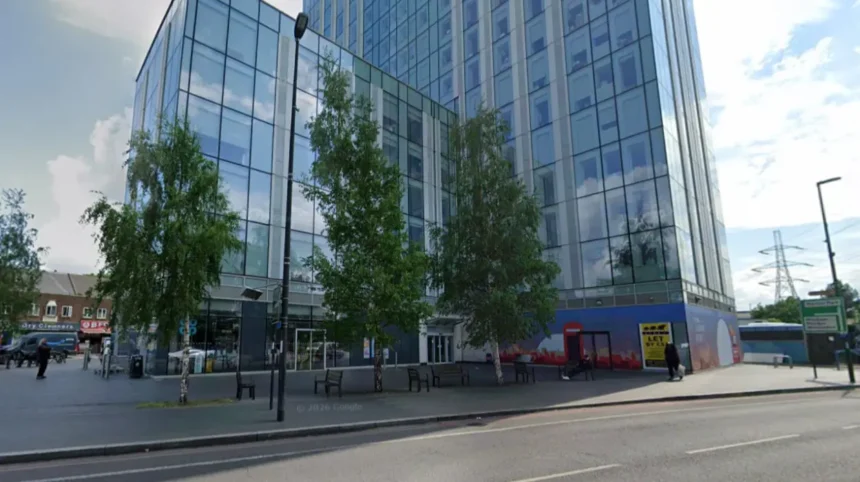
Britannia Point, located in Colliers Wood within the London Borough of Merton, is a prominent 19-storey high-rise tower originally constructed as an office block in the 1960s. Following major redevelopment under Permitted Development Rights (PDR)—a planning policy allowing commercial properties to be converted into residential dwellings without full planning permission—the structure was transformed into modern apartment units.
In recent years, local authorities across Greater London have increasingly relied on former commercial buildings like Britannia Point to secure temporary accommodation for homeless families facing acute housing shortfalls. Under these tripartite arrangements, local councils contract housing providers and management agencies to place vulnerable individuals into privately owned developments.
However, sealed glass-fronted former office blocks frequently present thermal management challenges during extreme summer weather. Without functioning central ventilation or air conditioning, indoor ambient heat can rise significantly higher than external temperatures, creating heightened risks for infants, young children, and individuals with underlying medical conditions.
Prediction: How This Development Can Affect Temporary Housing Residents and Local Councils
The public disclosure of emergency medical incidents at Britannia Point is likely to accelerate regulatory scrutiny surrounding the standards of temporary accommodation provided to homeless families across the United Kingdom.
1. Stricter Environmental and Safety Regulation for Temporary Accommodation
Local authorities and housing advocates may push for statutory minimum thermal comfort standards in temporary housing. Currently, housing regulations strictly enforce minimum heating requirements during winter months, but lack equivalent legally binding maximum indoor temperature thresholds for summer periods. This incident may prompt local councils to mandate operational cooling or certified heat-mitigation protocols before approving leases in glass-clad conversions.
2. Legal and Contractual Re-evaluations
Housing providers and management entities face heightened exposure to legal liability regarding health and safety duty of care. Landlords offering converted commercial properties with sealed windows may find it legally untenable to restrict access to pre-existing environmental controls like air conditioning during extreme heat events.
3. Impact on Local Council Procurement
London boroughs relying heavily on commercial conversions for emergency housing placements may revise their procurement frameworks. Councils are likely to require clear operational guarantees from leaseholders and freeholders that essential amenities—including climate control infrastructure—remain accessible to residents without additional charges or contractual restrictions during extreme weather events.