- Transport for London (TfL) and the British Transport Police (BTP) have launched Operation Vector, a joint intelligence-led operation targeting fare evaders across London’s transport network.
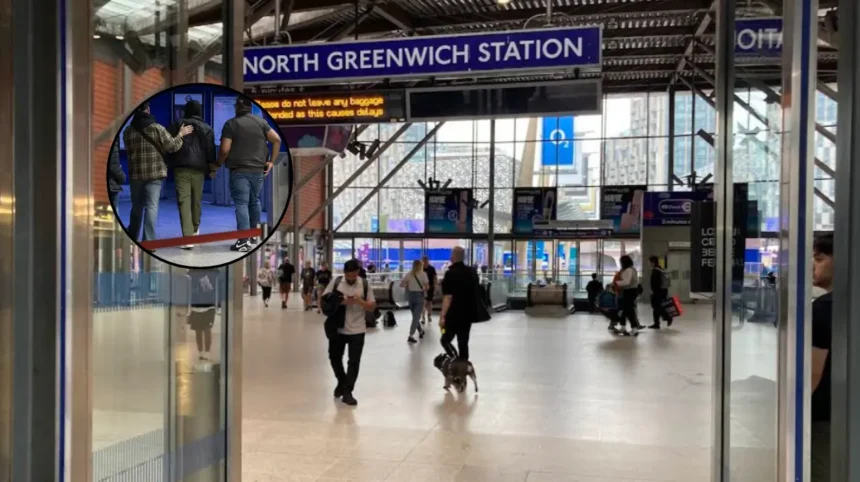
- Over the course of a single day, plain-clothed enforcement officers stopped approximately 50 fare dodgers at North Greenwich Underground station.
- Since its launch on 5 October, Operation Vector has resulted in 467 people being stopped, 156 penalty fares issued, 175 reports for potential prosecution, and 24 arrests.
- Fare evasion costs Transport for London up to £210 million per year.
- Frontline staff reports on common practices like “double-gating” and “gate-pushing” directly inform officer deployment times and locations.
- Intercepted fare evaders have also been found carrying illegal items, leading to seizures of drugs and knives by BTP officers.
Greenwich (South London News) November 3, 2026 – Transport for London (TfL), in partnership with the British Transport Police (BTP), has rolled out a new intelligence-driven targeted enforcement initiative known as Operation Vector. The operation utilizes real-time data and direct incident reports provided by frontline station staff to deploy plain-clothed enforcement officers directly to identified fare-dodging hotspots across the capital. During a single operation observed first-hand by the Local Democracy Reporting Service at North Greenwich station, officers intercepted around 50 individuals attempting to travel without paying valid fares within a single day.
- How is Transport for London Tackling Illegal Travel on the Network?
- What Impact Does Operation Vector Have on Wider Network Safety?
- How Substantial is the Financial Loss from Unpaid Fares in London?
- Background of the Particular Development
- Prediction: How This Development Can Affect London Commuters and Transport Users
How is Transport for London Tackling Illegal Travel on the Network?
As reported by Local Democracy Reporter Kumail Jaffer, who joined TfL and BTP officers on the ground at North Greenwich station to observe the enforcement operation first-hand, the joint task force intercepted non-paying passengers immediately as they attempted to pass through ticket barriers. Over an hour of mid-morning observation, plain-clothed officers positioned near ticket barriers repeatedly caught individuals attempting to pass straight through the wide accessibility gates or following closely behind paying passengers.
The targeted push relies heavily on intelligence gathered directly from transport employees who observe daily ticket barrier breaches. Explaining the mechanism behind the operational strategy, Director of Security, Policing and Enforcement at TfL, Siwan Hayward, stated:
“We receive a massive amount of feedback from frontline staff witnessing double-gating and gate-pushing, which directly informs where the operations take place, at what times, and who to look out for. We have seen huge successes in just the few weeks it has been running.”
Since its initial launch on 5 October, Operation Vector has yielded significant initial enforcement numbers across London. Figures released by transport authorities reveal that the operation has already resulted in 467 individuals being intercepted, 156 penalty fares being issued directly on site, and 175 formal reports compiled for prospective criminal prosecution.
What Impact Does Operation Vector Have on Wider Network Safety?
Beyond recovering unpaid transport revenues, police enforcement under Operation Vector has uncovered broader illegal activity occurring across the network. Officers from the British Transport Police have made 24 arrests in connection with Operation Vector since the campaign began last month.
During routine barrier interceptions, officers routinely perform background checks and searches on non-compliant individuals. In multiple instances during these operations, law enforcement officers have seized illegal drugs and bladed weapons, including knives, from offenders stopped primarily for ticket irregularities.
The strategy combines high-visibility policing with undercover tactical deployments. By utilizing plain-clothed officers alongside uniformed transport staff, enforcement teams are able to observe double-gating (where a non-paying passenger walks closely behind a paying commuter through an opening barrier) and gate-pushing (forcing barrier gates open) in real time before offenders realize police are present on the concourse.
How Substantial is the Financial Loss from Unpaid Fares in London?
Unpaid travel across London Underground, London Overground, DLR, and bus networks presents a severe financial strain on capital infrastructure. Transport for London official estimates indicate that fare evasion costs the network up to £210 million every year.
The revenue lost to deliberate fare dodging deprives the network of funding required for ongoing maintenance, infrastructure upgrades, operational staffing, and service improvements. The implementation of data-led operations like Operation Vector is designed to send a clear deterrent signal across all London Underground zones that non-payment will lead to immediate financial penalties or formal legal proceedings.
Background of the Particular Development
Fare evasion has remained a persistent operational challenge for Transport for London, particularly following changes in travel patterns and increased cost-of-living pressures across the United Kingdom. Historically, revenue protection relied primarily on static uniformed barrier checks or station-specific enforcement operations by high-visibility inspectors. However, persistent fare evaders frequently adapted to visible enforcement by avoiding stations with active inspectors or utilizing wide-aisle gates where physical surveillance was limited.
To combat increasingly tactical evasive behavior—such as coordinated gate-pushing, abuse of emergency exit doors, and aggressive double-gating—TfL and the British Transport Police restructured their joint response strategy. Operation Vector represents a shift toward intelligence-led policing within public transport. By digitizing and consolidating incident reporting from station staff, TfL can identify micro-trends in offender behavior, pin-pointing specific station entrances, peak hours, and gate types experiencing high failure rates. This data enables the strategic deployment of plain-clothed officers to intercept repeat offenders who actively evade standard high-visibility controls.
Prediction: How This Development Can Affect London Commuters and Transport Users
The continued expansion and systematic deployment of Operation Vector will likely have distinct effects across different groups within the London commuting public:
- Regular Paying Passengers: Law-abiding commuters can expect a visible reduction in gate congestion caused by ticketless individuals forcing their way through barriers or double-gating. Additionally, because enforcement interceptions have repeatedly led to the seizure of weapons and illicit substances, the suppression of fare evasion is likely to yield a secondary benefit of improved safety and reduced anti-social behavior across Underground platforms and trains.
- Intentional Fare Evaders: Individuals who routinely travel without paying face a significantly heightened risk of detection, immediate penalty notices, and criminal prosecution. The deployment of plain-clothed officers eliminates the predictability of static barrier checks, creating a stronger psychological deterrent across all zones of the network.
- Frontline Transport Staff: Station staff are likely to experience reduced friction and less physical confrontation at barrier lines. As intelligence submitted by staff directly triggers targeted police deployments, station teams gain greater institutional support in addressing persistent gate-pushing and abuse.
- Transport Infrastructure and Taxpayers: Increased recovery of lost revenue—targeting the £210 million annual deficit caused by ticketless travel—will help protect TfL’s operating budget. Over time, reducing financial leakage ensures that public funds and passenger fare contributions are retained for network maintenance, service reliability, and transport pricing stability.