
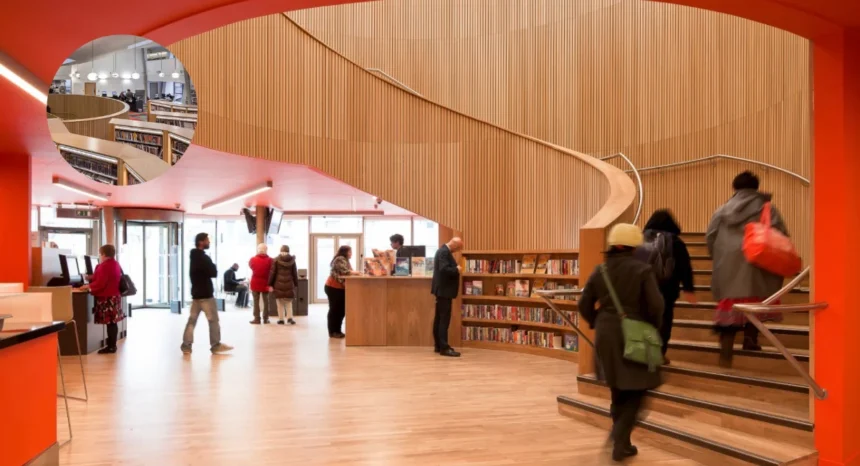
Across the UK, reading for pleasure is in decline; “only 32.7% of children and young people say they enjoy reading in their free time, and fewer than one in five read daily.” However, in Canada Water Library, desks are full, memberships are climbing, and staff greet visitors with the easy familiarity of regulars. What is taking shape here feels almost like a well-kept secret, less a traditional library and more a kind of softly claimed territory, the library has become a space its community has subtly made its own.
Returning and repurposing it in ways that feel welcomingly collaborative for the times. With 41 study spaces rarely empty and a café that keeps people lingering, it operates somewhere between reading room and living room, both formal institution and informal gathering place. If the gym has become the new nightclub, then this corner of Southwark makes a compelling case for the library as the new community centre, quieter, warmer, and, perhaps, more necessary than ever.
Having just won the British Books Awards’ Library of the Year, highlighting that community impact and social wellbeing are as central to its mission, as lending books. Having evolved beyond a traditional lending space into a “third space”,somewhere between home and work where people connect and learn. Practical services like digital skills workshops provide access to those who would otherwise be ostracised, in a seemingly individualistic age. In an era when public spaces often feel transactional, Canada Water
demonstrates how coffee, comfort, and accessibility can transform a library into social infrastructure. “We don’t ask anything of you…a free space which is especially important in the development of young people” says one of the librarians, emphasising the commitment the library places on accessible education.
The library’s programs reinforce its role as a community anchor
Children can attend Bookstart sessions for toddlers, Chatterbooks groups for school-aged readers, or STEM and robotics clubs for teenagers; while adults join monthly book groups, poetry sessions, or digital skills workshops. Offering the community independence, the confidence to explore their curiosity, and the reassurance that there will always be something here for them. Alongside these programs, friendly, proactive staff play a central role; recommending books, remembering names, and nurturing relationships that encourage participation. This human touch is as important as the books themselves in creating an inclusive, intergenerational environment. Further modelling a flexible, responsive approach to community needs. Its ‘Library of Things’ allows borrowing of household items like drills or carpet cleaners, and a free health kiosk provides blood pressure and BMI checks.
Film clubs displaced from other Southwark libraries, including ‘Dulwich Film Club’ screenings, now meet here, further positioning the library as a versatile local hub. The cumulative effect is a space that quietly defies national trends. By combining practical support, creative programming, and welcoming atmospheres, Canada Water illustrates how a library can function as a social, educational, and civic hub, helping residents of all ages access learning opportunities while feeling connected and included.
In a time of declining literacy, Canada Water Library shows that public libraries remain indispensable. They are living, breathing centres of learning and community where reading is not just a pastime but a reason to gather, explore, and belong.
Here in Southwark, the story of literacy and inclusive, community-focused education, is far from over.