Key Points
- A wave of new 5G installations has been proposed across Croydon town centre, with multiple applications submitted within days of each other.
- Antennas are set to be mounted onto existing lamp posts to improve connectivity in busy shopping streets and transport routes.
- Key locations include outside Box Park on George Street, outside Marks and Spencer’s on North End, outside Sainsbury’s on George Street, outside 21–23 Church Street, outside 40 Station Road, and outside Advance House on North End.
- Additional sites beyond the town centre: Beulah Road in Thornton Heath and 53 Stoats Nest Road in Coulsdon.
- Equipment details: 6m high omni-directional antenna, remote radio units at around 5m above ground, feeder pillar cabinet at street level, and extra items like GPS nodes.
- Applications fall under national permitted development rights for electronic communications equipment, bypassing full planning permission.
- Croydon Council can still review impacts on siting and appearance.
- Surge suggests a coordinated rollout of small-cell 5G infrastructure.
- Small-cell systems attach to street furniture like lamp posts to boost capacity in dense areas, unlike traditional large masts.
- Area chosen due to high retail shops, bus interchanges, and East Croydon station.
- Past applications have faced objections over visual impacts, street clutter, cumulative effects, proximity to homes/businesses, and health concerns.
- Health risks cannot be considered if equipment meets ICNIRP standards, per planning rules.
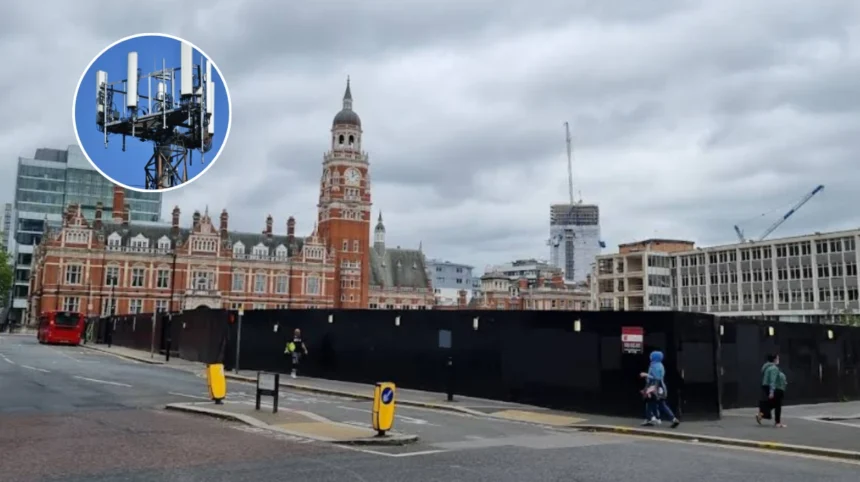
Croydon (South London News) April 2, 2026 – A significant expansion of 5G infrastructure is underway in Croydon town centre, with multiple applications lodged to install small-cell antennas on existing lamp posts. These proposals target some of the borough’s busiest shopping streets and transport hubs, aiming to enhance mobile connectivity amid growing demand. Submitted under permitted development rights, the plans signal a coordinated push by telecom providers, though they have sparked familiar debates over aesthetics and community impact.
- Key Points
- What are the proposed locations for the new 5G installations in Croydon?
- What equipment will be installed on Croydon’s lamp posts?
- Why do these 5G plans fall under permitted development rights?
- What is the significance of this surge in 5G applications?
- How do small-cell 5G systems differ from traditional masts?
- What objections have arisen from past telecom installations in town centres?
- Can health concerns influence these Croydon 5G decisions?
- What role does Croydon Council play in approving these installations?
- How does this fit into broader UK 5G rollout efforts?
- What are the potential benefits for Croydon residents and businesses?
- Will these installations cause disruptions during setup?
- What happens next in the approval process?
What are the proposed locations for the new 5G installations in Croydon?
The applications pinpoint high-traffic spots in Croydon town centre, as detailed in submissions to the local planning authority.
Prominent sites include outside Box Park on George Street, a vibrant area known for its street food and events; outside Marks and Spencer’s on North End, a key retail stretch; and outside Sainsbury’s on George Street, another busy shopping zone.
Additional town centre locations encompass outside 21–23 Church Street, outside 40 Station Road, and outside Advance House on North End. These choices reflect the area’s dense footfall from shoppers and commuters.
Proposals extend beyond the core town centre. One site is on Beulah Road in Thornton Heath, a residential and commercial corridor. Another is at 53 Stoats Nest Road in Coulsdon, further south in the borough. As reported in the original coverage by London Now journalists, these spots were selected to cover
“prominent spots” and “busiest shopping streets and transport routes,”
ensuring broad network densification.
What equipment will be installed on Croydon’s lamp posts?
Each installation follows a standardised design for small-cell 5G tech. A 6m high omni-directional antenna will crown the lamp posts, providing 360-degree coverage. Remote radio units will sit around 5m above ground level, processing signals efficiently.
At street level, a feeder pillar cabinet will house core electronics, with supplementary gear like GPS nodes added for precision location services. This setup minimises new construction by repurposing existing street furniture.
The London Now report specifies that
“these lamp posts will be fitted with a 6m high, omni-directional antenna, with remote radio units positioned around 5m above ground level. A feeder pillar cabinet will be installed at street level, with extra equipment such as GPS nodes also being added.”
No alternative configurations were mentioned across sources.
Why do these 5G plans fall under permitted development rights?
The applications leverage a national permitted development route for telecommunications infrastructure, exempting them from full planning permission. This streamlines rollout for electronic communications equipment, provided it meets specific criteria.
However, Croydon Council retains oversight. It can deliberate on “impacts on siting and appearance,” potentially imposing conditions or rejecting proposals if they harm local amenity. The original London Now article notes:
“The applications have been presented under a national permitted development route for telecommunications infrastructure, which means full planning permission is not required. Despite this, the council can still deliberate over the impacts on siting and appearance.”
This framework balances rapid deployment with local input, a common approach for 5G small cells nationwide.
What is the significance of this surge in 5G applications?
The timing—multiple submissions “within days of each other”—points to a coordinated rollout. London Now coverage describes it as “a surge of applications suggests a coordinated rollout of small-cell 5G infrastructure across the town.”
This aligns with industry efforts to densify networks in urban hotspots. Croydon’s town centre, with its
“high number of retail shops, bus interchanges, and East Croydon station nearby,”
makes it ideal. East Croydon station, a major rail hub, underscores the transport focus.
Unlike hulking traditional masts, small cells are discreet, attaching to lamp posts to boost capacity where users cluster—think shoppers at Marks and Spencer’s or diners at Box Park.
How do small-cell 5G systems differ from traditional masts?
Small-cell systems are compact, designed for dense urban environments. They mount on street furniture like lamp posts, unlike towering masts that dominate rural skylines. London Now explains:
“Unlike the traditional big masts, small-cell systems are attached to street furniture, like lamp posts, and are designed to boost network capacity in dense areas, such as Croydon town centre.”
This approach handles high data demands from 5G users streaming video or working remotely, without sprawling new structures.
What objections have arisen from past telecom installations in town centres?
Previous applications in similar areas have drawn scrutiny. Common concerns include visual impacts from antennas altering streetscapes, potential street clutter from cabinets, and the cumulative effect of multiple sites.
Proximity to homes and businesses raises privacy and disruption fears, while health worries persist despite regulations. London Now reports:
“Previous telecommunications applications in town centres have drawn objections about visual impacts, the potential for street clutter, the cumulative impact of multiple installations, proximity to homes and businesses, and health concerns.”
Residents and traders often cite these in consultations, pushing councils to scrutinise designs.
Can health concerns influence these Croydon 5G decisions?
Planning rules limit this. Health risks “cannot be considered if the equipment adheres to International Commission on Non-Ionizing Radiation Protection (ICNIRP) standards.” London Now states:
“It should be noted that according to planning rules, health risks cannot be considered if the equipment adheres to International Commission on Non-Ionizing Radiation Protection (ICNIRP) standards.”
Providers must certify compliance, shifting focus to aesthetics and amenity. This national policy aims for consistency, though it fuels ongoing debates.
What role does Croydon Council play in approving these installations?
While permitted development fast-tracks approval, the council reviews for adverse effects. It assesses siting—ensuring antennas don’t block paths—and appearance, like matching lamp post designs.
If issues arise, conditions could mandate screening or relocation. No statements from council officers were quoted in the London Now piece, but its deliberation power is explicit:
“the council can still deliberate over the impacts on siting and appearance.”
How does this fit into broader UK 5G rollout efforts?
Croydon’s plans mirror national pushes for 5G coverage. Operators like Vodafone and EE target urban densification to meet demand, with small cells key to the strategy. The Shared Rural Network complements this by filling gaps elsewhere.
In South London, similar installs have appeared in boroughs like Lambeth and Wandsworth, often on lamp posts near stations. Croydon’s surge underscores town centres as priorities.
What are the potential benefits for Croydon residents and businesses?
Enhanced connectivity promises faster downloads, reliable video calls, and better smart city apps—like traffic monitoring or public Wi-Fi boosts. Retailers on North End or George Street could see uplifts from seamless customer experiences.
Commuters at East Croydon station gain from improved network capacity during peak hours. London Now highlights the area’s suitability due to
“high number of retail shops, bus interchanges, and East Croydon station nearby.”
Will these installations cause disruptions during setup?
Works involve minimal digging for cabinets, but expect short-term closures or scaffolding. Lamp post modifications require traffic management, potentially affecting pedestrians on busy George Street.
No specific timelines were detailed, but permitted routes prioritise swift execution to limit inconvenience.
What happens next in the approval process?
Applications enter prior approval consultation, where the council notifies residents and businesses within 56 days. Objections can influence outcomes. If approved, installs could begin soon after.
Stakeholders should monitor Croydon Council’s planning portal for updates. The coordinated nature suggests more sites may follow.